Inkling 2 Mini: A 26B Model That Thinks in Loops, Not Tokens
Inkling 2 Mini runs its middle 12 layers three times per token. AA Index 20.1 at $0.59 per task, 48.2 percent on DeepSWE, Apache 2.0 weights at about 20GB.
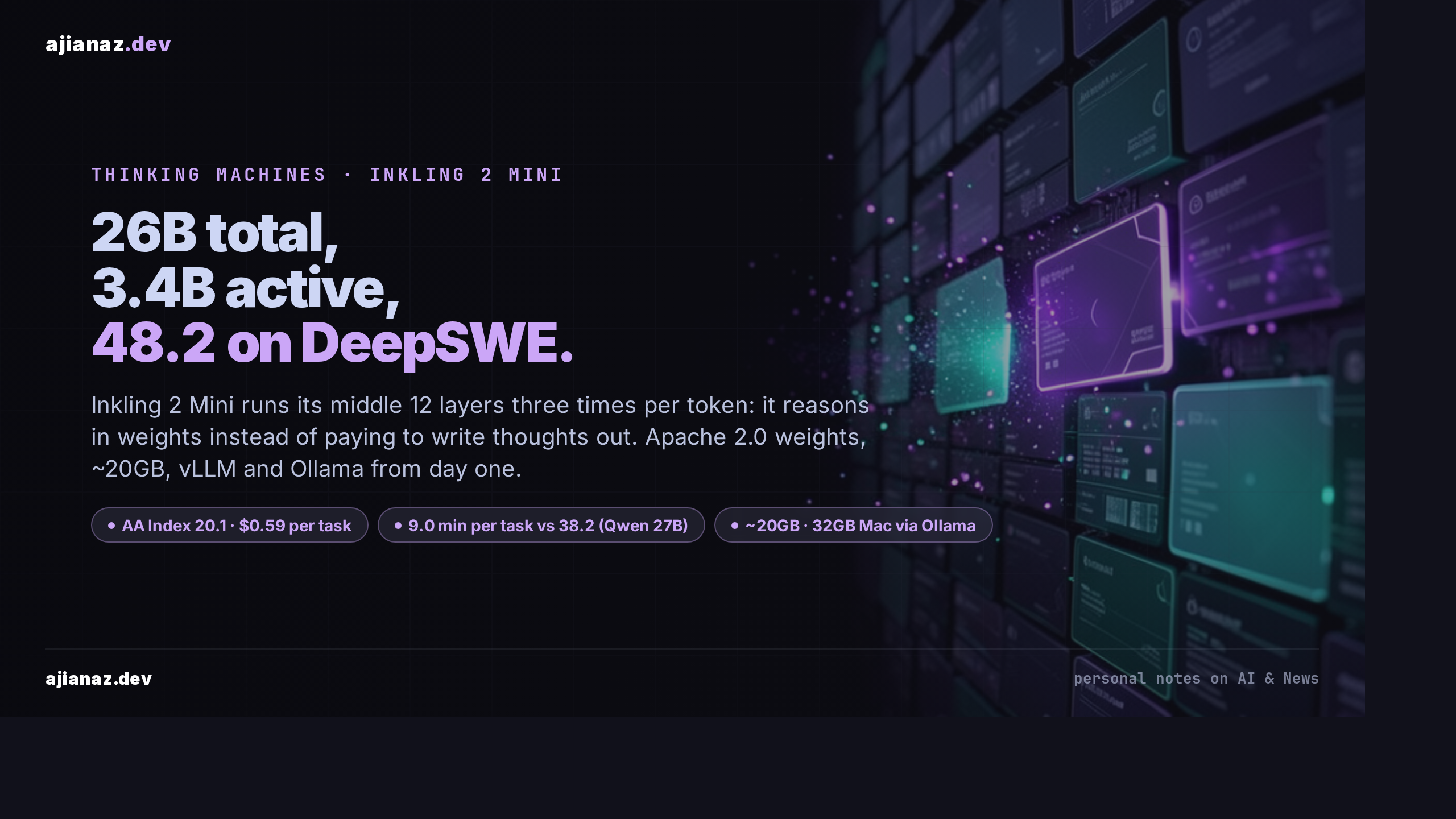
Thinking Machines released Inkling 2 Mini on November 20, and the loop is the whole story: the model runs its middle 12 of 24 layers three times per token, so it reasons in weights instead of paying to write thoughts out as tokens. The result is a 26.4B-parameter MoE with 3.4B active and 5.4B weight activations per token, a ~20GB footprint, and an Apache 2.0 license. It leads every open-weights model under 100B total parameters on DeepSWE v1.1 (48.2 percent) and Vals Index v2.2 (46.5 percent). Weights are on Hugging Face, inference support from day one in vLLM, SGLang, and Ollama. And the lab measured what looping does to chain-of-thought monitoring instead of hand-waving about it.
Looping beats writing it out, and they can count the saving. On their scaling ladder, the non-looped twin needed 140 percent more inference compute to match the looped model's loss on 512k-token agentic traces, while training 7.5 percent cheaper. Artificial Analysis ran the full Intelligence Index: 20.1 on the AA Index at $0.59 and 9.0 minutes per task, against Qwen3.8-27B's 20.1 at $3.53 and 34.1 minutes. Same score, about one-sixth the cost, about a quarter of the wall clock.
On agentic coding, Mini beats Qwen3.8-27B where the loop matters. DeepSWE v1.1 under mini-swe-agent: 48.2 vs 42.2 percent. SWE-bench Pro v2 Hard: 77.9 vs 73.8 percent. BrowseComp with compaction: 79.0 vs 61.6 percent. But chat is the weak spot, by the lab's own limitations section: 50.0 percent on MultiChallenge and 33.4 percent on ComplexConstraints v1.1, behind Qwen3.8-27B on both. The loop buys reasoning depth, not knowledge: AA-Omniscience is in line with its size class, so the model covers the gap with tools. It leads its class on BrowseComp, DeepSearchQA (85.3 percent), and MCP Atlas (82.7 percent). If your workload is agent-plus-tools, this points at you; if it's multi-turn chat with heavy constraints, Qwen still wins that pair.
The most interesting page is the monitorability section. Looped layers raise the ceiling on internal computation per token, which is exactly what CoT monitoring relies on not happening. Thinking Machines trained a research variant (TML-d24-varloop-research, one to five passes, weights public) and measured it. Its no-CoT time horizon grew from 16 seconds at one pass to 37 seconds at three, roughly flat beyond three. Chain of thought got shorter with more loops but stayed legible, and sabotage-benchmark scores showed no clear trend with loop count at this scale, "at this scale" being the part to underline. They shipped the artifacts: weights on Hugging Face, Goodfire early-access findings already public, NDIF access for interpretability researchers. Mini is the second looped model with open weights, since Small's Apache 2.0 weights landed on November 12. What no other lab has shipped is a monitorability section this explicit.
First-party numbers make the local math concrete. Mac with at least 32GB RAM runs it via Ollama at native NVFP4, last four layers MXFP8, no conversion loss, ~20GB footprint. On DGX Spark, Stanford's intelligence-per-watt paper measured 0.703 for Mini against 0.430 for Qwen3.6-35B-A3B and 0.036 for Qwen3.5-27B. GGUF quantizations from Unsloth and llama.cpp trade some of that precision headroom for smaller memory, quantized GGUFs are the pragmatic pick on machines with less than 32GB. Our Kimi K3.1 Pro piece covered the self-hosting trade at the 1T scale; Mini compresses the same argument down to a laptop.
The pitch is one sentence per buyer. If your agents do checkable work (coding, search, tool loops) and you want local control under an Apache 2.0 license, Mini is the strongest open option under 100B, at $0.59 per index task and a 9.0-minute pace. Multi-turn chat with heavy constraints still belongs to Qwen3.8-27B by the lab's own table. And if you want to study what looping does to CoT monitoring, the launch post puts it plainly: these are "some of the first models with looped architecture available to researchers," and the variable-loop twin is already on Hugging Face.
Sources: Thinking Machines' Inkling 2 Mini launch post, weights on Hugging Face plus the variable-loop research variant, Artificial Analysis' Index and cost-per-task numbers, Goodfire's early interpretability findings, Stanford's intelligence-per-watt paper, NDIF, Unsloth's GGUF quantizations, and our Kimi K3.1 Pro self-hosting math.
Comments ()