Gemini 4 Neon: One Model, Four Thinking Levels, 17 Points Apart
Gemini 4 Neon's thinking levels score 44, 55, 60, and 61 on the AA Index at one token rate. What the dial moves is your wait and your bill.
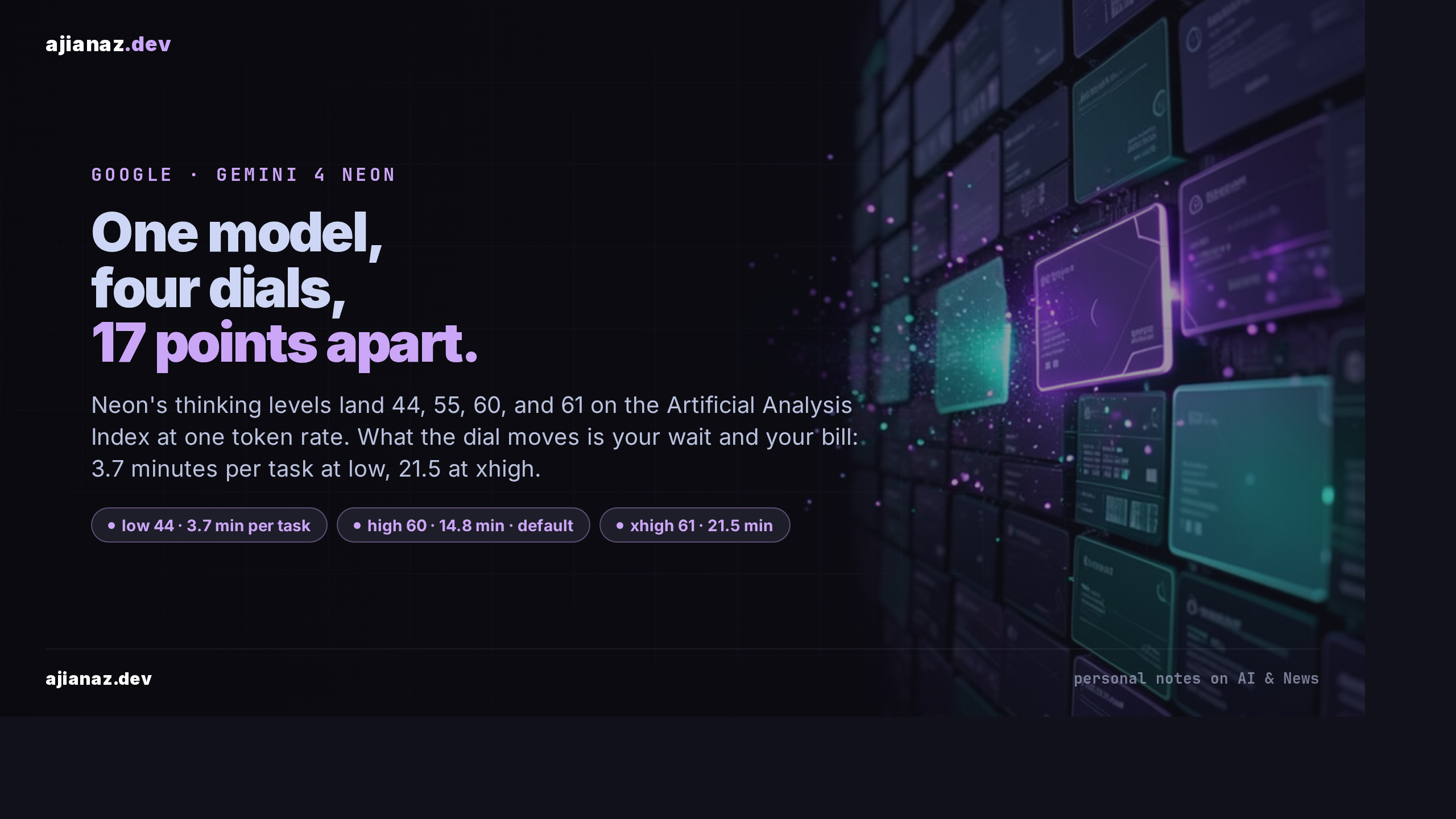
Google shipped Gemini 4 Neon on November 18 with one price and four thinking levels: $3 per million input tokens, $15 out, a 1 million-token context window, and low, medium, high (default), xhigh. The levels are the interesting part. They are one model at one rate, and they land 17 points apart on the Artificial Analysis Intelligence Index. What moves with the dial is your wait, your token count, and your bill.
Artificial Analysis ran all four levels on November 19 and published both halves of the trade. Low scores 44 on the index and takes 3.7 minutes per task. Medium scores 55. High scores 60 at 14.8 minutes. Extra high scores 61 at 21.5 minutes, 5.8 times the low setting's wall clock. The last step is the worst deal per point: from high to xhigh, a single index point costs an extra 6.7 minutes per task.
Token counts say the same thing. Simon Willison ran the identical pelican prompt at three Neon levels on launch day. Low produced 4,974 output tokens for 7.47 cents. High produced 9,691 tokens for 14.55 cents, roughly double the cost, and finished in a minute eleven against Hydrogen's 19 seconds on the same task. Reasoning tokens bill at output rates. The dial is a multiplier on the most expensive token class you have.
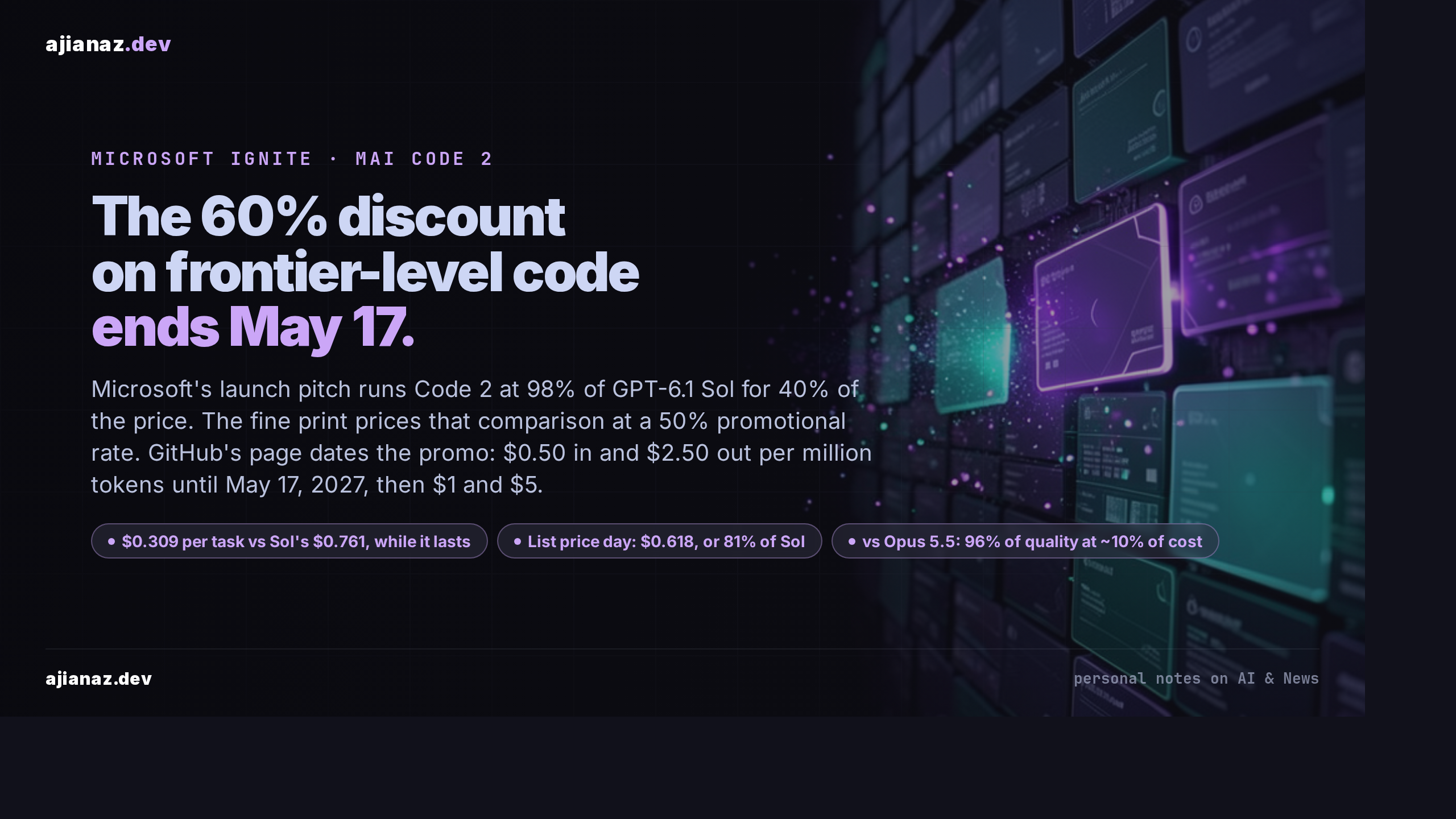
The lineup slide adds a pricing wrinkle. Google's chart puts Carbon above Neon at $4 and $20, but Carbon runs a $2 and $10 promo through November 30, as Willison flagged in his launch notes. Until that date Neon is the most expensive Gemini on the board: $3/$15 against Carbon's $2/$10 and Hydrogen's $1.50/$7.50. Google's own graphic scores the family 60, 61, and 54 on the AA Index, so the cheap models sit one and seven points below the one you are being upsold to. On December 1 the expected order arrives: Carbon, Neon, Hydrogen. Microsoft ran the mirrored play with MAI Code 2, a 50 percent launch discount with a May 17, 2027 expiry printed on GitHub's pricing page. Launch-week leaderboards are now set by promos, and the expiry date sits one click down each time.
The bill you control has two levers beyond the dial. Cached input runs $0.15 per million tokens, 95 percent off, with a 4,096-token minimum prompt for eligibility, and Neon's cache is implicit: there is no manual cache creation interface. Batch pricing is flat half, $1.50 in and $7.50 out. A nightly repo-review run holding 100,000 uncached input tokens and producing 10,000 output tokens costs $0.45 synchronous. The same run with 90 percent cache hits through batch comes to about $0.097. Over a hundred reviews a night that is $45 down to $9.68. Budget at the uncached rate until you have evidence of reuse in your own transcripts.
On coding, Google claims the top slot on the Artificial Analysis Coding Agent Index at 58.6, plus 65.2 percent on Terminal-Bench 4.1 and 46.2 percent on FrontierCode 2.0 at the default high setting. The instructive pair is SWE-sweep: 12.8 percent under mini-SWE, a deliberately minimal agent setup, 39.0 percent inside Google Antigravity. Same model, same benchmark, different agent scaffolding, triple the score. That is a Google number on Google tooling, so read it as a reason to test your own stack, not as a forecast for your integration. On security, Neon for cyber posts 90.5 percent on SEC-bench Pro and 76 percent on AutoBaxBench's hard tier, but it stays gated to Fairwind Program members and is still rolling out to them.
For a buyer the read is short. Skip xhigh unless you have a specific failure and a checkable result; one index point rarely justifies 6.7 extra minutes per task. Default to high, cache what repeats, batch what can wait. The cheap end of this family already got its own breakdown here: Gemini 4 Hydrogen outscored the frontier Argon by a point at default, at $1.50/$7.50 flat. Google is selling one family three ways, and the dial, the promo calendar, and your cache hit rate decide which of the three you pay for.
Sources: Google's Gemini 4 Neon launch post, Artificial Analysis' per-effort Neon results, Simon Willison's launch-day pricing notes, Google AI Studio pricing, Digital Applied's effort-level breakdown, our Gemini 4 Hydrogen analysis, and our MAI Code 2 promo-expiry breakdown.
Comments ()