Qwen4-Max Launches at $1.50, Cheaper Per Task Than Its Own Flagship
Alibaba's Qwen4-Max launched at $1.50 in and $4.50 out, down 25 percent, with Work360 cost per task cut 62 percent. Independent tests score it 43, three behind Kimi K3.1 Pro.
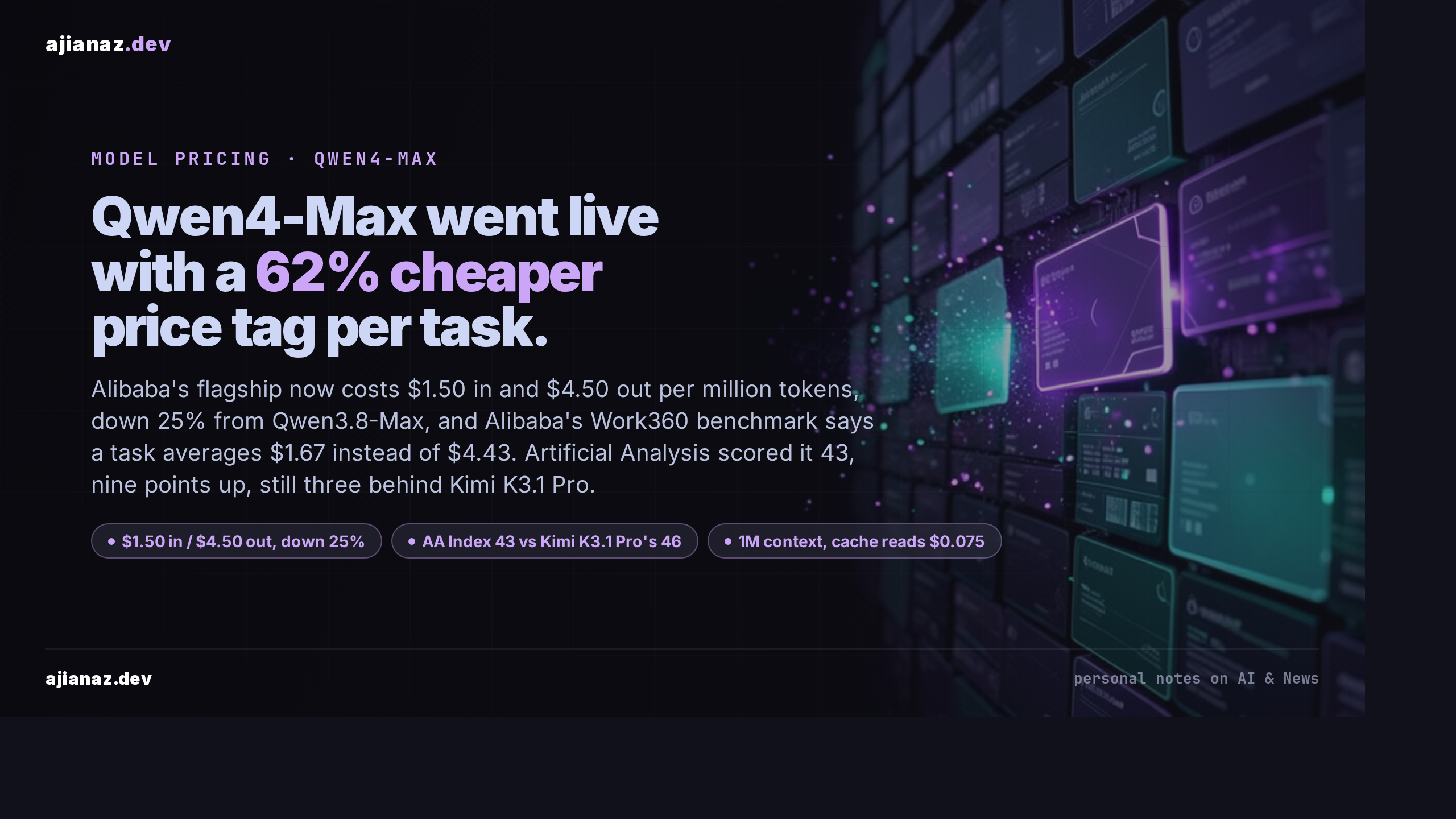
Alibaba made Qwen4-Max generally available on November 16, and the launch numbers read like a price sheet. The API went live at $1.50 per million input tokens and $4.50 per million output, each down 25 percent from Qwen3.8-Max's $2 and $6. Alibaba's own Work360 benchmark puts the average cost of a task at $1.67, down from $4.43, a 62 percent cut it attributes mostly to the model finishing jobs with roughly half the tokens. The same morning, Artificial Analysis measured the model at 43 on its Intelligence Index. Qwen3.8-Max scored 34. That is a nine-point generation jump, and it still leaves Qwen4-Max three points behind Moonshot's Kimi K3.1 Pro, which costs $2 in and $10 out.
Start with what is documented. The model page lists text, image, and video input, a 1,000,000-token context window, and thinking on by default at high reasoning effort, with low and xhigh available. Thinking and the final answer share a 262,144-token budget, and reasoning tokens bill as output. Cache reads cost $0.075 per million tokens, and Alibaba now offers explicit caching with five-minute or one-hour lifetimes alongside the automatic kind. Fine-tuning is unsupported in every documented region, and batch inference runs only in Beijing. The model is callable through OpenAI Chat Completions, OpenAI Responses, Anthropic Messages, and DashScope, which means an existing client connects with a base URL, a key, and a model string.
The price story has a catch that the launch post does not spell out. Those 62 percent savings are measured on Work360, Alibaba's own benchmark covering 721 professional fields. Alibaba has not published a parameter count, an expert configuration, or a replication of the token-savings claim from anyone outside the company. The independent measurement that exists points the other way on raw quality: 43 on the Artificial Analysis Index puts Qwen4-Max below Kimi K3.1 Pro and Claude Opus 5.5, and the 34-to-43 jump, while real, lands the family in the middle of the pack. The honest framing sits between the two datasets. Alibaba proved its model is cheaper per task on its own test. Independent evaluators have tested capability so far, and nobody has rerun the cost-per-task claim yet.
The gap matters less once you price the whole loop. Agent workloads spend most of their budget on input, because every turn re-sends the context. A 40-turn loop holding 100K tokens of context spends 4 million input tokens and roughly 40 thousand output tokens per run, which lands at $6.18 per run on Qwen4-Max's published rates. The same loop on Kimi K3.1 Pro costs $8.40, and on Gemini 4 Hydrogen, with flat $1.50 in and $7.50 out, it lands at $6.30. Cached input narrows that gap further: with Alibaba's $0.075 cache reads, a well-prefixed Qwen4-Max loop drops below $2. The 1M window removes the long-context surcharge entirely, so the bill is now a routing problem, not a pricing problem.
The preview explains the five days between first access and this launch. Qwen4-Max-Preview opened November 11 and was scheduled to run through November 25 on Alibaba's Token Plan subscription, with no per-token price, no benchmarks, and no weights. Yotta Labs documented the preview's trap for existing code: max_tokens started meaning the combined budget for reasoning and the answer, thinking defaulted to the highest effort level, and multi-turn calls returned reasoning in a separate field. Code that swapped the model string and nothing else got truncated answers. The general release keeps those semantics and adds the pricing, so a client that survives the preview survives production. Alibaba has promised smaller open-weight Qwen4 models without giving a date, and the launch thread spent its energy on local runs, serving speed, and that index score.
Two checks are worth running this week. Independent labs will publish their own Intelligence Index and Terminal-Bench numbers in the coming days, and those runs decide whether the 43 holds or moves. And anyone holding a Qwen3.8-Max bill can settle the cost claim on their own traffic: take your ten most expensive workloads, run them on both model strings, and compare cost per finished task. Alibaba's $1.67 against $4.43 is where that comparison starts. It is not where it ends.
Sources: Qwen4-Max model documentation (Alibaba Cloud Model Studio, Nov 16), the model release notes, Qwen4-Max pricing analysis (Artificial Analysis), Artificial Analysis on the 43 score, Qwen4-Max launch coverage (Startup Fortune), Singapore price list analysis (Unite.AI), Qwen4-Max-Preview documentation (Yotta Labs), our Gemini 4 Hydrogen pricing breakdown, and our Kimi K3.1 Pro hosting math.
Comments ()