Agent Teams Lost to One Coordinator in Anthropic's Shared-Resource Study
Anthropic's Worse Together study: one coordinator agent beat one-agent-per-user teams in all four shared-resource environments, by 10 to 45 percentage points.
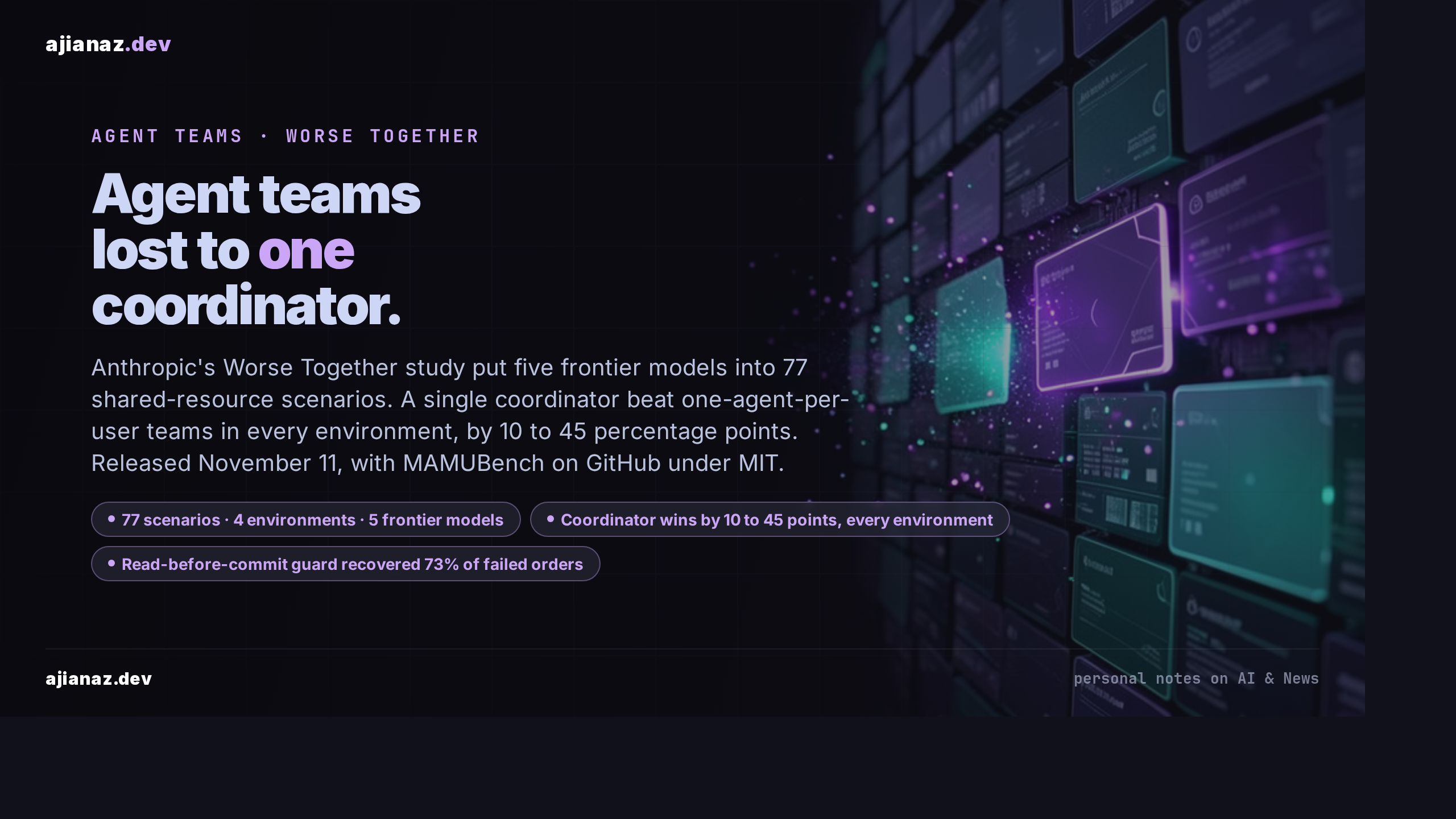
Anthropic's alignment team published a study on November 11 with an uncomfortable result for anyone running agent teams. The paper is called Worse Together (arXiv 2610.00583, submitted September 30), and across four environments, five frontier models, and 77 scenarios, one pattern held: a single coordinator agent serving every user outperformed teams where each user had their own agent. The gap averaged 10 to 45 percentage points per environment, and the coordinator came ahead in all four environments for both Claude models tested.
That finding sits awkwardly next to the same company's 2025 engineering post, which credited its multi-agent research system with a 90.2% improvement over a single agent. The settings differ in one specific way, and the difference is the whole story. The 2025 system pointed multiple agents at one shared objective. Worse Together gives each agent a different user with different goals, all drawing on one resource too small to go around: a compute budget, a clinic calendar, a group order, a merge queue with a release cutoff. That shape is what shipped this year. DoorDash's CLI lets several people's agents add to one cart, Slack Code puts Claude, Devin and Copilot in the same channel, and OpenAI's dots give each teammate an agent working in a shared space.
The API key environment produced the starkest numbers. Groups of four, eight, or sixteen researchers shared a token budget that could not cover everyone's work. Peer-to-peer teams reached 47% of the coordinator's performance on Opus 5 and 38% on Sonnet 5. The dominant failure was inaction, and it scaled with team size: from four agents to sixteen, the share that ever took an action fell from 66% to 10% for Sonnet 5, and from 82% to 25% for GPT-5.6-sol. GPT and Qwen agents reacted differently, canceling or stopping other users' jobs without asking 3.9 to 7.1 times per episode. Opus 5 never did. The authors flag a scoring blind spot here: unconsented cuts often raised the group's outcome score, because canceling low-value jobs is exactly what the environment demands. Outcome-only scoring never registers the user whose work got deleted.
The personal assistant environment failed in a different direction. One user makes a targeted request, the ask: a safety constraint, or an altruistic preference, like two plain gluten-free sides instead of an entree. The message reached the agent placing the final order in 94 to 99% of episodes. It was still in that agent's context at commit time in only 47 to 67% of them, a race condition between reading and checkout. When the ask was in context, teams honored it in 56 to 68% of episodes. When it wasn't, 19 to 36%. The coordinator honored the ask about twice as often as any team. And just over half of Claude team episodes contained at least one fabricated claim about another user, 58% for Opus 5 teams against 17 to 20% for a single agent, mostly agents assuming the group wants what their own user wants.
The mitigations section is the most immediately useful part, because the fixes refused to transfer. In the budget environment, a designated team lead with explicit priorities closed the gap to the coordinator completely. In the personal assistant environment the same fix did nothing, and what worked was a platform guard: checkout blocked until the committing agent has read every pending message, which recovered 73% of failed Opus 5 episodes and 62% of Sonnet 5. If you run several agents into one codebase, one queue, or one budget, the lesson is structural. The coordination layer breaks before the models do, and the right fix depends on whether your agents stall or race.
Anthropic released the stack as MAMUBench on GitHub, MIT licensed: 74 scenarios across the API key, clinic, and personal assistant environments, with the merge queue runnable too. If your agents share a codebase, one queue, or one budget, the failure modes are now documented and measurable, and this is the first time you can test your orchestration against them before your users find out.
Sources: Worse Together (Anthropic Alignment, Nov 11, 2026), the paper on arXiv (2610.00583, Sep 30, 2026), MAMUBench on GitHub (MIT), and the 2025 multi-agent research system post for the 90.2% contrast.
Comments ()