Three Labs, One Price: Meta Just Matched Haiku and Luna at $0.10
Meta's Muse Ember launched at $0.10 per million input tokens, the same number as Claude Haiku 5.5 and gpt-6-luna. Price stopped being the tiebreaker.
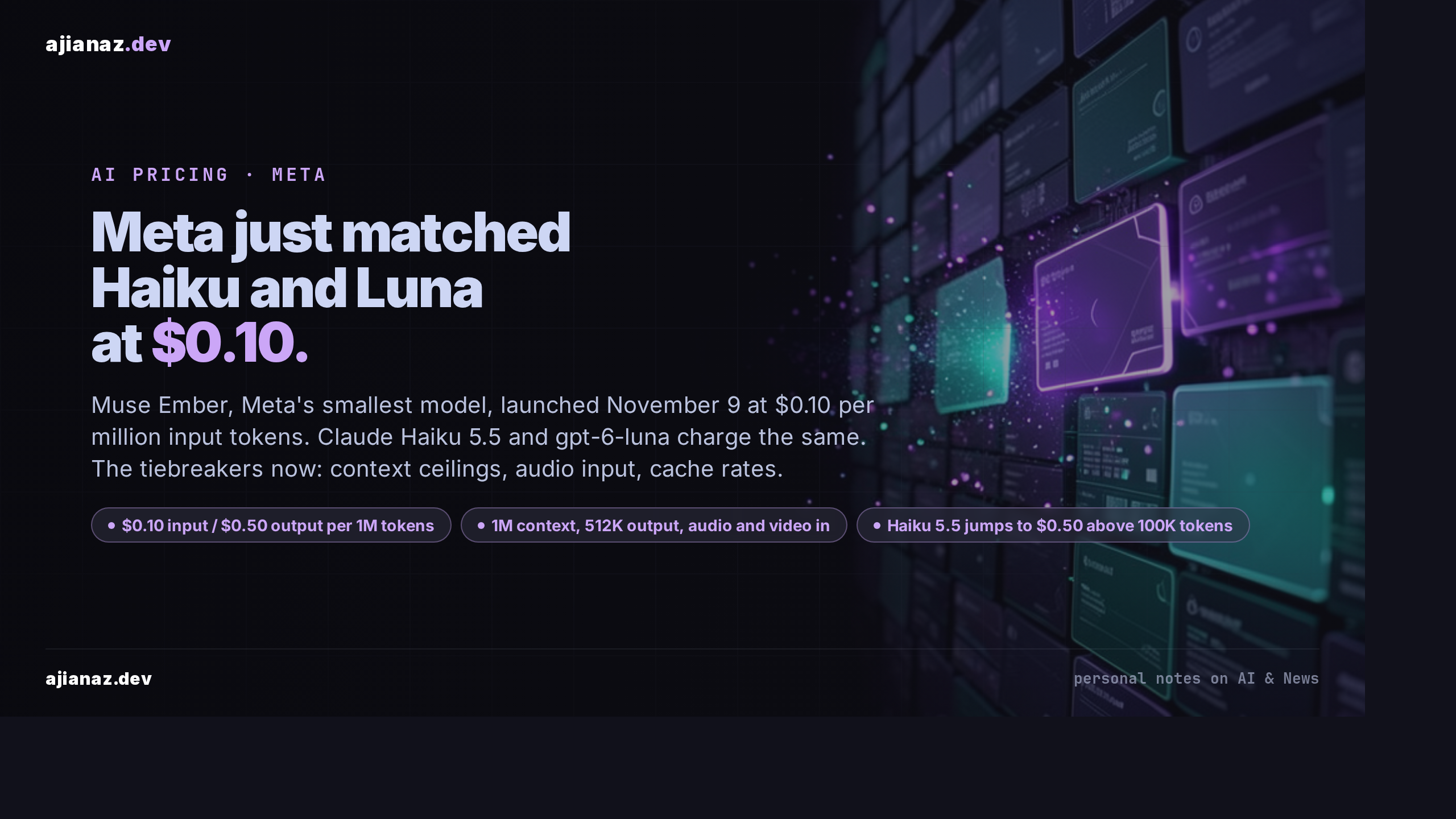
Meta priced its smallest model at exactly what the two cheapest models from Anthropic and OpenAI already charge. Muse Ember went live on November 9 at $0.10 per million input tokens and $0.50 per million output. Claude Haiku 5.5 is $0.10 input for prompts under 100,000 tokens. gpt-6-luna is $0.10. Three labs, one number, announced within a year of each other. The price floor is in.
The launch doc claims Ember "delivers more intelligence per dollar than Claude Haiku 5.5 or GPT-6 Luna at any reasoning setting," with Artificial Analysis numbers attached: $0.116 per task at a 33.9 score, $0.136 at 35.8. Haiku spans $0.092 at 24.6 up to $0.411 at 36.2, so Meta's chart holds up on the low end of the curve. Luna tops out at $0.152 and 27.8. On AutomationBench-AA, a business-workflow suite, Ember scored 37.8 against 20.2 for Luna and 13.9 for Haiku.
Read past the summary chart and the story gets less clean. Haiku beats Ember on FrontierCode 2.0-AA, real engineering tasks judged on mergeability: 34.9 against 27.2. Luna is half of Ember's price at the smallest reasoning settings, $0.073 per task against $0.116. Meta's own benchmark table shows its model winning some rows and losing others. That is an honest table. It is also a table where the pricing matters more than any single row, because the lowest rung costs $0.10 on all three.
Price convergence moves the decision to the fine print, so we compared the three pricing pages directly. Haiku's $0.10 lasts only up to 100,000 prompt tokens, then jumps to $0.50, a 5x penalty that lands on exactly the long-document work a small model gets bought for. Luna is $0.10 flat with cached input at $0.01. Ember undercuts both on cache at $0.004 per million, carries a 1M-token context window with 512K output, and takes audio and video natively. At one cent per cached million, two thousand round trips that re-read a 50,000-token prompt cost $1.00 on Luna and $0.40 on Ember, and that gap compounds over an agent's lifetime. If your agents fetch audio, or ingest meeting recordings, Haiku drops out of the comparison entirely.
What the volume work looks like decides it from there. Meta's positioning quote is blunt: "Muse Wonder plans, Muse Ember handles the volume." Ember is the fourth Muse model this year, after Spark in April, the open-weights Glimmer in August, and Wonder in October, and it is the first trained with Muse Wonder Full. The family pricing shows the spread: Spark 1.3 runs $1.25 in and $4.25 out and costs $2.39 per Artificial Analysis task, roughly 17 times Ember's $0.14. Meta is building a ladder where the top reasons and the bottom executes.
The bill for an agent stack is dominated by repeated small calls, routing, extraction, tool use, so a default model at a fifth of the ladder's mid-step changes what gets shipped. We made the same argument from the billing side last week: once agents do the spending, the per-call price becomes a design constraint that decides which tasks get the strong model and which get the cheap one. Apple's $200 daily cap for its engineers is the same constraint seen from the buyer's side, and it went live on this blog last night.
What to watch now: whether Anthropic and OpenAI answer the $0.004 cache rate, and whether the $0.10 floor moves or three labs just agreed on it without a meeting. When the cheapest tier stops competing on price, competition moves down into the fine print, and that is where the actual savings live.
Sources: Muse Ember launch post (Meta, Nov 9), Meta Muse Ember and the $0.10 input price (RuntimeWire), Three labs, one price: $0.10 (AIToolsRecap, Nov 10), Hacker News discussion, plus the Anthropic and OpenAI pricing pages checked the same day.
Comments ()