Gemini 4 Hydrogen Outscored Gemini 4 Argon by One Point
Google's new fast tier scored 51 on the Artificial Analysis Intelligence Index at default, one point ahead of frontier model Argon, at $1.50 per million input tokens.
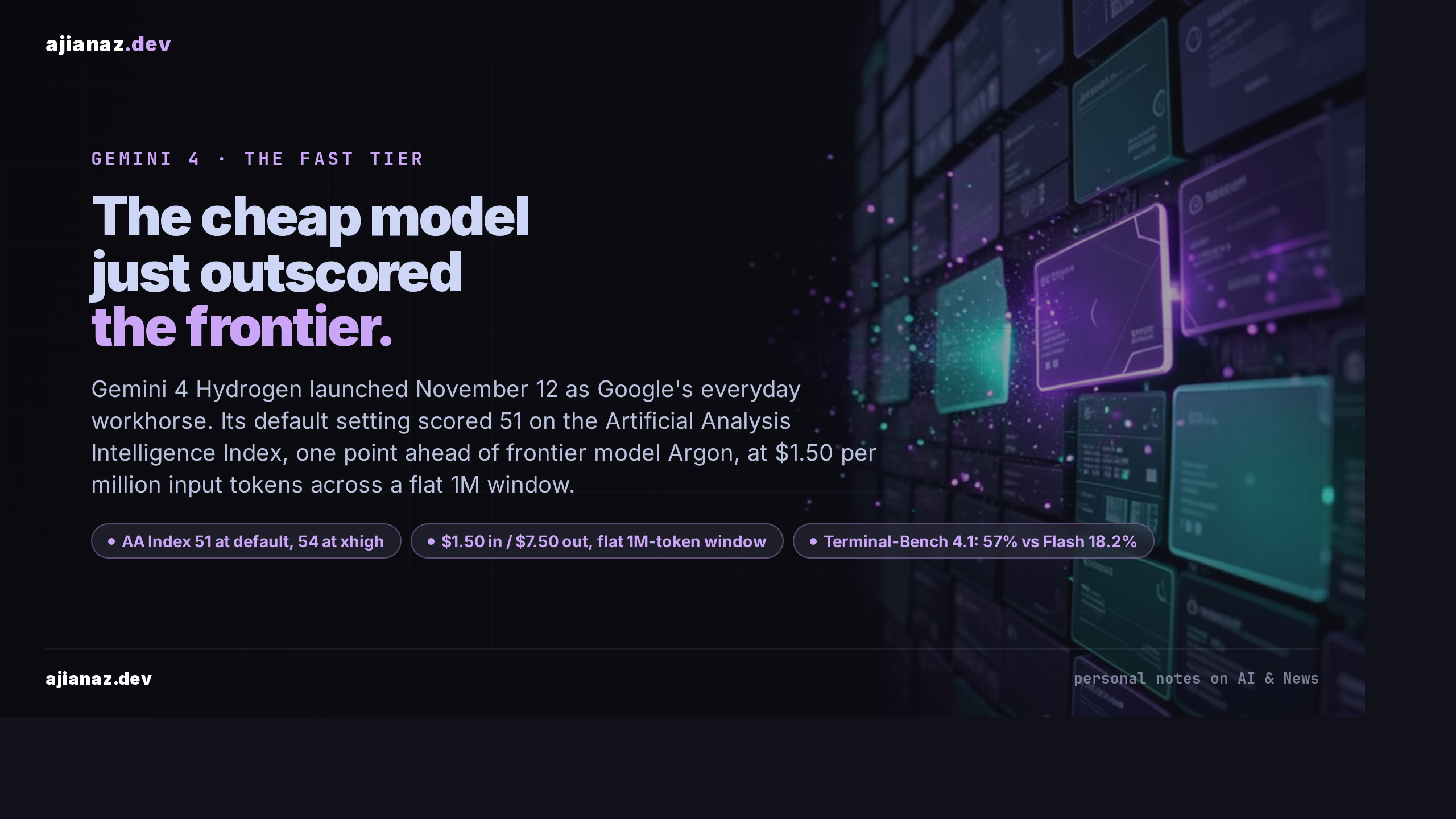
Google put a third Gemini 4 model into production on November 12 and gave it the least glamorous job in the lineup: the fast one. The benchmark table that came with it does something a tier chart is not supposed to do. Gemini 4 Hydrogen scored 51 on the Artificial Analysis Intelligence Index at its default high thinking setting, one point ahead of Argon, one of the two frontier reasoning models in the family. Push Hydrogen to the new xhigh level and the score reads 54. The price is flat across the entire 1 million token window: $1.50 per million input tokens, $7.50 per million output tokens.
Positioning says workhorse, and the specs agree. Hydrogen takes over the everyday tier from Gemini 3.8 Flash with 1 million tokens of input, up to 1 million tokens of output, and four thinking levels from low to xhigh with high as the default. Against 3.8 Flash, Google reports 2.5x faster task completion at the default setting, a Terminal-Bench 4.1 score of 57 percent against 18.2, and a drop of more than 5x in fabricated claims. Early partner numbers on repository work add 2x to 2.8x faster runs with 12 to 23 percent fewer tokens. Rollout is wide: AI Studio on every tier, the Gemini API, the Gemini app, Search, and GitHub Copilot carried it one day after launch. Every performance figure in this paragraph comes from Google's own evaluation stack, and none of it has been independently reproduced yet. The same caveat I flagged on Moonshot's Terminal-Bench claim yesterday applies here in full.
The product call that matters more than the index is Orchestrator in Google Antigravity. Instead of running one model end to end, Orchestrator switches between Carbon and Hydrogen inside a single session and reached near-Carbon task success on Terminal-Bench 4.0 while consuming 24 percent less quota and finishing 19 percent faster. For parallel work, Carbon coordinates while Hydrogen powers the worker and verifier agents. The three-tier ladder is turning into a routing problem, and Google shipped the router in the same announcement.
Read the 51-to-50 line with care. One point on a composite index is a rounding error, the submission settings are the vendor's own, and the xhigh score spends reasoning tokens that get billed as output. What the number documents is direction. The capability spread between a lab's fast tier and its frontier models has collapsed to a few index points, which moves the buying decision to latency, price per token, and how honestly the model fails. On that last axis Google published numbers: overreach in agentic tasks down up to 81 percent, misaligned actions and task shortcutting down 12x, a 94 percent honesty rate on internal agent evaluations, and 99.9 percent chain-of-thought legibility across more than 200,000 audited turns. Self-reported, but more than most vendors put on a model card.
The pricing is the quieter story. Flat rates across a 1M window remove the long-context surcharge that used to make big-window calls punishing. The bill in agent loops still comes from input, because every turn re-sends the context. A 40-turn loop holding 100K tokens of context spends 4 million input tokens and about 40 thousand output tokens per run, which lands at $6.30 per run at Hydrogen's published rates. Run that workflow a thousand times a day and the bill is roughly $6,300 before a single cache hit. Context trimming and prompt caching move that number more than any model choice. On this week's ladder, Meta's Muse and Ember set the floor at $0.10 per million tokens, Moonshot's API anchors $2 in and $10 out, and Hydrogen claims the working middle with a headline number every fast tier will now be compared against.
Two things to watch from here. Independent runs of that 51, which usually land within weeks of a launch this size. And whether the three extra index points at xhigh pay for their token bill on real workloads, a breakdown Google's launch materials do not provide. The useful benchmark this month is your own: log tokens and pass rates per thinking level for a week, then set defaults per task instead of leaving every call on high. A fast tier that outscores the frontier models is only a bargain if you route to it well.
Sources: Gemini 4 Hydrogen announcement (Google, Nov 12), the developer rollout post, the Hydrogen model card, Orchestrator in Google Antigravity, Terminal-Bench, the Artificial Analysis Intelligence Index, Hydrogen in GitHub Copilot (Nov 13), our Kimi K3.1 Pro hosting math, and Meta's $0.10 price floor.
Comments ()