Microsoft's Code 2 Undercuts Sol by 60 Percent, Until May 17
Microsoft's MAI Code 2 launch ratios were priced at a 50 percent promo rate that ends May 17, 2027. At list price the gap to GPT-6.1 Sol shrinks from 40 to 81 percent.
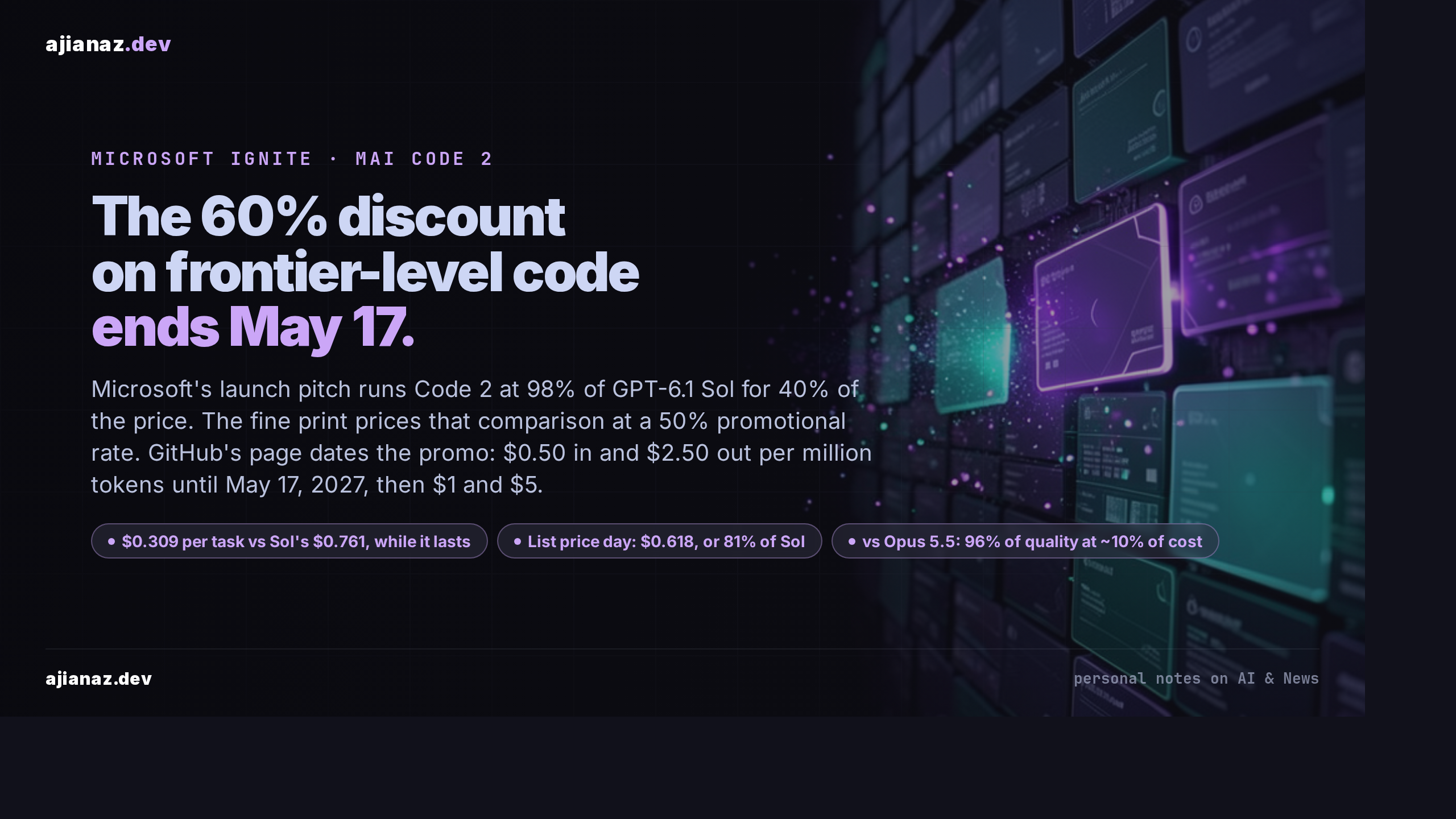
Microsoft launched a seven-model MAI family at Ignite on November 17, and nearly every headline number is a ratio: MAI Code 2 reaches 98 percent of GPT-6.1 Sol's coding quality at about 40 percent of the price, and 96 percent of Claude Opus 5.5's at 5 percent. The footnote under Microsoft's own chart says the cost side of those ratios was measured while MAI Code 2 rides a 50 percent promotional discount. GitHub's pricing page puts an expiry on it: $0.50 per million input tokens and $2.50 out until May 17, 2027, then $1 and $5. One claim in the lineup already survived independent checking. Artificial Analysis ranks MAI Image 2.7 first on its image editing board, ahead of GPT Image 2.6 Sunburst (max), at about a sixth of the price of the four models behind it.
The benchmark average underneath the headline is 63.2 percent across DeepSWE 1.1, Terminal Bench 2.1, SWE Atlas, and FrontierCode v1.1, with every model run at maximum reasoning effort. GPT-6.1 Sol averages 64.1, Claude Opus 5.5 65.3. Code 2 wins none of the four outright. It beats Sol only on FrontierCode, by 2.6 points, and it loses SWE Atlas to Opus by 14.4. The spread matters because of how the tests were run: DeepSWE, Terminal Bench, and SWE Atlas were executed on MSBench, Microsoft's internal evaluation platform, through the Copilot CLI without subagents. Only the FrontierCode scores come from Artificial Analysis, an outside lab, and none of these numbers had been independently reproduced as of November 18. Microsoft's own post draws a line around the ambition: the models are, in its words, "explicitly not yet tuned for harder problems, like fundamental science research and very long horizon agentic work."
The per-task costs Microsoft published: $0.309 for Code 2, $0.761 for GPT-6.1 Sol, $6.306 for Opus 5.5. At the promo price that is 40.6 percent of Sol. At the list price that starts May 17, the same workloads cost $0.618 per task, which is 81 percent of Sol, a fifth cheaper, not 60 percent cheaper. The discount against Opus is the durable one: even at list, Code 2 runs about a tenth of Opus's cost per task. A concrete loop makes the same point. A 40-turn agent run holding 100K tokens of context spends about 4 million input tokens and 40 thousand output tokens. On Code 2 that is $2.10 per run at promo and $4.20 at list, against $8.40 on Sol at its own list rates and $16.80 on Opus 5.5. Hacker News commenters found the footnote within hours of the post. One asked why Microsoft would not simply keep the lower price if the model is irrelevant by the time the real one kicks in.
Code 2 Flash may be the sharper deal. On the three benchmarks Microsoft ran for it, Flash averaged 61.0 percent against 55.1 for GPT-6 Luna and 53.9 for Claude Haiku 5.5, six to seven points higher than the models it was matched against, at a tenth of Code 2's token price: $0.05 in and $0.25 out on promo. The security entry, MAI Cyber 2 Flash, scored 92.3 percent on CyberGym-E2E against 91.5 for GPT-6 Astra at under 2 percent of the cost per task, and Microsoft's footnote there is worth reading twice: while reviewing results, the team found 92 of the benchmark's 905 tasks overlapped open source projects in its own training data, excluded them for every model, and reported on the remaining 813. The model costs $0.10 per million input tokens and $0.50 out, against Astra's $10 and $50, but distribution is locked to Microsoft security products, replacing the current model in MDASH for eligible customers from mid-December. On the boards Microsoft does not grade itself, Image 2.7 holds the top editing slot, Artificial Analysis lists Microsoft AI as the second-ranked lab across its image arenas, and the Decision 1.1 router scores 68 on the AA Decision Index at $0.042 per million input tokens.
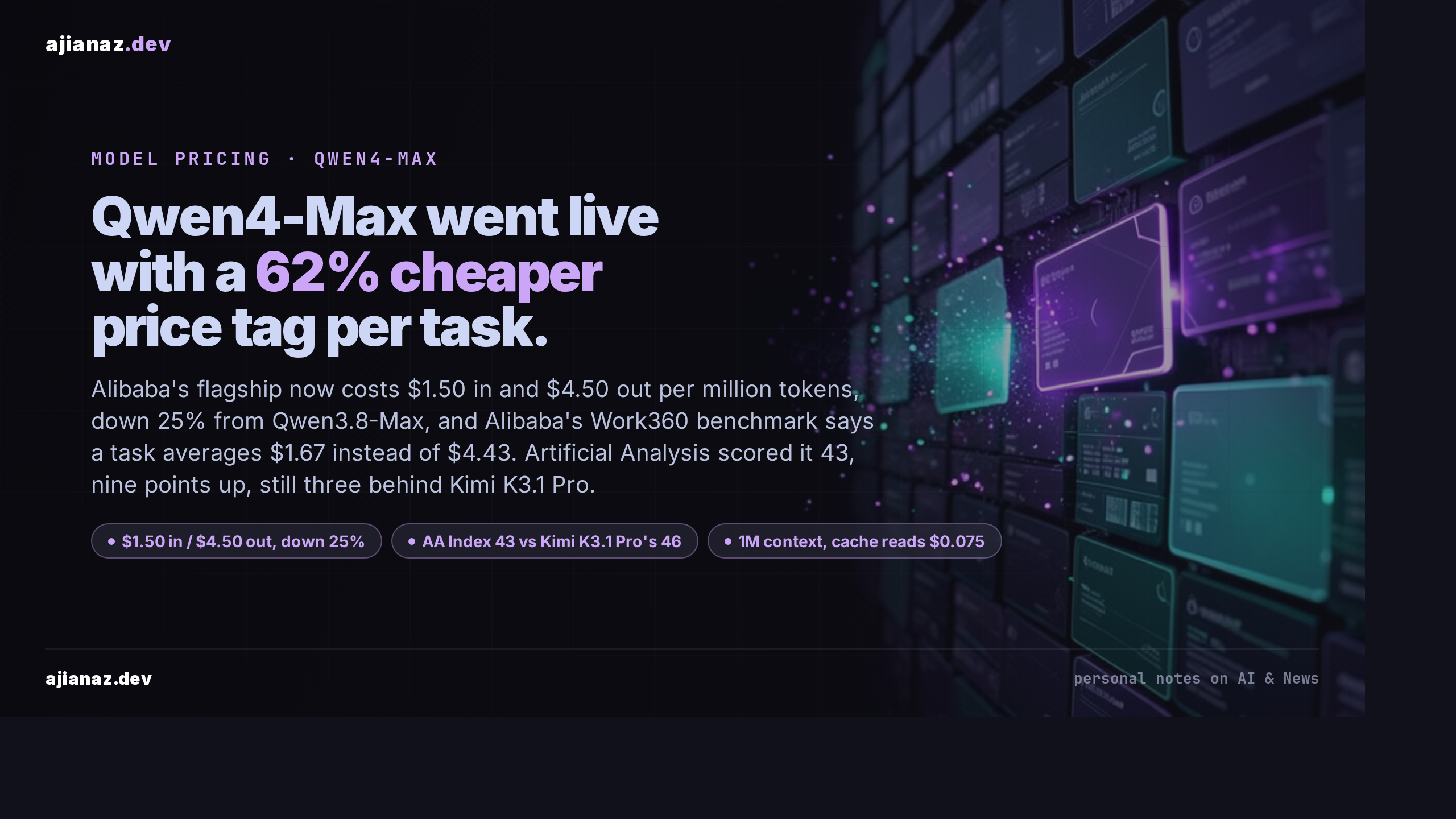
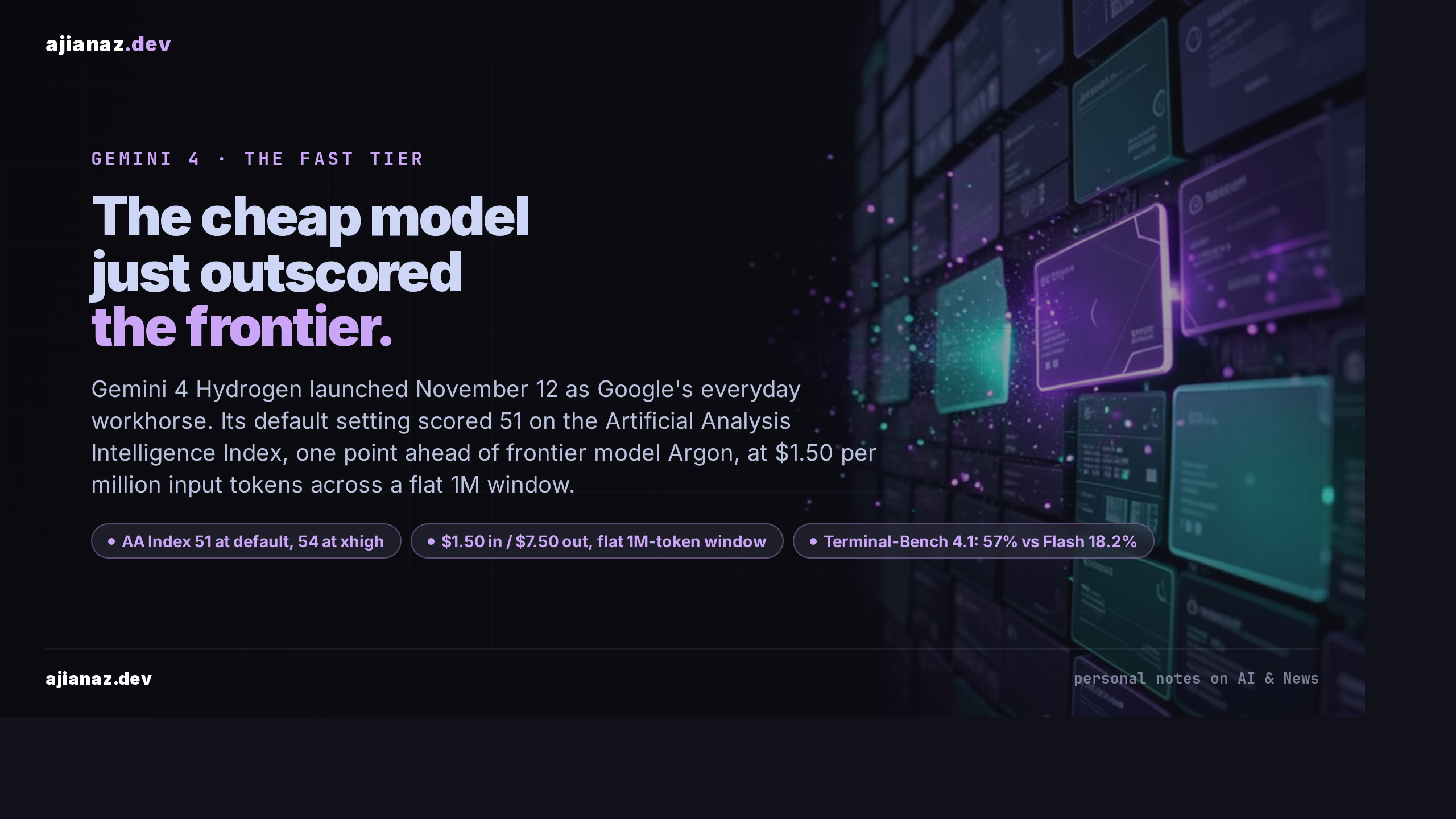
For a buyer, the numbers split into two piles. The Sol comparison expires in May: plan bills from May 17, 2027 at $1 and $5 per million, which is half of Sol's $2 and $10, not 40 percent of it. The Opus comparison holds: 96 percent of the quality at roughly a tenth of the cost survives the promo ending, as long as the workload stays inside everyday coding and away from the long-horizon agent runs Microsoft says it is not tuned for. The safest read treats the launch the way Alibaba's Work360 cost-per-task claim for Qwen4-Max should be treated: a vendor measurement waiting for an outside rerun. Google took a different road with Gemini 4 Hydrogen, a flat $1.50 and $7.50 with no expiry date to track. Outside labs will get to the coding numbers when they rerun them; the image editing crown, the one claim that went through an outside board first, is already standing.
Sources: the Ignite launch post, Microsoft's MAI Code 2 announcement with its footnotes, the GitHub Copilot pricing page that dates the promo, the MAI Cyber 2 Flash writeup, Artificial Analysis' image editing leaderboard, AA confirming Image 2.7 at number one, TestingCatalog's launch recap including the MDASH timing, the Hacker News thread, our Gemini 4 Hydrogen pricing breakdown, and our Qwen4-Max Work360 analysis.
Comments ()