A House Report Puts a Price on Your Cheap AI Stack
A 50-page House report prices PRC open-weight models at $1.15 to $4.95 per million tokens against $30 to $35 for frontier APIs, names Cursor's Composer 2 base model, and asks federal systems to drop them.
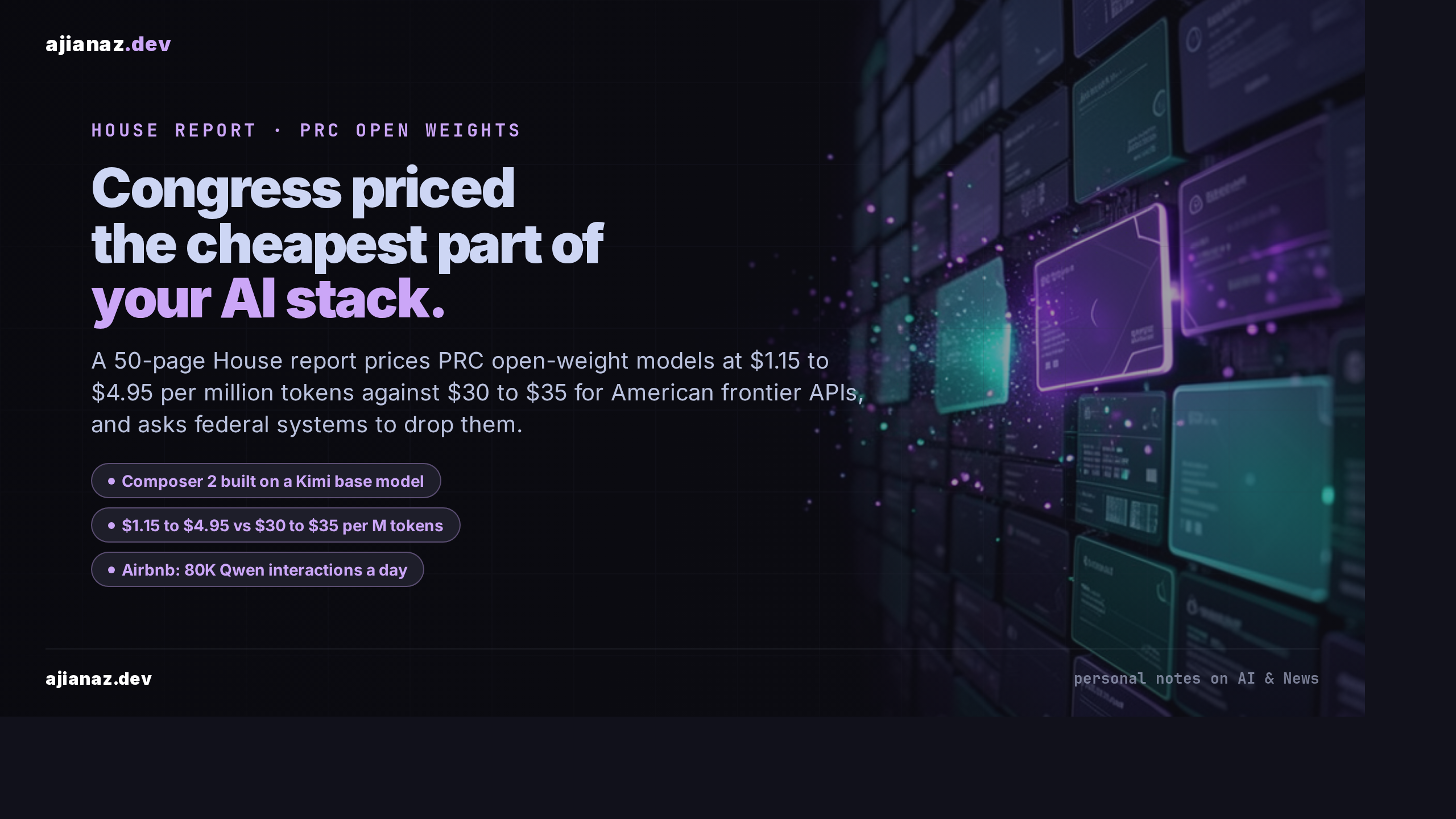
One congressional report just put a price tag on the cheapest part of your AI stack. On November 20, the House Homeland Security Committee and the Select Committee on the CCP released a 50-page joint report on PRC-developed open-weight models, and the numbers inside it describe the exact margin a lot of startups are quietly living on: hosted inference from $1.15 to $4.95 per million tokens, against $30.00 for Claude Opus 4.8 and $35.00 for GPT-5.5. The committees want the cheap models out of federal systems and high-risk infrastructure, and they want a national American open-weight initiative launched so companies stop facing that choice. Nothing is banned yet.
The Cursor detail is what makes this a developer story instead of a policy PDF. Per the report, Anysphere built Composer 2, the flagship model in its Cursor coding platform, on a Moonshot AI base model (Kimi K2.5 per the House investigation), and the report notes that this became public only after an independent developer identified the underlying model. Anysphere told committee staff it plans to explore phasing out PRC-developed open-weight models because of geopolitical risk. Elon Musk, whose SpaceX owns Cursor, posted "We aren't serving open source models" about two hours after CNBC broke the news. Both statements can be true at once: a base model can be fine-tuned into a product that never ships as an open model, and that is exactly why the report argues that "built on" should be as visible as "sold by."
The three case studies show this is not about one company. Airbnb told the committees it runs customized Alibaba Qwen models in customer support: about 80,000 interactions a day and 250,000 support calls summarized daily. DoorDash reported 25 Chinese model families authorized and deployed, and estimated a full replacement could take up to six months. The report also tracks the surge: one gateway analysis found PRC models going from 4.5 percent of weekly token consumption by American companies in the first half of 2025 to more than 30 percent starting in February 2026, peaking at 46 percent. It is blunt about why: cost, customization, and near-frontier performance, because the United States lacks a competitive open-weight alternative at the price and performance the market demands.
One point in the report deserves more airtime than it is getting. The House found that running open weights on your own hardware does not eliminate the risk. Latent vulnerabilities can be embedded during base pretraining, before anyone in your country ever downloaded the checkpoint. Self-hosting answers the data question. It does not answer the provenance question, and the report is explicit that the two are different. If the provenance question matters to your regulators or your customers, no amount of GPU isolation fixes it, because the thing under scrutiny is the pretraining history baked into the weights themselves. We walked the self-hosting math for a newer Kimi, K3.1 Pro: that trade is about economics and data control, and it starts at 16 GPUs. Provenance is a separate axis.
What would change the picture is recommendation 1, a national American open-weight AI initiative. The report concedes the market picked Chinese models for rational reasons: cheap, customizable, competitive. Until a domestic open-weight option exists at comparable quality and price, a ban pushes companies toward closed American APIs at a multiple of today's inference cost, or toward slower self-hosted deployments, or toward quietly keeping the models they already run. Analysts cited in coverage made the same point: without a domestic open-weight alternative, restrictions risk inflating budgets for startups and entrenching a small circle of closed providers.
The committees also found the other half of the story uncomfortable: proxy networks and fraudulent accounts used to extract outputs from American frontier models, and American data-labeling firms supplying training data to Chinese labs. Recommendation 9 would hold illicit distillers accountable and close the gray market. Recommendation 10 would examine sales of American training data to Chinese AI laboratories. Those two recommendations target the supply side that made the cheap weights possible in the first place.
If you build on these models, the practical read is about procurement, not panic. Nothing here is law. Lawmakers plan to advance 12 recommendations in early 2027, and companies got letters from these committees months before the report, so this has been moving for a while. The durable shift is that "what model is your product built on" is now a procurement question, and vendors should expect it in writing. The price spread in the report ($1.15 to $4.95 per million tokens versus $30.00 to $35.00 for American frontier APIs) explains why adoption happened; the origin question explains why it suddenly matters. Both halves are facts about your stack right now.
Comments ()