Photonic AI Computing: How Light-Matter Particles Could Solve the Energy Crisis Powering Artificial Intelligence
Why Are We Still Using Electrons to Run AI?
Eighty years ago, researchers at the University of Pennsylvania launched the computing age with ENIAC, the world's first general-purpose electronic computer. That machine, built by J. Presper Eckert and John Mauchly, used streams of electrons to solve complex mathematical problems. Today, that same fundamental architecture still powers everything from smartphones to the largest AI data centers on Earth.
But here's the problem: electrons are reaching their limits. Because they carry an electrical charge, they generate heat, face resistance as they move through materials, and waste enormous amounts of energy. Those inefficiencies were tolerable when computers ran simple calculations. In an era where training a single large language model can consume as much electricity as a small country uses in a year, they're becoming unsustainable.
The International Energy Agency projects that data centers will consume approximately 1,000 terawatt-hours of electricity by 2026, roughly equivalent to Japan's total power consumption. AI workloads are the primary driver of that growth, with some estimates suggesting AI training and inference could account for 3-4% of global electricity generation by the end of the decade.
Researchers have been exploring alternatives for years, and one approach has consistently stood out for its theoretical promise: replacing electrons with photons—particles of light. Light is charge-neutral, has zero rest mass, and can carry information at extraordinary speeds with minimal energy loss. The telecommunications industry already relies on photonic technology for fiber-optic networks. The challenge has always been getting light to do the one thing computers need most: switch signals on and off to perform logical operations.
What Are Exciton-Polaritons, and Why Do They Matter?
Photons are exceptional at transmitting information but terrible at interacting with their environment. That neutrality—the same quality that makes them perfect for fiber-optic cables—is exactly what makes them unsuitable for the signal-switching operations that form the backbone of computation. You can send data across the world on a beam of light, but you can't easily make that light "decide" anything.
A team of physicists led by Professor Bo Zhen at the University of Pennsylvania may have found the solution. Their work, published in Physical Review Letters, demonstrates a way to create quasiparticles called exciton-polaritons that combine the speed of light with the interactive properties of matter.
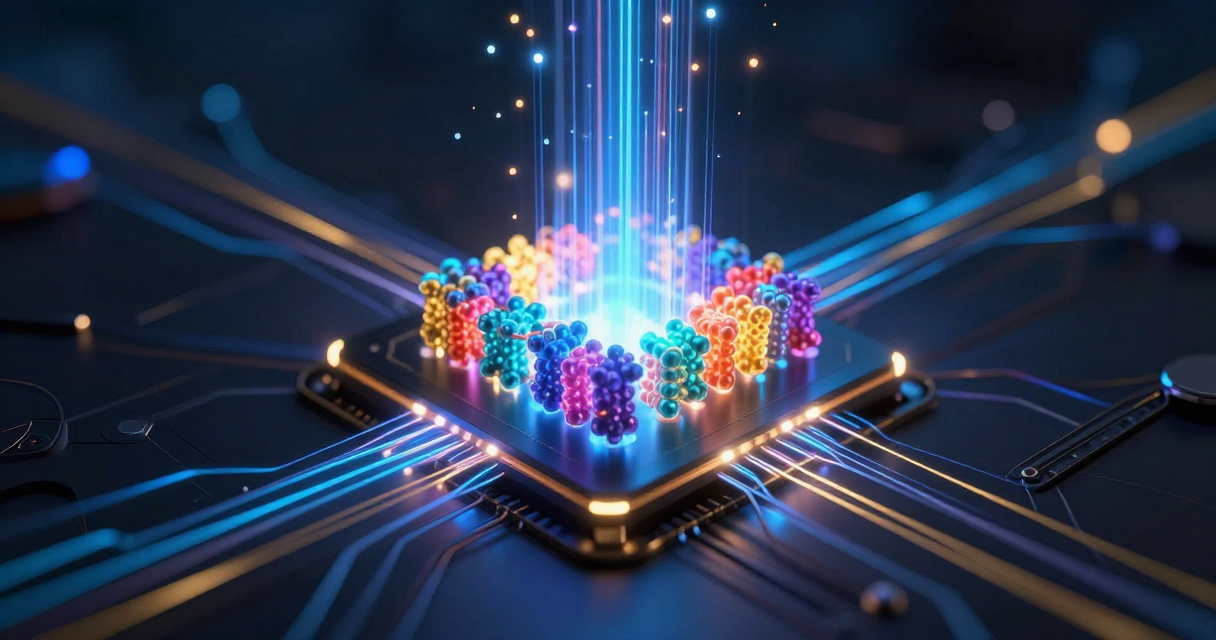
Here's how it works: the researchers coupled photons with electrons inside an atomically thin semiconductor material. This coupling creates a hybrid particle that inherits light's velocity while gaining the ability to interact strongly enough to perform the signal-switching operations required for computation. Think of it as giving light a temporary "body" that allows it to push things around.
"Because they are charge-neutral and have zero rest mass, photons can carry information quickly over long distances with minimal loss," explains Li He, co-first author of the study and a former postdoctoral researcher in the Zhen Lab who is now an assistant professor at Montana State University. "But that neutrality means they barely interact with their environment, making them bad at the sort of signal-switching logic that computers depend on."
The exciton-polariton approach overcomes this fundamental limitation by creating particles that are, in essence, part light and part matter. The result is a system capable of performing all-optical switching—no electrons required—at an energy cost of approximately 4 quadrillionths of a joule per operation. That's an almost incomprehensibly small amount of energy, far below what's needed to briefly power a single tiny LED.
How Does This Change the AI Computing Landscape?
The implications for artificial intelligence are significant, though it's important to distinguish between what's been demonstrated and what's ready for deployment. The Penn team has proven the concept at the nanoscale. Scaling it to practical AI workloads is a challenge that will take years of engineering effort. But the direction is clear, and it addresses one of the most critical bottlenecks in AI hardware.
The nonlinear activation problem. Modern AI systems rely on neural networks with billions of parameters. These networks perform two types of operations: linear transformations (matrix multiplications) and nonlinear activation functions (the "decision" steps where a neuron "fires" or doesn't). Photonic chips have been able to handle the linear parts for years—light is naturally good at parallel processing. But when it comes to the nonlinear activation steps, most photonic AI chips have to convert light signals back into electronic ones. That conversion is slow, energy-intensive, and defeats much of the purpose of using photons in the first place.
The exciton-polariton approach demonstrated by Zhen's team enables all-optical switching, meaning the nonlinear operations can happen entirely within the light domain. No conversion to electrons, no conversion back. If this can be scaled, it would eliminate one of the biggest remaining obstacles to practical photonic computing.
Direct image processing. One particularly compelling application is processing visual data directly from cameras without any electronic intermediary. Today, when a self-driving car's camera captures an image, that light gets converted into electronic signals, processed by electronic chips, and then potentially converted back into optical signals for transmission. Each conversion costs energy and adds latency. A photonic chip running on exciton-polaritons could theoretically process the raw light data directly, dramatically reducing both power consumption and processing latency for computer vision tasks.
Quantum computing bridge. The Penn researchers also suggest that the platform could support basic quantum computing capabilities on future chips. While this is more speculative, the ability to manipulate light-matter particles at the nanoscale shares conceptual ground with photonic quantum computing approaches being explored by companies like PsiQuantum and Xanadu.
How Does Photonic Computing Compare to Other Post-Silicon Approaches?
Penn's breakthrough doesn't exist in a vacuum. Multiple research groups and companies are pursuing alternative computing architectures to address AI's growing energy demands. Understanding where photonic computing fits in this broader landscape is essential for evaluating its practical significance.
Neuromorphic computing takes inspiration from the human brain, combining memory and processing in a single unit to eliminate the energy-intensive data shuttling that plagues traditional architectures. In April 2026, researchers at the University of Cambridge demonstrated a hafnium oxide-based memristor that mimics how neurons process and store information simultaneously, potentially slashing AI energy use by up to 70%. Led by Dr. Babak Bakhit, the work was published in Science Advances. Neuromorphic approaches are further along in practical development than photonic ones, with companies like Intel (Loihi), IBM (NorthPole), and BrainChip shipping actual products.
Analog computing uses continuous physical quantities rather than binary digits to perform calculations. Companies like Mythic and Analog Devices have developed analog AI accelerators that offer impressive efficiency for specific workloads, particularly inference tasks where precision requirements are more relaxed.
Photonic computing occupies a unique niche in this landscape. While neuromorphic and analog approaches optimize within the electronic domain, photonic computing proposes a fundamentally different physical substrate. The potential efficiency gains are enormous—light generates essentially no heat when carrying information, and optical signals can be multiplexed to carry vast amounts of data simultaneously through the same physical channel. The trade-off is maturity: photonic computing is earlier in its development cycle, and the engineering challenges around integrating optical components with existing electronic infrastructure are substantial.
What makes the Penn research noteworthy is that it addresses the most fundamental criticism of photonic computing: the inability to perform nonlinear operations without electronic conversion. If that barrier truly falls, the case for photonic AI accelerators becomes dramatically stronger.
What's the Path from Lab to Data Center?
Despite the excitement, significant hurdles remain before you'll see exciton-polariton chips running large language models.
Fabrication and integration. The current demonstration operates at the nanoscale in a controlled laboratory environment. Scaling to production-grade chips requires manufacturing processes that can reliably create atomically thin semiconductor layers with the precision needed for consistent exciton-polariton behavior. While semiconductor fabrication has made extraordinary advances over the past decades, integrating optical components alongside electronic ones on the same die remains challenging. Companies like Intel and Ayar Labs have made progress in silicon photonics for interconnects, but computational photonic chips are a different beast entirely.
Software ecosystem. Even if perfect photonic AI chips existed tomorrow, the software stack to program them doesn't. Today's AI frameworks—PyTorch, TensorFlow, JAX—are designed around electronic hardware. Mapping neural network operations onto photonic architectures requires new compilers, new numerical representations, and potentially new model architectures optimized for optical processing. Several startups, including Lightmatter and Luminous Computing, are working on this software challenge, but it remains a significant barrier to adoption.
Economic viability. NVIDIA's dominance in AI hardware isn't just about performance—it's about ecosystem lock-in. CUDA, the company's parallel computing platform, has over a decade of developer investment and optimization. Any photonic computing solution needs to either interoperate seamlessly with existing CUDA workflows or offer efficiency gains so dramatic that they justify a complete platform migration.
The IEA's projection of 1,000 TWh of data center electricity consumption by 2026 suggests the economic pressure for more efficient computing will only intensify. As AI models continue to scale—OpenAI, Google, Anthropic, and others are all training models that dwarf their predecessors—the energy bill becomes a genuine competitive differentiator.
Should Developers Care About Photonic Computing Yet?
For the average software developer working with AI today, photonic computing remains a research topic rather than a practical tool. You won't be deploying models on photonic hardware in the next product cycle. But there are reasons to pay attention now.
First, the energy trajectory of AI is unsustainable. If your organization runs large-scale AI workloads, the cost of compute—and the associated carbon emissions—are going to become increasingly significant business considerations. Photonic computing, if it matures, could fundamentally alter the economics of AI deployment.
Second, understanding the direction of hardware evolution can inform architectural decisions today. Photonic chips are likely to excel at specific types of operations—particularly parallel matrix multiplications and signal processing. Designing AI systems with hardware-agnostic abstractions makes it easier to take advantage of these specialized accelerators when they become available.
Third, the research itself is a reminder that the computing landscape is far from settled. The von Neumann architecture that has dominated for eight decades is showing its age, and multiple alternative paradigms are converging toward practical viability. The organizations that position themselves to adopt new computing architectures early will have a significant competitive advantage.
The Penn researchers' work, funded by the US Office of Naval Research and the Sloan Foundation, represents one thread in a much larger tapestry of post-silicon computing research. But it's a thread that's getting brighter. By solving the nonlinear switching problem at a femtojoule energy scale, the team has removed one of the most fundamental obstacles to practical photonic AI computing. The question is no longer whether photonic computing can work in principle—it's whether it can work at scale, reliably, and affordably. The answer to that question will shape the next decade of AI infrastructure.
Sources:
- University of Pennsylvania — "Forget electrons, this breakthrough uses light-matter particles to power AI" (ScienceDaily)
- Penn Today — "Making Light Work for Computing"
- University of Cambridge — "This new brain-like chip could slash AI energy use by 70%" (ScienceDaily)
- IEA Data Center Power Projections 2026
- Nature — "Industry insight: photonics to scale AI data centers"



Comments ()