GitHub's Supply Chain Nightmare, Gemini 3.5 Flash, and the Security Crisis Hiding in AI Infrastructure
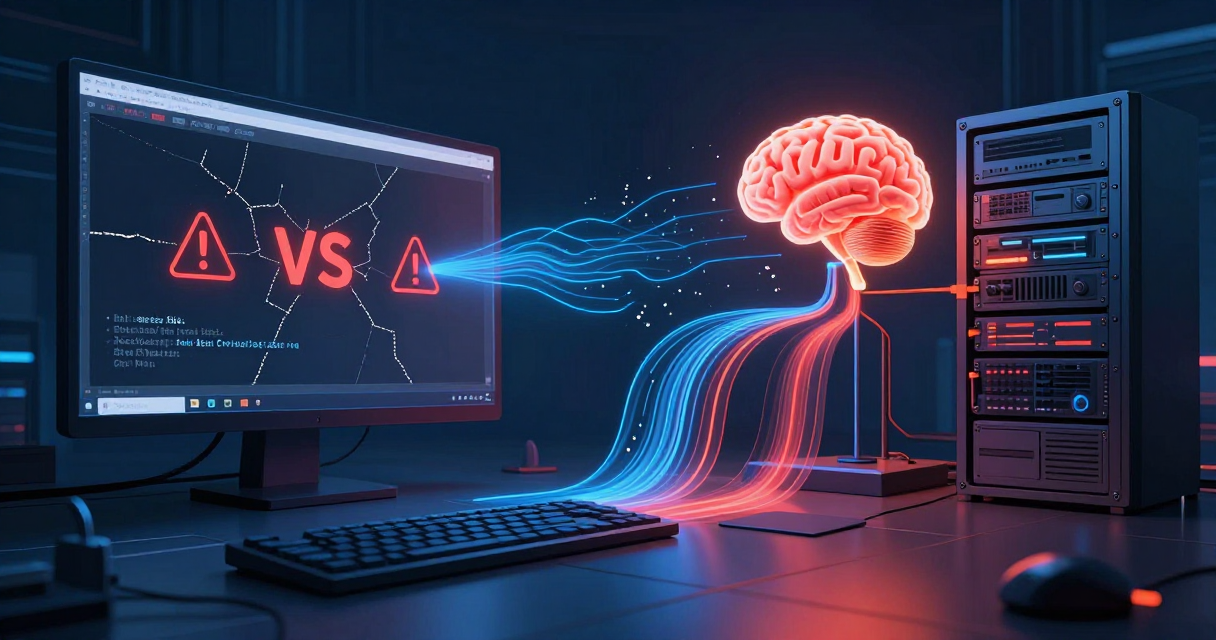
This week delivered a stark reminder that the tools powering modern development are simultaneously the most powerful and the most fragile components of our digital infrastructure. From supply chain attacks on the world's largest code platform to unauthenticated remote code execution in a widely deployed AI database, the attack surface of the software ecosystem has never been wider — or more consequential.
Google unveiled Gemini 3.5 Flash, positioning it as the fastest agentic AI model available. A Beijing-based lab closed a $2 billion round at a $20 billion valuation. And security researchers discovered that thousands of AI-generated applications were leaking corporate and personal data onto the open web with virtually no authentication. Five stories, one theme: the intersection of AI capability and systemic risk has become the defining axis of the current technology cycle.
GitHub Breached: 3,800 Repositories Exposed Through a Single Malicious Extension
GitHub confirmed that approximately 3,800 internal repositories were compromised after one of its employees installed a trojanized VS Code extension. The company detected and contained the compromise on May 19, isolating the affected device and removing the malicious extension from the VS Code Marketplace. In a statement, GitHub acknowledged that the attacker's claim of "~3,800 repositories" was "directionally consistent" with its own investigation, though it emphasized that no customer data stored outside the affected repositories was impacted.
The hacker group TeamPCP claimed responsibility, offering the stolen data for a minimum of $50,000 on the Breached cybercrime forum and threatening to leak it for free if no buyer emerged. TeamPCP has a documented history of supply chain attacks targeting developer infrastructure — including PyPI, npm, Docker, and GitHub Actions — and was recently linked to the "Mini Shai-Hulud" campaign that also impacted two OpenAI employees through a TanStack supply chain attack.
This incident is particularly significant because of what it represents rather than what it exposed. GitHub hosts over 420 million repositories used by more than 180 million developers and serves as the backbone of the global software supply chain. If an organization of GitHub's own security sophistication can be compromised through a single poisoned extension, the implications for the broader developer ecosystem are sobering. The VS Code Marketplace — Microsoft's official extension store — has been a recurring attack vector, with malicious extensions accumulating millions of installs before detection. This breach adds urgency to the growing debate about whether extension marketplaces need the same rigorous review processes as package registries like npm or PyPI.
Gemini 3.5 Flash: Google's Answer to the Agentic AI Challenge
At Google I/O, the company introduced Gemini 3.5, its latest family of AI models built specifically for complex agentic workflows. The initial release, 3.5 Flash, is available today through the Gemini app, Google Search's AI Mode, Google AI Studio, Android Studio, and the new Google Antigravity agent-first development platform. Google claims it delivers intelligence rivaling large flagship models while running four times faster than competing frontier models in output tokens per second.
The benchmark numbers are substantial: 76.2% on Terminal-Bench 2.1, 1656 Elo on GDPval-AA, and 83.6% on MCP Atlas — outperforming Gemini 3.1 Pro across multiple challenging coding and agentic benchmarks. Google also highlights 84.2% on CharXiv Reasoning for multimodal understanding. Perhaps more importantly, the company positions 3.5 Flash as a production tool rather than a research demonstration, emphasizing that it operates at less than half the cost of competing frontier models — a claim that, if accurate, could significantly accelerate enterprise adoption of agentic AI systems.
Google also teased 3.5 Pro, already in internal use and slated for release next month. The broader strategy is clear: build the fastest, most cost-effective infrastructure for AI agents and make it accessible through every Google surface. As we've noted in our analysis of the AI agent framework wars, the companies winning in this space are those building the deepest platform layers — and Gemini 3.5 Flash represents Google's most aggressive move yet to claim that territory.
Moonshot AI's $2 Billion Raise Signals Open-Source AI's Commercial Moment
Beijing-based Moonshot AI, the lab behind the open-weight Kimi large language model, closed a $2 billion funding round at a $20 billion valuation — a fourfold increase from its $4.3 billion valuation in late 2025. The round was led by Long-Z Investments, the venture arm of Meituan, with participation from Tsinghua Capital and China Mobile. Moonshot has raised a cumulative $3.9 billion in the past six months alone, driven by what TechCrunch describes as "explosive demand for open-source AI that offers cheaper inference."
The commercial traction behind this valuation is real. Moonshot's Kimi K2.6 model has become the second most-used LLM on OpenRouter, and the company's annualized recurring revenue surpassed $200 million as of April 2026. The funding reflects a broader market thesis: open-weight models that can run efficiently on commodity infrastructure are increasingly competitive with proprietary alternatives, particularly for enterprise deployments where cost predictability and data sovereignty matter more than marginal quality differences.
This round also highlights the divergence between U.S. and Chinese AI investment dynamics. While U.S. venture capital continues to concentrate heavily on frontier model development and foundation model companies, Chinese investors are placing large bets on the commercialization layer — the models, platforms, and services that translate AI capabilities into deployable products. Moonshot's trajectory suggests this approach may be yielding faster revenue growth than the frontier-first strategy dominant in Silicon Valley. As explored in our coverage of DeepSeek's $50 billion valuation, the Chinese AI ecosystem is demonstrating that open-source models can sustain massive commercial operations when paired with aggressive go-to-market execution.
5,000 "Vibe-Coded" Applications Are Leaking Corporate Data
Security researchers at RedAccess, led by Dor Zvi, discovered more than 5,000 web applications built using AI development tools — including Lovable, Replit, Base44, and Netlify — that had virtually no security or authentication. Approximately 40 percent of these applications were exposing sensitive data, including medical information, financial records, corporate strategy presentations, and customer chatbot conversation logs.
The discovery method itself was alarmingly simple. Because these AI platforms host applications on their own domains rather than user-controlled ones, researchers identified vulnerable apps through straightforward search queries. Many of the exposed applications required nothing more than typing a URL into a browser to access confidential data. In some cases, applications granted full administrative access to anyone who discovered them — no login required. WIRED independently verified that several of the exposed applications remained online and accessible at the time of publication.
This finding represents a new category of security risk that existing frameworks are poorly equipped to handle. Traditional application security assumes a development process with code review, security testing, and deployment pipelines. Vibe-coded applications bypass all of these stages: a non-technical user describes an application in natural language, an AI generates it, and it's immediately deployed to the web. There is no security review, no access control audit, no penetration test. The democratization of development through AI tools is creating a parallel software ecosystem with effectively zero security hygiene — and, as RedAccess's research demonstrates, that ecosystem is already handling sensitive corporate and personal data at scale.
ChromaDB's Critical RCE Vulnerability Exposes AI Infrastructure
A critical vulnerability in ChromaDB, the open-source vector database widely used for AI-powered semantic search and retrieval workflows, has put a significant portion of the AI infrastructure layer at risk. Tracked as CVE-2026-45829 ("ChromaToast"), the flaw exists in the Python FastAPI server implementation and enables unauthenticated remote code execution through a pre-authentication ordering bug.
The attack vector exploits how ChromaDB handles embedding function configuration. When a user creates a collection via the API, the server processes the embedding model loading — including fetching and executing code from HuggingFace repositories — before performing authentication verification. An attacker can submit a collection creation request with a malicious HuggingFace model URL and trust_remote_code=true, causing the server to execute arbitrary code before the authentication check even runs. The response returns an error, but the code has already executed.
ChromaDB versions 1.0.0 through 1.5.8 are affected, with approximately 73 percent of internet-exposed instances falling within the vulnerable range. The database reports roughly 13 million monthly pip downloads and 27,500 GitHub stars, and is used in production by organizations including Capital One and UnitedHealthcare. The vulnerability underscores a broader pattern in AI infrastructure: the rush to deploy retrieval-augmented generation and semantic search systems has often prioritized functionality over security fundamentals. ChromaDB has not yet released a patch, recommending that users switch to the Rust-based deployment or restrict network access to the FastAPI port as interim mitigations.
The Takeaway
What unites these five stories is a common thread: the tools and platforms that represent the frontier of technological capability are simultaneously creating new categories of systemic risk. GitHub's breach shows that even the most sophisticated organizations remain vulnerable to supply chain attacks through trusted developer tools. ChromaDB's vulnerability reveals that AI infrastructure — the databases, vector stores, and retrieval systems powering modern applications — often lacks the security hardening expected of mature software. The vibe-coded applications expose a growing ecosystem of production systems with no security model at all.
At the same time, the investment and product news shows no sign of slowing. Gemini 3.5 Flash, Moonshot AI's $2 billion round, and the continued growth of AI-powered development tools all point to an acceleration of deployment, not a pause for security review. The tension between speed and safety in the AI era isn't abstract — it's playing out in real time, in production systems, with real data on the line. The organizations that navigate this tension successfully will be those that treat security architecture as a first-class design constraint, not an afterthought to be addressed after the next breach makes headlines.
Comments ()