From Single Agent to Agent Armies: The Multi-Agent Orchestration Shift Reshaping AI
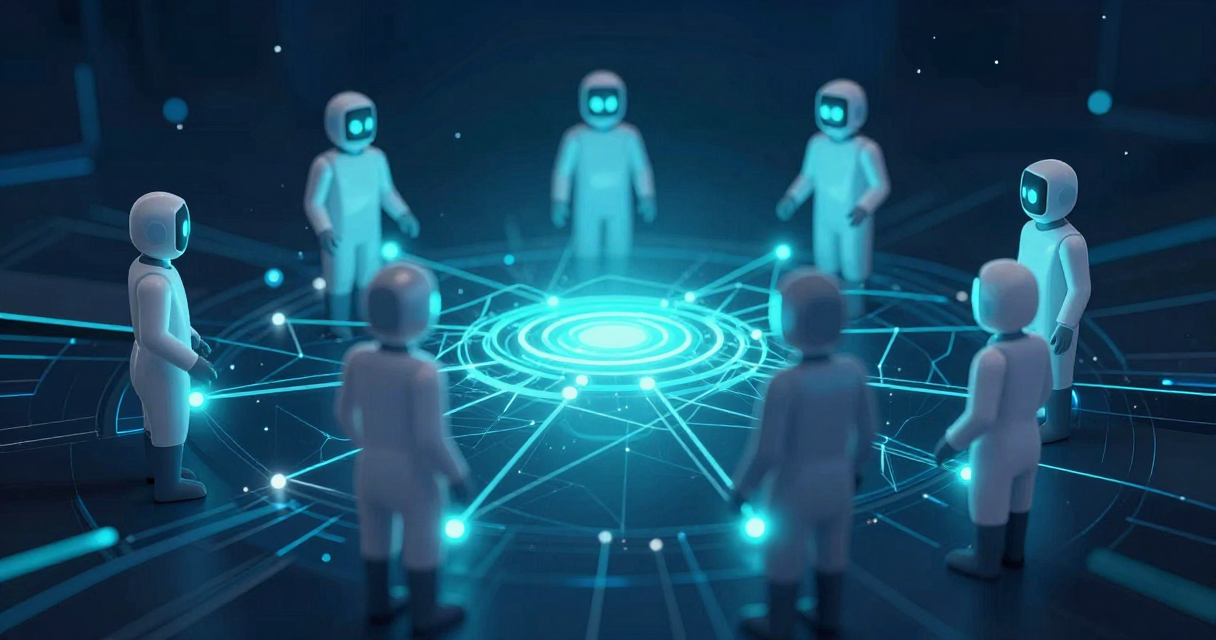
When OpenAI launched ChatGPT in late 2022, it cemented a mental model that persists to this day: one AI, one conversation, one user. Two and a half years later, that model is buckling under its own weight. The biggest shift happening in enterprise AI right now isn't a new model release or a benchmark breakthrough — it's the move from single-agent systems to orchestrated multi-agent teams. And it's changing everything about how AI gets deployed in production.
According to IEEE Spectrum's analysis of the Stanford 2026 AI Index, global AI spending is projected to hit $2.53 trillion in 2026 and $3.33 trillion in 2027. The autonomous AI agent market alone is projected to reach $8.5 billion by 2026 and $35 billion by 2030, according to Deloitte estimates cited by Redwerk. Yet a MIT report indicates that 95% of AI initiatives still fail to reach production — not because models lack capability, but because the systems built around them lack architectural robustness. Multi-agent orchestration is emerging as the answer to that gap.
Why Do Single-Agent Systems Hit the Wall?
The first wave of generative AI adoption followed a predictable pattern: organizations integrated a single large language model and tasked it with broad requirements. For controlled pilots, FAQ bots, or internal productivity experiments, this approach worked fine. But as enterprises move beyond experimentation, the centralized intelligence model collapses.
A single LLM serving multiple business lines creates domain overload — finance logic, clinical compliance, and customer support require fundamentally different reasoning boundaries. Context degradation follows: as task complexity increases, response consistency declines. In production systems serving millions of users, these aren't edge cases — they're systemic risks.
"Single-agent systems struggle with domain overload, governance complexity, and performance bottlenecks in production environments," writes Codebridge's Myroslav Budzanivskyi in a February 2026 analysis of multi-agent orchestration patterns. The centralized model also creates a single point of failure — a monolithic agent that requires access to diverse, sensitive datasets becomes a security liability.
What Exactly Is Multi-Agent Orchestration?
A multi-agent system (MAS) distributes workloads across specialized AI agents that coordinate to accomplish complex tasks. Rather than one generalist model doing everything, you get a team of specialists — each with defined roles, tools, and boundaries — coordinated by an orchestration layer that manages communication, shared state, task routing, and failure recovery.
The distinction between "frameworks" and "orchestration platforms" matters. Frameworks like LangGraph, CrewAI, and AutoGen are developer libraries — you write the code, define agents, wire tools, and own infrastructure. Orchestration platforms like Azure AI Foundry, AWS Bedrock AgentCore, and Google Vertex AI Agent Builder sit above that layer, bundling deployment, governance, and observability into managed services.
MIT Technology Review's April 2026 "10 Things That Matter in AI Right Now" report identified agent orchestration as one of the defining trends of the year. The publication noted that the first wave of AI agents — tools that could browse the web or send an email — acted alone. "New tools can yoke together multiple agents, give each of them a different job, and orchestrate their behaviors so that they all pull together to complete tasks more complex than an individual agent could do by itself."
Which Frameworks Are Actually Winning?
The framework landscape has consolidated sharply since 2024. A May 2026 analysis by Presenc AI, which tracks production multi-agent deployments, provides the clearest picture of where the market stands. LangGraph dominates with an estimated 38% of multi-agent production deployments, followed by custom orchestration (28%), CrewAI (12%), Microsoft AutoGen (9%), Anthropic's Claude Skills compositions (5%), Google ADK (4%), OpenAI Swarm (2%), and others (3%).
The key takeaway from Presenc AI's research is striking: for most enterprise deployments, the framework choice is less consequential than the underlying model selection, evaluation infrastructure, and human-checkpoint design. "A frontier model in a basic framework outperforms a weaker model in a sophisticated framework," the report concludes.
LangGraph's dominance comes from its graph-based state machine model, which maps cleanly to production workflows. Its supervisor pattern — where a coordinator agent delegates tasks to specialized sub-agents — is battle-tested at scale. The tight integration with LangSmith for observability gives it the most mature trace tooling available for LLM applications. The trade-off is a steeper learning curve and an ecosystem coupled to the broader LangChain project.
CrewAI takes a different approach with its role-based "crew" abstraction, where agents collaborate like a human team. It excels at rapid prototyping — developers can spin up a multi-agent system with clear roles, goals, and tool sets in minutes. But it trails on production observability and error recovery, making it better suited for validation than for mission-critical deployments.
How Are Big Tech Platforms Responding?
Every major cloud provider has now shipped a managed multi-agent orchestration product. The April 2026 Redwerk survey identified the top platforms: OpenAI's Agents SDK (MIT-licensed, Python), Google's Agent Development Kit or ADK (Apache-2.0, Python and Java), Microsoft's AutoGen (MIT, Python and .NET), Anthropic's Claude Skills compositions, and Strands Agents SDK from AWS (Apache-2.0, Python and TypeScript).
On the orchestration platform side, Azure AI Foundry Agent Service targets enterprises on the Microsoft stack with CI/CD-ready agent pipelines. AWS Bedrock AgentCore offers serverless agent orchestration for Lambda-native deployments. Google Vertex AI Agent Builder provides managed Gemini-native orchestration for GCP-first teams.
What's notable is the convergence pattern. Each vendor's framework is optimized for its own model ecosystem — OpenAI's Agents SDK works best with GPT models, Google ADK with Gemini, Anthropic's Claude Skills with Claude. This vendor coupling isn't accidental. It's the new moat: if your orchestration infrastructure is tightly integrated with one provider's models, switching costs compound rapidly.
Where Is Multi-Agent AI Already in Production?
The most visible multi-agent deployments are in software development. Claude Code, released by Anthropic, lets developers launch and coordinate multiple coding agents simultaneously — some users report running up to two dozen subagents, with different agents writing code, testing it, and fixing bugs in parallel. Cursor's agent mode takes a similar approach, reading entire codebases and making multi-file changes through coordinated sub-agents. Codex from OpenAI and Windsurf's Cascade system provide comparable multi-agent coding workflows.
Beyond development, Google DeepMind's Co-Scientist applies multi-agent coordination to research workflows — coordinating literature searches, hypothesis generation, experiment design, and peer review simulation. Anthropic's Claude Cowork (which the company claims to have built using Claude Code in just 10 days) applies agent teams to general white-collar productivity tasks: managing inboxes, handling customer complaints, and coordinating across business workflows.
MIT Technology Review's analysis frames the significance bluntly: "Think of multi-agent systems as the new assembly lines. Henry Ford's innovation upended entire industries last century. In theory, networks of AI agents could do to white-collar knowledge work what assembly lines did to manufacturing."
What Are the Real Risks?
The same capabilities that make multi-agent systems powerful also introduce new failure modes. When agents interact with real-world systems — healthcare, finance, social media — the consequences of hallucination or miscoordination escalate dramatically. MIT Technology Review's report raises the question directly: "Are we ready for agents to be let loose on our ubiquitous digital infrastructure, from health care to finance, social media to missile launchers?"
The codegen.com analysis identifies three layers in the AI coding tool space that illustrate the risk spectrum. Editor assistants (like GitHub Copilot inline completions) stay contained within an IDE. Autonomous agents (like Claude Code and Cursor) operate at the repository level with access to file systems and terminals. The orchestration layer — which coordinates multiple agents across environments — amplifies both capability and blast radius.
Enterprise governance challenges compound these risks. In regulated industries like FinTech and HealthTech, multi-agent systems require permission isolation, audit trails, deterministic fallbacks, and cost controls. Each additional agent introduces new attack surfaces and failure points. The shift from "one model, one conversation" to "agent teams coordinating across systems" demands a fundamentally different security posture.
What Does This Mean for Developers?
For engineering teams evaluating multi-agent adoption, the Presenc AI analysis offers clear guidance: start with model selection before framework selection, invest in evaluation infrastructure early, and design human checkpoints deliberately. The report recommends LangGraph or custom orchestration for enterprise production with mature engineering teams, CrewAI or AutoGen for rapid prototyping, and vendor-specific frameworks (Google ADK, Claude Skills) when you're already committed to a particular model ecosystem.
The Stream.io comparison guide highlights an emerging pattern: the most successful multi-agent deployments in 2026 aren't the most architecturally sophisticated ones — they're the ones where human oversight is baked into the orchestration layer from the start, not bolted on after deployment.
For individual developers, the immediate impact is already visible. AI coding tools that were limited to inline completions two years ago now coordinate parallel agents across entire repositories. The role of the developer is shifting from writing code to orchestrating agent teams — managing task delegation, reviewing agent output, and maintaining the system architecture that keeps agents productive and aligned.
Multi-agent orchestration isn't a niche research topic anymore. With $2.5 trillion in projected AI spending this year and every major platform shipping orchestration tooling, it's the infrastructure layer that determines whether AI deployments actually reach production — or join the 95% that don't.
Sources
- MIT Technology Review — Agent Orchestration
- Presenc AI — Multi-Agent Orchestration Frameworks 2026
- Codebridge — Mastering Multi-Agent Orchestration
- Redwerk — 10 Best Multi-Agent AI Frameworks 2026
- Stream.io — 9 Best AI Orchestration Tools 2026
- Codegen — Best AI Coding Agents Comparison
- IEEE Spectrum — Stanford 2026 AI Index Analysis
- Yahoo Finance — AI Spending Projections
Comments ()