Generative AI in the Workplace: The Automation Revolution That's Actually Working (No, Really)

Generative AI in the Workplace: The Automation Revolution That's Actually Working (No, Really)
Remember when "digital transformation" was just corporate buzzword bingo? Well, buckle up, because generative AI in the workplace is making those buzzwords look like ancient hieroglyphics. While your CEO was busy filling whiteboards with meaningless synergistic paradigms, AI quietly started doing the actual work—and the results are honestly kind of embarrassing for anyone still manually scheduling meetings.
The Numbers Don't Lie (And Yes, They're Actually Real)
Hold onto your quarterly reports, because these statistics are wilding. According to recent research from StackAI, 88% of enterprises now spend more than 5% of their IT budget on AI—with many gunning for 25%+ soon. But here's the kicker: this isn't just hype-fueled spending for the sake of it. 74% of companies report their AI initiatives meet or exceed ROI targets, with about 20% seeing returns over 30%. That's the kind of ROI that makes CFOs weep tears of joy.
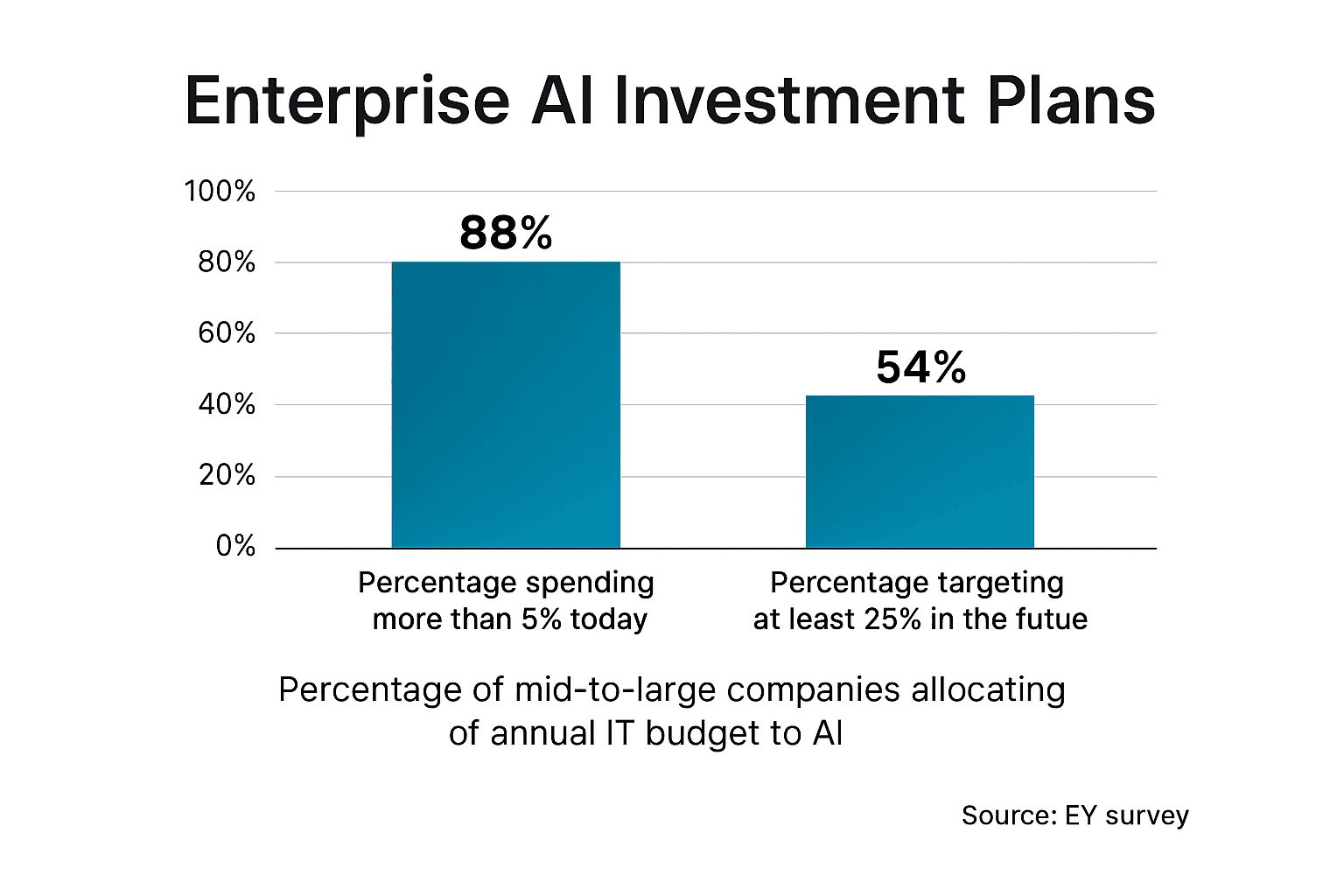
Source: StackAI analysis of enterprise AI adoption trends showing investment acceleration
Deloitte's analysis reveals that generative AI has boosted productivity by 20-30% for junior employees and 10-15% for senior staff. Translation: that fresh college hire you just onboarded? They're suddenly outperforming your mid-level managers, thanks to AI assistants that don't need coffee breaks or dental benefits.
Who's Actually Winning? (Spoiler: It's Not Your Company Yet)
Let's look at some real companies making real money while you're still debating whether ChatGPT is "secure enough" for your office:
- Uber saved 3,400 hours annually using Microsoft Power Automate—an estimated $30 million in cost savings. That's literally millions of dollars saved by automating workflows that most companies still run on spreadsheets and prayer.
- Robinhood expanded its AI operations from 500 million to 5 billion tokens daily using AWS Bedrock, cutting AI costs by 80% and reducing development time by 50%. Meanwhile, you're celebrating because you set up an auto-reply email filter.
- JPMorgan Chase reduced fraud losses by 20% and improved regulatory reporting accuracy using AI. That's not just efficiency—that's the difference between "we caught it" and "oops, where'd that billion go?"
- Walmart lowered stockouts by 30% through AI-powered supply chain optimization. Goodbye, empty shelves. Hello, customers who can actually buy what they came for.
- Pfizer cut new drug development timelines by 18% with AI-assisted R&D. You know how much faster your competitors will beat you to market if they're operating on 80% of the timeline you need?

Source: Prompts.ai platform comparison highlighting enterprise workflow automation capabilities
The Platforms Actually Worth Your Time (And Budget)
The AI workflow automation market has exploded like a supernova, and not all platforms are created equal. Here's what the landscape actually looks like:
Prompts.ai emerged as the multi-model maverick, integrating over 35 leading large language models (including GPT-5, Claude, LLaMA, and Gemini) into a single interface. Their TOKN credit system promises up to 98% cost reduction compared to managing multiple subscriptions individually. For companies tired of the "AI vendor lock-in" subscription treadmill, this is actually a compelling alternative.
Microsoft Power Automate continues dominating the low-code space, with Premium plans starting at $15/user/month. Companies report a staggering 248% ROI over three years, and with over 1,400 prebuilt connectors for SAP, Salesforce, and Dynamics 365, it integrates with basically everything your company already uses. The "natural language workflow creation" feature means your business analysts can actually build automations without calling IT every five minutes.
AWS Bedrock is the enterprise-grade heavyweight, trusted by over 100,000 organizations for its serverless architecture and security-first approach. Their three-tier pricing (Standard, Priority, and Flex) offers flexibility that actually makes sense for real business use cases, and companies like Robinhood have demonstrated that scale without breaking the bank is absolutely achievable.
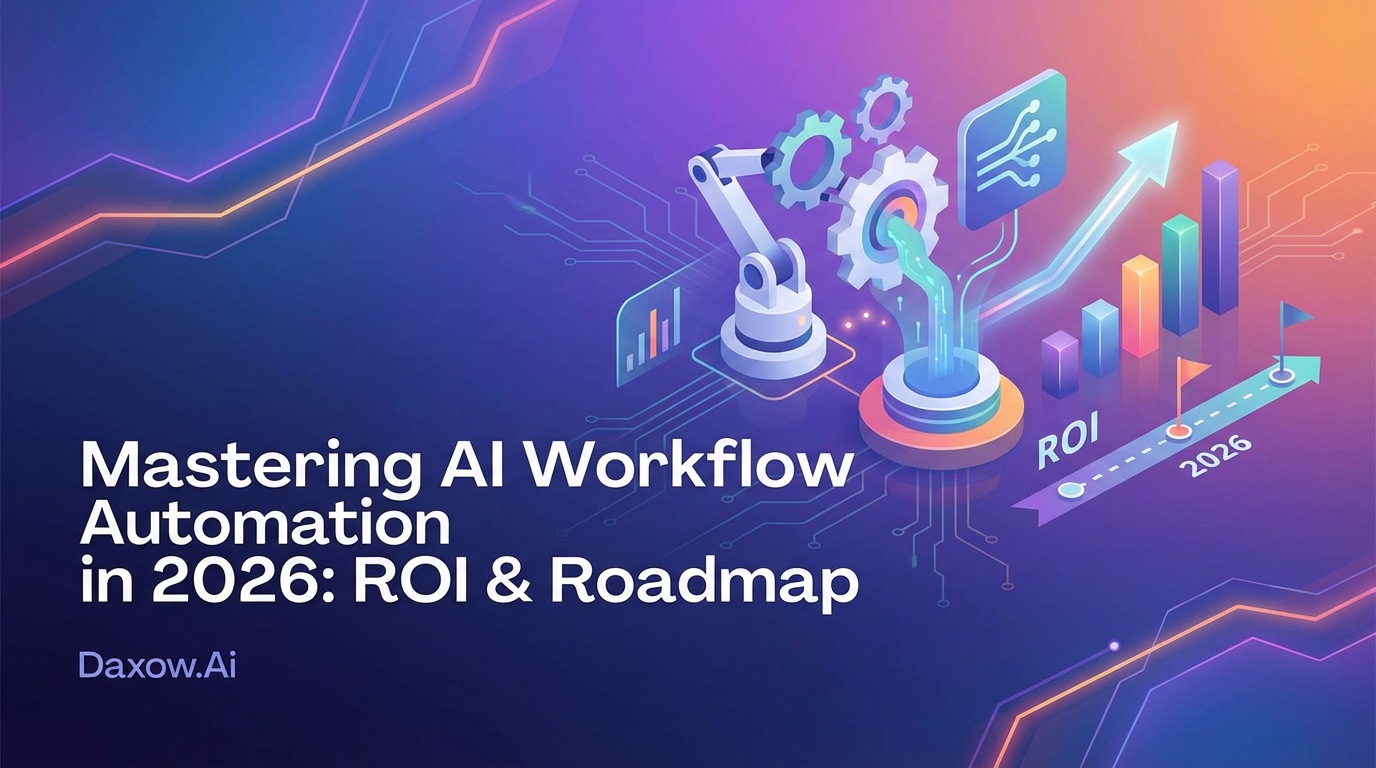
Source: Daxow.ai's 3-6 month implementation framework for enterprise AI automation
The Dirty Secret Everyone Ignores: This Isn't Magic
Here's the thing nobody wants to admit in their slick keynote presentations: successful AI workflow automation requires actual work. Daxow.ai's research shows that well-scoped AI workflow automation programs produce 3-5x faster ROI when paired with disciplined implementation—data readiness, cross-functional teams, iterative pilots. You can't just buy a "AI solution," sprinkle it like fairy dust, and expect miracles.
The companies seeing 20-50% operational cost savings and 30-40% productivity gains are the ones who:
- Actually assessed their workflows instead of automating broken processes (hint: your processes are definitely broken)
- Prepared their data because AI without good data is just expensive hallucinations
- Started small with high-impact use cases instead of trying to boil the ocean
- Monitored continuously because models drift, business needs change, and static solutions fail
What's Actually Coming Next (Beyond the Buzzwords)
The 2026 landscape isn't just about "more AI"—it's about better AI integration:
- Agentic AI is shifting from chatbot responses to autonomous task execution. Think AI that doesn't just answer questions but actually does things—researching, planning, executing multi-step workflows without constant human hand-holding.
- Multimodal AI is becoming standard, meaning your systems will seamlessly process text, images, audio, and video together. No more juggling six different tools because each handles one type of content.
- RAG (Retrieval Augmented Generation) is becoming the enterprise default, finally addressing the hallucination problem by grounding AI responses in your actual data instead of making up convincing nonsense.
- On-device AI is accelerating privacy-first implementations because, shockingly, not every company wants to send their proprietary data into some random cloud model.
The Bottom Line Nobody Wants to Hear
Here's the uncomfortable truth: while your company was holding meetings about meetings, your competitors were building AI agents that automate entire business processes. 70% of global enterprises are already using AI in at least one business function, and the gap between leaders and laggards is widening rapidly.
The companies that will still exist in five years aren't the ones with the fanciest AI strategy presentations. They're the ones who took these tools seriously, started somewhere (anywhere), and iterated based on actual results instead of hypothetical scenarios.
Your move. Or, you know, you could just schedule another quarterly review meeting. That's working great for you so far, right?
Sources
- Prompts.ai - Leading AI Workflow Platforms for Enterprises in 2026
- StackAI - State of Generative AI for Enterprises in 2025
- Daxow.ai - Mastering AI Workflow Automation in 2026
- Kellton - Generative AI Trends 2026
- Adamo Software - Generative AI Trends 2026
- Beam.ai - Best AI Copilots for Enterprise Productivity in 2026
- Prezent.ai - 10 Leading Enterprise Generative AI Tools in 2026
- MIT Sloan - Looking Ahead at AI and Work in 2026
Comments ()