Turso: Making SQLite a First-Class Citizen for Edge Computing
Remember when SQLite was just that tiny database file you'd throw in your local project and pray nobody accidentally deleted it? Yeah, those days are officially over. Enter Turso, the platform that took everyone's favorite embedded database and decided, "Hey, what if we made this thing actually useful for the modern world?"
Let's be real for a second—SQLite has always been the unsung hero of the development world. It's lightweight, it's fast, and it works practically everywhere. But when it comes to edge computing, serverless functions, and globally distributed applications, traditional SQLite is about as useful as a chocolate teapot. That's where Turso steps in, transforming our beloved little database into something that can actually survive in the cutthroat environment of modern cloud architecture.
The Magic Trick: Embedded Replicas
Here's where Turso gets genuinely clever. Their flagship feature—embedded replicas—is essentially database black magic. Imagine having a perfect, always-in-sync copy of your cloud database living right inside your application's memory. We're talking microsecond read speeds because you're not going over the network at all. When your local SQLite read takes 0.2 milliseconds and Turso's embedded replica hits 0.6ms, yeah, you might think that's slower. But here's the kicker: that's still faster than trying to hit a PostgreSQL server in New York when your user is in Tokyo (we're talking 100+ms of lag minimum).

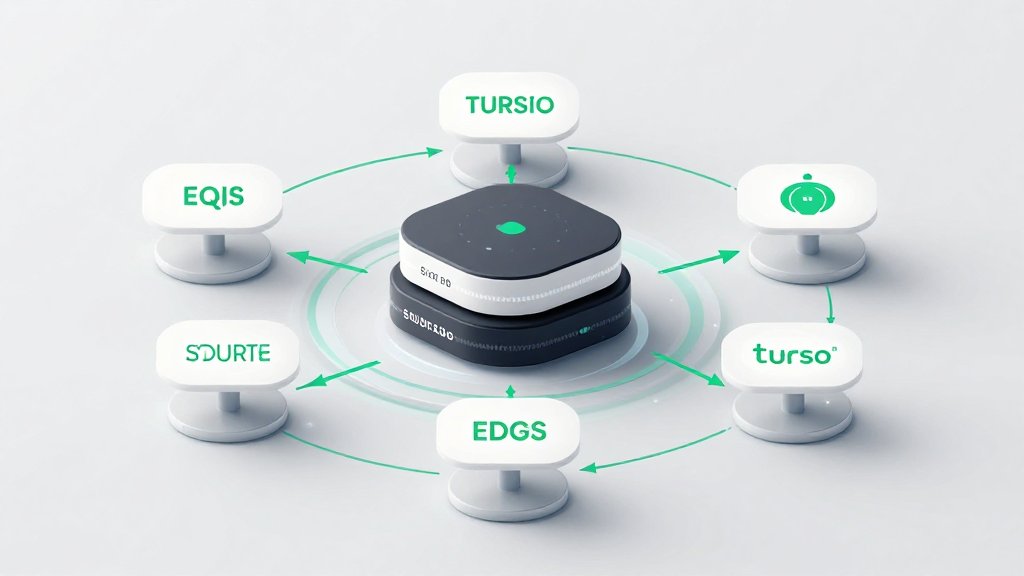
Turso logo representing the evolution of SQLite for modern cloud and edge computing requirements
The architecture solves a fundamental problem that traditional SQLite could never address: persistence in ephemeral environments. When you're running on Vercel, AWS Lambda, or Cloudflare Workers, that lovely file system you rely on literally vanishes the moment your function stops running. Your entire database? Poof. Gone. Turso plugs this hole by giving you the SQLite experience you love but with actual cloud persistence behind it.
The SDK Explosion
Turso isn't just sitting around patting themselves on the back for embedded replicas. They've been aggressively expanding their ecosystem with official SDKs that span practically every language developers actually use. We're talking TypeScript/JavaScript, Rust, Go, Python, Android, Swift, PHP, Ruby, Ruby on Rails, and yes, even C. That's not just covering the bases—that's practically buying the stadium and naming every seat after a programming language.
But wait, there's more. Community-driven SDKs extend this reach even further into Flutter/Dart, Capacitor, React Native (via OP-SQLite), Laravel, .NET, and Java. If you can't find a Turso client for your preferred stack at this point, you might want to consider that maybe you're the problem, not them.
AI Integration That Actually Makes Sense
Here's something actually cool: Turso's CLI now includes a built-in Model Context Protocol (MCP) server. What this means in plain English is that AI assistants like Claude can now directly interact with your Turso databases through natural language. No more writing queries manually—just ask your AI to "show me all users who signed up this week" and watch the magic happen. This isn't just a party trick; it's the kind of developer experience improvement that makes you wonder why every database doesn't do this.
Turso's comprehensive SDK ecosystem showing official and community support across multiple programming languages
The Pricing Model That Makes Competitors Nervous
Let's talk numbers, because that's what actually matters. Turso's free tier is almost laughably generous: 9GB of storage, 500 databases, and a whopping 1 billion row reads per month. For zero dollars. You read that right—one billion reads. Their paid tier at $29/month bumps you to 24GB storage with unlimited reads and unlimited databases. Compare that to what you're paying your current cloud provider for PostgreSQL or MySQL, and suddenly Turso starts looking like the only reasonable option in the room.
The Bottom Line
Turso isn't just "making SQLite cloud-native"—they're fundamentally reimagining what a database should be in a world where code runs everywhere and users expect instant responses. By combining the simplicity developers have loved about SQLite for decades with the infrastructure demands of globally distributed applications, they've created something that feels inevitable in hindsight.
Is Turso perfect? Probably not. What is? But they're solving real problems that actual developers face every day, and they're doing it with an elegance that makes you wonder why it took this long. The era of apologizing for using SQLite in production might actually be over. About time.

Comments ()