OpenAI's Custom Chip Breakout, SpaceX's $80B Compute Empire, and Scattered Spider's Day in Court
The Week AI Infrastructure Hit the Silicon Ceiling
While most of the tech world focused on yet another model release cycle, this week's most consequential moves happened behind the scenes — in chip fabs, data center construction sites, and courtroom dockets. OpenAI unveiled a custom inference chip designed to escape Nvidia's grip on AI economics, SpaceX quietly became the world's most important compute landlord, and two Scattered Spider hackers finally faced justice for a cybercrime spree that cost victims over $115 million. Together, these stories paint a picture of an industry that's simultaneously building its future infrastructure and reckoning with the fallout of its breakneck growth.
OpenAI's Jalapeño Chip: A $14 Billion Bet to Break Nvidia's Inference Monopoly
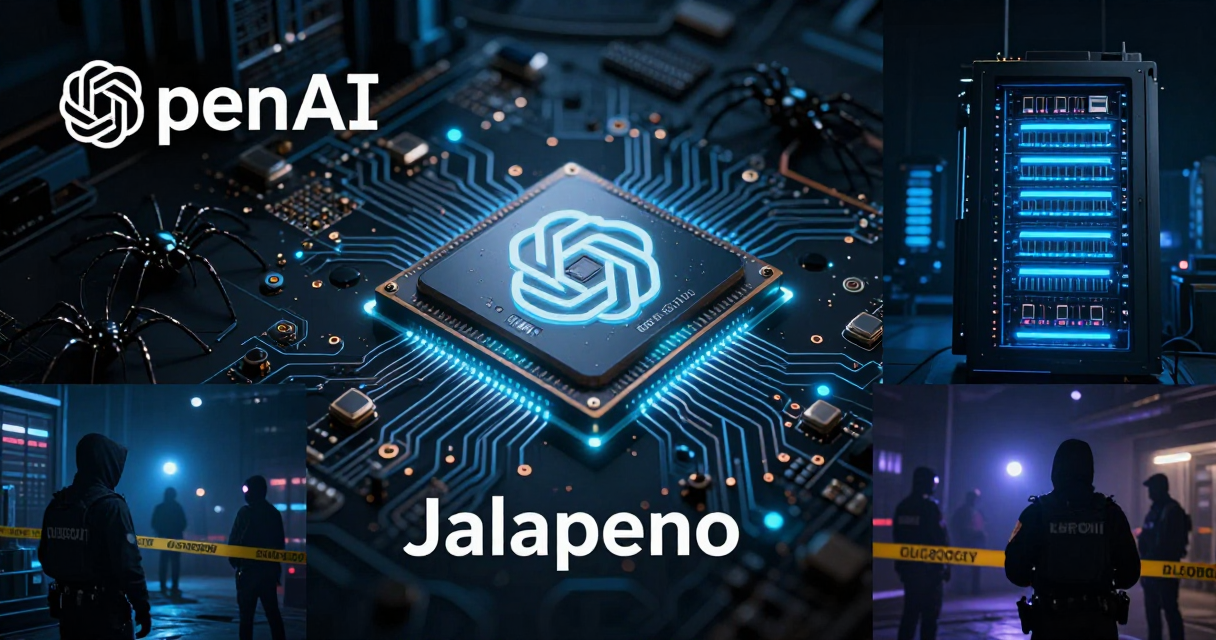
OpenAI has officially entered the silicon game. The company revealed Jalapeño, a custom ASIC designed in collaboration with Broadcom specifically for LLM inference workloads. The chip represents a strategic pivot from OpenAI's previous reliance on Nvidia GPUs — a dependence that, with 900 million weekly ChatGPT users, was projected to cost the company roughly $14 billion in annual compute costs.
According to reporting from AI News, the chip design moved from blank-slate concept to tape-out in just nine months — an unusually fast timeline that OpenAI accelerated by using its own language models to automate portions of the hardware design process. The company has committed a staggering $1.4 trillion to compute infrastructure over the next eight years, and Jalapeño is central to making that math work.
What makes this significant isn't just the chip itself. It's the signal it sends: when the most prominent AI company in the world decides to build its own silicon rather than pay Nvidia's margins, the entire industry takes notice. Google has TPUs, Amazon has Trainium and Inferentia, and now OpenAI has Jalapeño. The "Nvidia tax" era may be approaching its endgame. Initial deployment is slated for late this year.
SpaceX's $6.3 Billion Compute Deal: The Space Company That Became an AI Giant
In a move that would have seemed absurd just two years ago, SpaceX signed a $6.3 billion contract with Reflection AI for access to Nvidia GB300 chips housed at the Colossus 2 data center near Memphis, Tennessee. Under the terms, Reflection AI will pay $150 million per month starting in July 2026 through 2029 — making it one of the largest single compute agreements in history.
SpaceX's total committed compute revenue now exceeds $80 billion, with Anthropic ($1.25 billion/month) and Google ($920 million/month) as the other anchor tenants. The company, which went public via SPAC in 2024, has effectively transformed itself into the world's largest AI infrastructure provider — its Colossus cluster, originally built to train Grok models for xAI, has become the most sought-after compute resource on the planet.
This deal underscores a broader trend: the AI compute market is consolidating around a handful of massive providers. Companies that can't secure capacity at scale face an existential disadvantage. Reflection AI's willingness to commit $6.3 billion over three years suggests the competitive pressure to access frontier compute is only intensifying.
Scattered Spider Pleads Guilty: The $115 Million Cybercrime Saga Ends in Court
Two key members of the Scattered Spider cybercrime group — Thalha Jubair, 20, and Owen Flowers, 18 — pleaded guilty in a UK court this week to charges stemming from the August 2024 attack that crippled Transport for London's public transit systems. Their guilty pleas came on the first day of what was expected to be a six-week trial, sparing prosecutors the need to present evidence in full.
The scope of Scattered Spider's criminal activity is staggering. According to a 2025 U.S. federal indictment, Jubair and associates were responsible for 120 network intrusions across 47 U.S. entities between May 2022 and September 2025, with victims paying at least $115 million in ransom. The group is also linked to the infamous ransomware attacks against MGM Resorts and Caesars Entertainment in 2023, as well as a massive SMS phishing campaign that compromised over 130 organizations including LastPass, DoorDash, Mailchimp, Plex, and Signal.
The guilty pleas represent a significant win for law enforcement agencies across multiple countries. Scattered Spider's young members — many teenagers at the time of their crimes — demonstrated sophisticated social engineering and lateral movement techniques that traditionally required years of experience. Their prosecution sends a clear message that youth is no defense in cybercrime cases.
Cisco's Zero-Day Crisis: Mandiant Exposes Systemic SD-WAN Flaws
Mandiant released a detailed analysis of how attackers exploited a previously unknown vulnerability in Cisco Catalyst SD-WAN Manager (tracked as CVE-2026-20245) to gain full root access on enterprise networks. The attacks, which began in March 2026, used a creative approach: attackers established fake SD-WAN peering connections, then uploaded a malicious CSV file through the tenant-upload CLI feature that created a new root-level account.
What's particularly alarming is the attackers' operational discipline. After creating the backdoor account, they extracted device configurations from edge devices, maintained access, and then restored original configurations to avoid detection. The vulnerability affects Cisco Catalyst SD-WAN Manager, Controller, and Validator — essentially the entire management stack for SD-WAN deployments. Cisco has released patches but noted there is no workaround for affected versions.
This isn't Cisco's first zero-day crisis this year — a previous incident already put the company's security posture under scrutiny. For enterprises running Cisco SD-WAN infrastructure, the Mandiant report is essential reading and a reminder that supply chain and management-plane vulnerabilities remain the most dangerous attack surface in modern networks.
Oracle's 21,000 Layoffs: The Human Cost of AI's Enterprise Advance
Oracle disclosed in an SEC filing this week that it eliminated 21,000 positions over the past fiscal year — nearly 13% of its workforce. The company explicitly cited AI adoption as the primary driver, joining a growing list of tech giants including Meta, Microsoft, Google, and Amazon that have undertaken similar workforce reductions.
What distinguishes Oracle's cuts is their scale and the company's candor about the motivation. The $1.84 billion severance bill is being redirected toward an estimated $70 billion annual investment in AI data center infrastructure — a tradeoff that Oracle's executives described as necessary to remain competitive. The company is building massive GPU clusters to serve customers like OpenAI and Meta, and AI-driven automation is replacing roles previously held by database administrators, support engineers, and IT operations staff.
The broader implication is sobering. As enterprise AI adoption accelerates, the workforce displacement question is no longer theoretical. Oracle's 21,000-person reduction — the largest single tech layoff explicitly attributed to AI — suggests the industry is entering a phase where efficiency gains from AI are being captured through headcount reduction rather than revenue expansion.
What This Week Tells Us About AI's Trajectory
These five stories, taken together, reveal the tensions defining the current AI moment. On one hand, unprecedented capital is flowing into infrastructure — OpenAI's $1.4 trillion commitment, SpaceX's $80 billion in compute contracts, Oracle's $70 billion data center buildout. On the other hand, that infrastructure buildout is displacing workers at scale, enabling new forms of cybercrime, and concentrating compute power in fewer hands.
The Jalapeño chip and the SpaceX compute deals represent the industry's attempt to solve its scaling problems through engineering and capital. The Scattered Spider convictions and the Cisco zero-day disclosures represent the security and accountability challenges that scaling creates. And Oracle's layoffs represent the human dimension that policymakers and industry leaders can no longer afford to treat as an externality.
The infrastructure race is accelerating. The question now is whether the guardrails — legal, technical, and social — can keep pace.


Comments ()