OpenAI's $4B Consulting Gambit, ByteDance's $70B AI Blitz, and the Enterprise AI Arms Race That Changed Everything
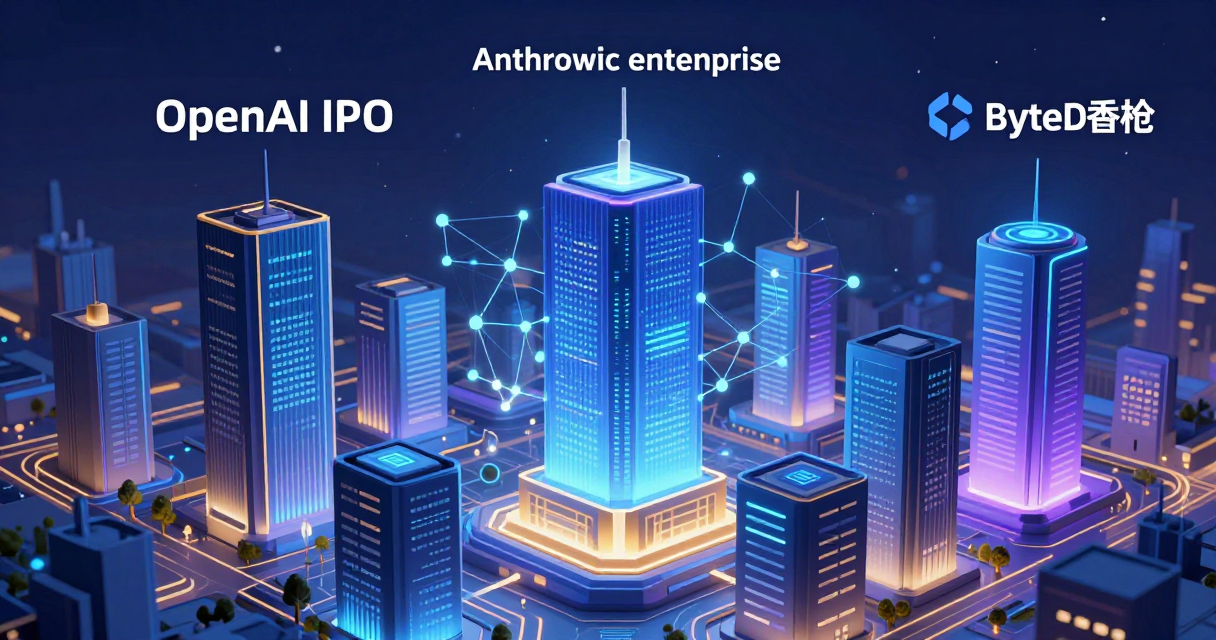
This was the week the AI industry's competitive landscape fundamentally shifted — not through a new model release or benchmark breakthrough, but through strategic moves that reveal where the real battle is being fought: enterprise deployment and infrastructure control.
From OpenAI's staggering IPO filing to ByteDance's unprecedented infrastructure commitment, from Anthropic's quiet dominance of the Big Four consulting world to a logistics startup turning fulfillment into an AI-powered moat, the signals are unambiguous. The AI race in 2026 is no longer about who builds the smartest model. It's about who owns the layer between that model and the customer's actual workflow.
OpenAI Files for IPO, Aiming for a $1 Trillion Valuation
On May 22, OpenAI quietly filed a confidential S-1 registration statement with the SEC, formally initiating what could become the most anticipated technology IPO since Google's debut in 2004. Goldman Sachs and Morgan Stanley are leading the underwriting, with a public debut targeted for Q4 2026 — potentially as early as September.
The valuation target is eye-popping: analysts project OpenAI could surpass $1 trillion, a dramatic leap from its current $852 billion private valuation. For context, that would place OpenAI among the ten most valuable companies in the world on day one — a remarkable achievement for an organization that only began charging for its products in early 2023.
But the filing also lays bare a critical tension. OpenAI is reportedly losing $1.22 for every $1 of revenue as of Q1 2026. Monthly revenue has reached approximately $2 billion, yet the cost of training frontier models and serving them to hundreds of millions of users continues to outpace income growth. The S-1 will eventually reveal whether OpenAI has a credible path to profitability — or whether it's betting that scale alone will solve a math problem that currently doesn't add up.
This filing arrives at a pivotal moment. Anthropic's aggressive enterprise push has already eroded OpenAI's once-dominant market position. The IPO represents both an opportunity to raise capital at a premium and a deadline to prove the business model works under public market scrutiny.
DeployCo: OpenAI's $4 Billion Answer to the Enterprise Problem
While the IPO grabs headlines, OpenAI's quieter announcement may prove more strategically significant. On May 11, the company launched the OpenAI Deployment Company — internally called DeployCo — a majority-owned consulting subsidiary backed by more than $4 billion in initial capital from a consortium of 19 investment firms and consultancies, including TPG, Goldman Sachs, McKinsey, Bain Capital, and Capgemini.
DeployCo copies a page from Palantir's playbook. Rather than selling API access and leaving integration to customers, the subsidiary will place "Forward Deployed Engineers" directly inside client organizations to build production AI systems on-site. It's a hands-on, high-touch model designed to address the persistent gap between AI capability and AI adoption — the gap that has allowed competitors to eat into OpenAI's market share.
The numbers tell the story of why this matters. OpenAI's share of the enterprise API market has reportedly fallen from roughly 50% in 2023 to approximately 25% by mid-2025. Anthropic and Google have made significant inroads, particularly through high-touch partnerships that go beyond simple API consumption. DeployCo is OpenAI's explicit acknowledgment that selling models isn't enough — you have to own the deployment layer.
As we've noted in our coverage of the broader AI power shift, the companies generating the most revenue in AI aren't necessarily those with the best benchmarks. They're the ones embedded deepest into enterprise workflows.
ByteDance's $70 Billion AI Infrastructure Blitz
While American AI companies fight over enterprise contracts, ByteDance is mounting an infrastructure offensive that could reshape the global compute landscape. Bloomberg reported on May 27 that TikTok's parent company is discussing capital expenditures of up to $70 billion in 2026 for AI data center expansion — more than double its spending from the previous year.
The funding source is notable: ByteDance generated approximately $50 billion in profit during 2025, giving it the financial firepower to self-fund this expansion without relying on external capital markets. This is a level of organic AI investment that few companies in the world can match.
Lower construction costs for data centers in China provide ByteDance with a structural cost advantage over American hyperscalers. While Amazon projects around $200 billion in capex, Alphabet targets $175–185 billion, and Meta plans $115–135 billion, ByteDance can build equivalent capacity for significantly less. This arbitrage could prove decisive as AI training costs continue to climb.
The strategic context extends beyond infrastructure. ByteDance's AI assistant Doubao has been growing rapidly in China, and the company has explicit ambitions to challenge US AI leaders internationally. The massive compute buildout is the foundation for that challenge — a foundation that American export controls on advanced chips were specifically designed to slow down.
Anthropic Conquers the Big Four as KPMG Deploys Claude to 276,000 Employees
If there's one company that exemplifies the deployment-layer strategy, it's Anthropic. On May 19, KPMG and Anthropic announced the KPMG Digital Gateway Powered by Claude, embedding Anthropic's frontier AI directly into KPMG's core client delivery platform across its entire global workforce of 276,000 professionals in 138 countries.
This isn't a pilot program. Claude Cowork and Managed Agents are being integrated directly into Digital Gateway — KPMG's primary platform for client work, proprietary tools, and AI-enabled workflows. Full Azure implementation is scheduled for September 2026, and the deployment spans tax, legal, and private equity service lines. One of the initial use cases is particularly notable: KPMG and Anthropic teams will use Claude for vulnerability scanning and security remediation in critical client systems.
The KPMG deal completes a remarkable sweep. With Deloitte (470,000 employees), PwC (hundreds of thousands of professionals), and now KPMG all standardizing on Claude, three of the four largest professional services firms have committed to enterprise-wide Anthropic deployment. Combined, these firms represent approximately 1.1 million professionals globally — and their collective client relationships span the Fortune 500, the Global 2000, and most major governments.
The sequencing is strategic. Deloitte was the first mover and anchor reference. Once public, PwC faced competitive pressure to announce. Once PwC announced, KPMG had to follow. EY, the sole holdout, now faces the most acute pressure to join. The enterprise AI tipping point Anthropic has been building toward is here.
Stord Raises $250 Million to Build AI's Physical Intelligence Layer
The AI enterprise race isn't limited to software. Stord, the Atlanta-based fulfillment and logistics platform, closed a $250 million Series F at a $3 billion valuation, led by existing investors Strike Capital, Kleiner Perkins, and Founders Fund. The round underscores that "physical intelligence" — applying AI to real-world logistics and warehouse operations — is becoming as strategically important as digital AI.
Alongside the funding, Stord launched Stord Labs, a dedicated physical intelligence lab where the company builds and validates agentic AI, robotics, and advanced automation against real orders on live fulfillment operations. Training AI models on actual warehouse data, rather than simulated environments, creates what Stord calls a "compounding advantage" — the more orders the system processes, the smarter it gets.
The financial metrics validate the approach. Stord's revenue has grown approximately 10x over the past four years, with an inflection point around mid-2023 that coincided with the broader AI adoption wave. The company now serves more than 1,000 customers processing over $15 billion in gross merchandise value — positioning it as a direct competitor to Amazon's fulfillment network for independent brands.
Stord's story illustrates a broader pattern: the most valuable AI applications in 2026 aren't always the ones with the flashiest demos. They're the ones that embed intelligence into operational infrastructure where the compounding effects of data, automation, and scale create durable competitive advantages. The shift from single-agent tools to orchestrated agent systems is playing out in warehouses just as much as in code editors.
The Deployment Layer Is Everything
What connects these stories is a single theme: the deployment layer has become the primary competitive battlefield in AI.
OpenAI's IPO filing and DeployCo launch are two sides of the same coin — one raises capital, the other spends it on embedding AI directly into customer organizations. ByteDance's $70 billion infrastructure bet is about ensuring it has the compute foundation to compete at the deployment layer globally. Anthropic's Big Four sweep demonstrates that the company with the deepest enterprise integrations wins, regardless of who leads on benchmarks. And Stord's physical intelligence play shows that deployment advantage extends beyond software into the physical world.
The implications for builders and business leaders are clear. If your AI strategy begins and ends with "call an API," you're already behind. The companies winning in 2026 are those building systems that embed AI into workflows, operations, and infrastructure in ways that create switching costs and compounding advantages. The model is becoming a commodity — the deployment layer is the moat.
The question isn't whether your organization will adopt AI. It's whether that AI will arrive through a relationship you chose — or one that chose you.
Comments ()