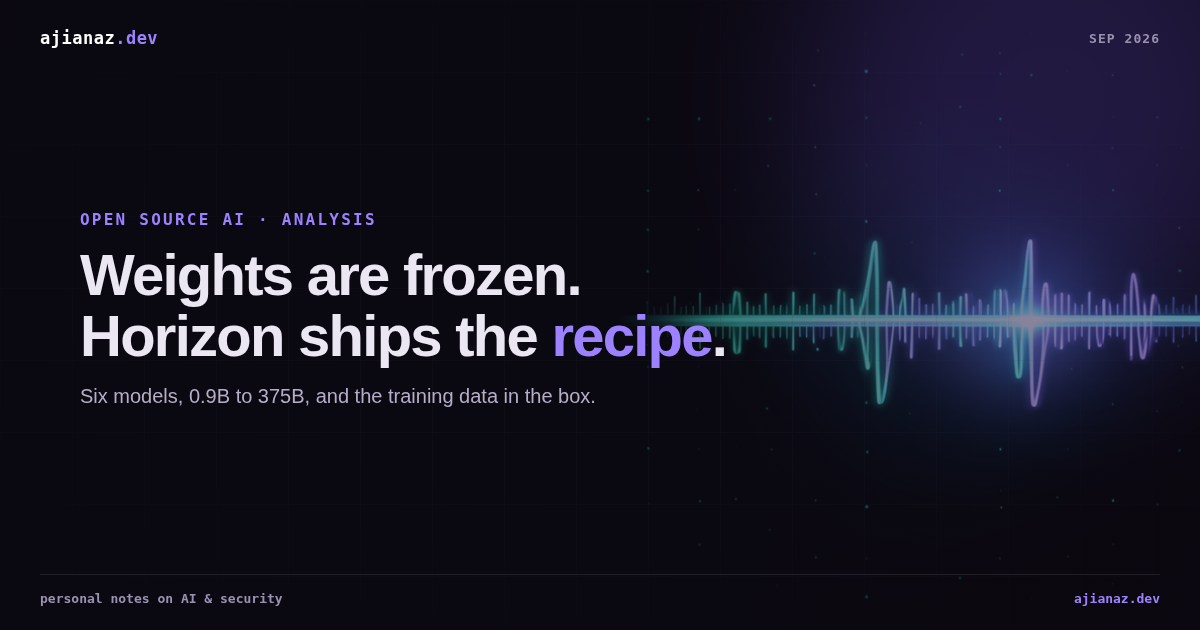
K2 Horizon Shipped the Training Data. That Changes the Argument.
Six models from 0.9B to 375B, and the first frontier-scale release to ship its training data. IFM just moved the open-source bar.
This summer, every AI lab learned to say the word "open". Meta ships weights stapled to a custom license. DeepSeek ships weights plus a tech report worth reading. And the conversation politely skips over the part nobody ships: the data the model was actually trained on.
On Wednesday, a lab in Abu Dhabi put the data in the box.
The Institute of Foundation Models (IFM), the frontier research arm spun out of MBZUAI in May 2025, released K2 Horizon: six models, from 0.9B parameters (small enough for a smartwatch) to a 375B flagship with 23B active. Weights, training code, training data, checkpoints, logs, evaluations. Apache 2.0, on Hugging Face, vLLM and SGLang from day one.
Eric Xing, IFM's founder, said the quiet part out loud: "Open source is much more than open weights. Science works when others can see the data, follow the method, reproduce the result, and improve on it."
That sentence is the whole story. The rest is detail.
What actually shipped on September 3?
Six models with a shared skeleton. Same architecture family, same vocabulary (the 0.9B excepted), same training methodology, same deployment tooling:
- 0.9B: self-reported best in class for math and tool use at its size; runs on watches and glasses.
- 3.7B: built for fine-tuning; IFM claims the best reasoning under 4B.
- 7B: claimed best performer under 10B, phone-sized.
- 32B dense: aimed at laptops and on-prem servers.
- 36B sparse with 4B active: a new "mixture of value attention" (MoVA) architecture that outperforms larger models while activating a fraction of the parameters.
- 375B with 23B active: the flagship, positioned against the strongest open-weight models on reasoning and agentic work.
Two engineering claims stand out. A diffusion distillation technique generates token blocks in parallel, roughly 3x faster generation at similar quality. And dynamic routing across the fleet means you can prototype on the 7B and move to the 375B without rewriting your deployment. Inference APIs are live through Compass, Cerebras and Nebius if you would rather not host.
The performance claims are theirs, mind. More on that below.
Why do most labs stop at the weights?
Because weights are the safe artifact. Shipping them builds adoption and costs nothing you cannot spare. The data is different. Data is where the legal exposure lives (copyright, licensing, PII) and where the actual competitive detail lives too: mixture ratios, deduplication choices, curriculum. A tech report describes the recipe. A weights file is the finished cake. Neither teaches you to bake.
There is precedent for going further. Allen AI's OLMo proved in 2024 that a fully documented release, data included, works at small scale. What IFM did this week is carry that idea up to frontier scale, which nobody had done before. You can argue about whether 375B still counts as "frontier" in September 2026. What you cannot argue is that anyone else shipped a model this size with the training data attached.
What does full openness buy you in practice?
Four things, in descending order of how many people will actually use them.
Audit. Every fight about what a model was trained on, from copyrighted books to toxic subsets, has so far been a fight conducted with screenshots and speculation. With the data shipped, it becomes an inspection task. Regulators, researchers and journalists can look instead of guess. For teams working under the EU AI Act's transparency requirements, that difference is hard to overstate.
Rerunnable evaluations. A benchmark score I cannot reproduce is marketing. IFM ships the evals with the models, so the claims are checkable. I have spent enough evenings chasing numbers through PDF appendices to find that alone worth the download.
From-scratch training at sane scale. Nobody outside a handful of labs can retrain 375B. But 0.9B through 7B is a project, not a moonshot: single-node, student-budget territory. For anyone learning how pretraining actually behaves, a fully documented small model beats a leaky giant every time.
Fleet portability. Same interfaces across sizes, routing that picks the cost-effective model per task. A nice property to have on the day your prototype outgrows its GPU.
Where would I keep the skepticism?
I want this to set a norm. I have also watched the word "open" get quietly redefined enough times to hedge a little.
The openness is asymmetric. Reproducing the flagship is a compute story almost nobody can afford; for the big model, "open" mostly means inspectable. That is still valuable, but say so plainly. Data dumps are heavy, too. Shipping terabytes and making them usable are different bars, and the logs and checkpoints help, but verification work will concentrate in the few organizations with bandwidth to do it.
And the state-of-the-art claims per size class are self-reported, evals in the box or not. Incentives being what they are, I will wait for third-party numbers before crowning the 7B the best under 10B.
None of that changes the main point. The claim IFM is making is "check us".
Why does this matter beyond Abu Dhabi?
The timing is what makes it sting. The same news cycle carries GPT-6 Astra, whose reasoning technique makes its chain-of-thought harder to audit, and K2 Horizon, which publishes its training set. Two frontier labs, moving in opposite directions on the same question: how much of the model do you get to see?
Whichever way the industry goes, the bar moved this week. Every weights-only release now answers to a one-line question it never had to face before: where is the data?
IFM answered on day one. Ask everyone else.
Comments ()