Why the Self-Hosted Clone Matters More Than the Launch
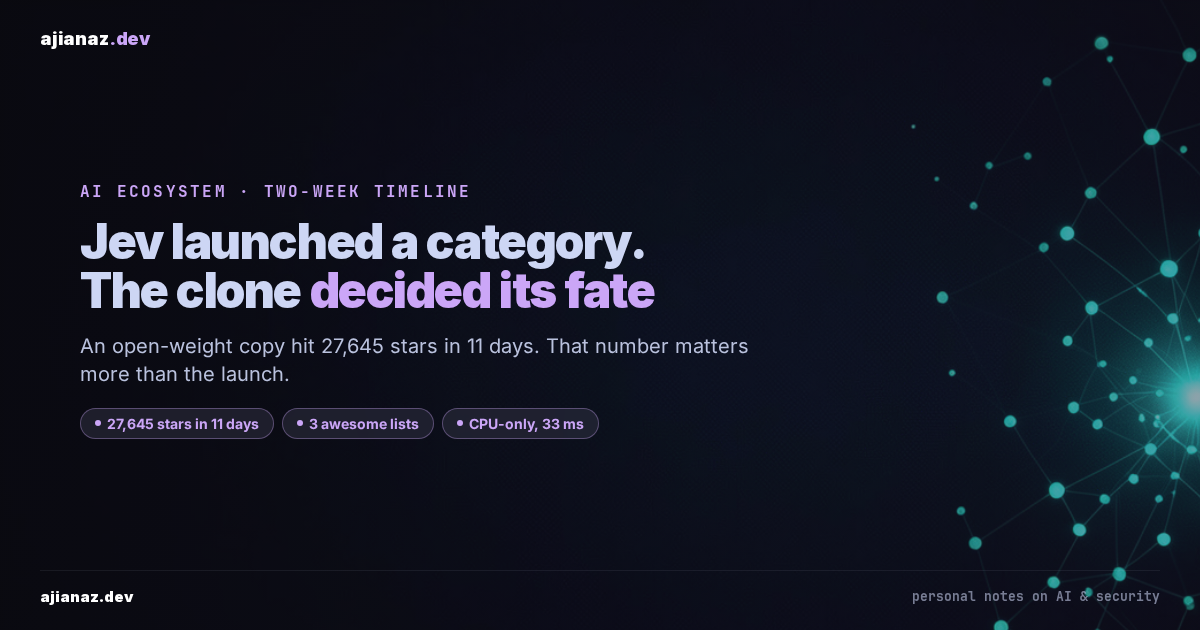
Jev launched September 15. Eleven days later its open source clone had 27,645 GitHub stars. The clone is the story.
On September 15, TypeSafe AI came out of two years of stealth and launched Jev, a model that refuses to write. It answers multiple-choice questions, scores text, and returns yes-or-no probabilities. Nothing else. The launch thread hit the front of Hacker News with 1,985 points and 520 comments, and for about a week my feeds would not shut up about it.
I think the launch was the less interesting half of the story. The clone is where it gets good.
Two weeks that defined a category
The first wave was explanation. OpenRouter published a "what is Jev" primer. Simon Willison wrote about the shape of it, calling the category System One models after TypeSafe's own terminology. Forbes ran a piece on September 22 under the headline that everyone was talking about an AI that does not chat. Victor Dibia went deeper on the calibration side. The term "Jev vs LLM" turned into its own genre.
The sharpest take came from a Hacker News thread on September 22: "OpenAI is well positioned to fast-follow Jev." It collected 328 points and 230 comments, and the argument underneath it was basically unanimous. Every major lab already runs hundreds of internal classifiers. Productizing them into a public API is an engineering quarter, not a research breakthrough.
If Jev were only a hosted API, that thread would be the whole story: a good idea, about to be commoditized by whoever ships it second.
The clone moved faster than the fast-follow
On September 18, three days after the launch, a repository called Laya appeared on GitHub. It describes itself as a non-autoregressive System 1 decision engine, and it is Jev-compatible: same typed questions, choice, score, and yes-or-no, over any text state.
The numbers are the part I keep re-checking because they do not look real. As of September 29, the repo has 27,645 stars and 2,409 forks. It is eleven days old. For calibration, most new model repos spend a year clawing toward five figures. Laya walked there before its first double-digit day count.
The project itself is serious. Apache-2.0 across the code and the published checkpoints, a router that picks the right checkpoint per request, a 322M-parameter multilingual checkpoint covering over 100 languages, and a published benchmark suite against the hosted API. One forward pass per question, 33 ms on a T4, or 7.2 ms per question batched. It was pushed as recently as September 27, so the pace has not slackened.
And Laya did not stay alone for long. There are now three separate awesome-jev lists on GitHub, two of them updated this week. A daily-updated directory called jevusers.com ranks the top 100 projects built on the interface. A group called llm-semantic-router shipped Decision 1.0, six open decision foundation models on Hugging Face, explicitly riding the same wave. Comparison posts titled "Jev vs Laya" are already a subgenre.
What the API standardized
People undersell what Jev standardized. The real contribution is not the model. It is the contract: send me a state and typed questions, and I return choices, scores, and calibrated probabilities in one round trip. That contract is simple enough that a 300M-parameter encoder can serve it from a laptop, and that is exactly what makes it portable.
This has happened before. Whisper was not the first speech recognition model, but its interface became the thing every local STT tool copied, and that copy step is what turned speech transcription from a cloud feature into a thing that runs offline everywhere. "Jev-compatible" is positioning itself as the same kind of de facto interface for decisions. The ecosystem did not wait for a standards body. Three independent awesome lists and a directory site are coordination nobody planned.
What self-hosting opens
Running Laya yourself gets you four things the hosted API cannot give you.
Your data stays inside your own perimeter, which matters for anyone building against EU customers or internal documents. It runs CPU-only, so there is no GPU capex and no queue behind someone else's capacity. The fine-tuning path is open, which is where I expect the specialized wins: a decision model tuned on your own triage history will beat a general one, and you cannot fine-tune a competitor's hosted endpoint. And at volume, flat cost beats per-token pricing. TypeSafe charges $0.042 per million input tokens with 70 to 500 ms latency per call, which is genuinely cheap, but a small container on a VPS you already run is even cheaper at scale.
The honest trade-offs: you give up the vendor's managed performance work, zero ops, and whatever calibration updates they ship. Running it yourself means the running is yours.
What I'm watching
Three things from here. Whether a major lab fast-follows with a hosted decision API of its own, which the HN thread considers inevitable. Whether vertical fine-tunes on top of the RLCD training recipe produce decision models that get weird and specialized in useful ways. And whether the typed-decision interface holds as a cross-vendor standard, or fragments now that there are three competing "compatible" ecosystems.
My money is on the category outliving any single vendor. The launch proved people want decisions, not prose. The clone proved the decisions can run anywhere. That combination, a shared contract and permissively licensed weights, is how a product becomes infrastructure.
The engineering version of this, with production numbers from running one of these services in a container, is on the CodeCora blog.
Comments ()