Google's AI-Powered Zero-Day, TanStack's Supply Chain Breach, and GM's AI Workforce Pivot
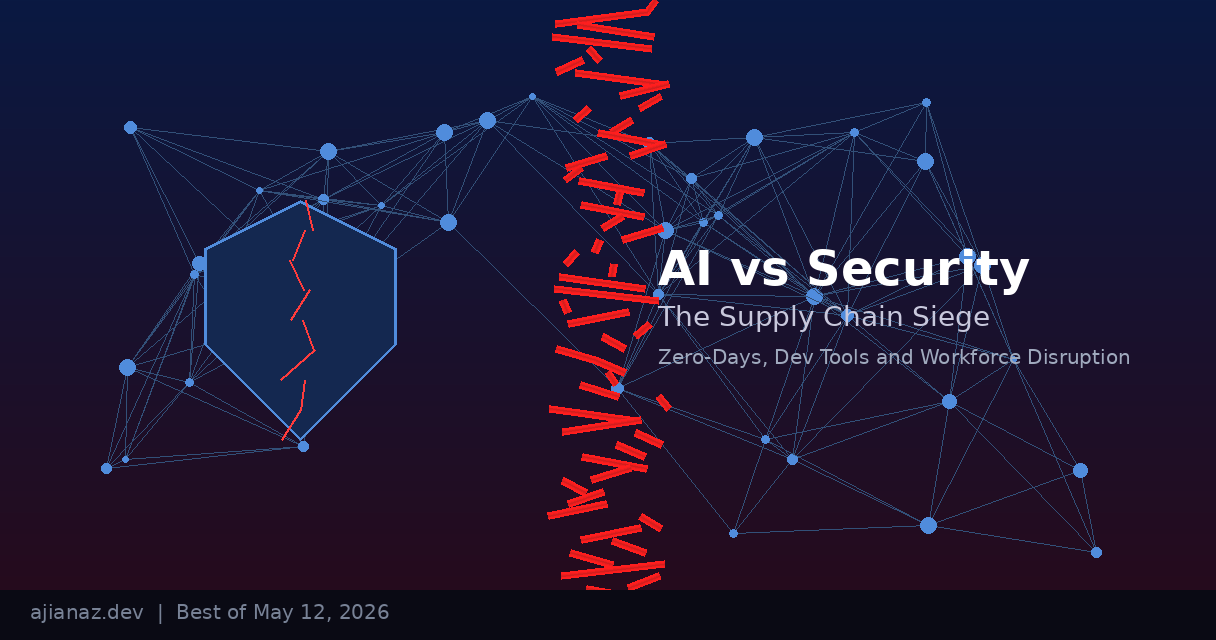
The Day AI Became Both Weapon and Workforce
May 12, 2026 delivered a stark reminder that the AI revolution isn't coming — it's already here, reshaping everything from how attacks are launched to how companies staff their engineering departments. Five stories dominated today's tech landscape, and they share a common thread: the old rules no longer apply.
1. Google Reveals the First AI-Powered Zero-Day Attack
Google's Threat Intelligence Group disclosed what they're calling the first documented case of criminal hackers using AI to discover and exploit a zero-day vulnerability. The target was a widely-used web administration tool, and the attackers used AI-generated fuzzing to find the bug, then automated the exploitation chain — including bypassing two-factor authentication.
What makes this different from previous AI-assisted attacks is the end-to-end automation. We've seen AI used in phishing and social engineering before, but this represents a qualitative leap: AI identifying the vulnerability, crafting the exploit, and executing the attack with minimal human intervention.
For security teams, the implications are sobering. As recent zero-day disclosures have shown, the window between discovery and weaponization is shrinking. AI accelerates that timeline dramatically.
2. TanStack Supply Chain Breach: 42 Packages Compromised
The JavaScript ecosystem suffered one of its most sophisticated supply chain attacks to date. Attackers compromised 42 TanStack-related npm packages by poisoning GitHub Actions caches and extracting OIDC tokens. A total of 84 malicious versions were published before the breach was detected.
The attack vector is particularly concerning because it targeted the CI/CD pipeline itself — not the code. By poisoning the GitHub Actions cache, the attackers injected malicious code that ran with the repository's own permissions, including OIDC tokens used for npm publishing. This means the malicious packages appeared to come from legitimate maintainers, with valid signatures.
This is a wake-up call for any organization relying on CI/CD pipelines with cached dependencies. Supply chain security has been a growing concern, and this incident proves that attackers are targeting the build pipeline with increasing sophistication.
3. GM Fires 600+ IT Workers, Replaces Them With "AI-Native" Talent
General Motors laid off over 600 IT workers in what the company is calling a "skills swap" — not a downsizing. The positions are being replaced with roles focused on AI-native development, data engineering, and prompt engineering. GM claims this isn't about cost-cutting but about aligning their workforce with where the industry is heading.
Whether you believe that framing or not, the signal is clear: traditional IT operations roles are being squeezed. Companies aren't just experimenting with AI tools — they're restructuring entire departments around them. AI agent frameworks and automation tools are maturing fast, and enterprises are moving from pilot programs to full organizational transformation.
The question isn't whether AI will displace IT workers — it's how fast, and whether the "AI-native" replacement roles will actually absorb the displaced workforce or simply represent fewer, more specialized positions.
4. GitLab's Act 2: Eliminating Management Layers for an AI Agent Platform
GitLab announced "Act 2" — a massive restructuring that eliminates three layers of management, splits the company into 60 autonomous teams, and pivots the entire product toward what CEO Sid Sijbrandij calls "the agentic era." The company is also ending its equity program for employees.
The vision is ambitious: GitLab wants to become the platform where AI agents plan, code, test, and deploy software autonomously. The 60 autonomous teams are designed to move fast without management bottlenecks, each responsible for a specific piece of the agentic development pipeline.
But ending the equity program alongside a massive layoff narrative has drawn criticism. GitLab is betting that the AI agent platform gamble will attract enough talent and investor confidence to offset the cultural damage. It's a high-stakes pivot that mirrors the broader tension in tech: move fast toward AI or get left behind, even if the human cost is significant.
5. The CLARITY Act: America's Biggest Crypto Regulation Framework
The U.S. Congress released the CLARITY Act — a 309-page comprehensive crypto regulation bill that addresses stablecoins, DeFi protections, and real-world asset tokenization. It's being called the most significant crypto legislation since the original Securities Act discussions.
Key provisions include a clear regulatory framework for stablecoin issuers, consumer protection requirements for DeFi protocols, and a pathway for tokenizing real-world assets like real estate and commodities. The bill aims to provide the regulatory certainty that the crypto industry has been demanding — while giving regulators the enforcement tools they've been lacking.
Whether the CLARITY Act becomes law remains uncertain, but its introduction signals that crypto regulation is moving from debate to legislative action.
The Bigger Picture
These five stories paint a picture of an industry in rapid transition. AI is simultaneously the biggest threat and the biggest opportunity — powering cyberattacks while reshaping workforces and product strategies. Supply chain security needs a fundamental rethink. Traditional organizational structures are being dismantled. And regulation is finally catching up with crypto.
The common thread? The old playbook is obsolete. Whether you're a developer, a security professional, an IT worker, or a founder, the message is the same: adapt quickly, because the pace of change isn't slowing down.
Comments ()