The AI Agent Framework Wars: Why 2026 Is the Year the Protocol Layer Won
What Exactly Are AI Agent Frameworks?
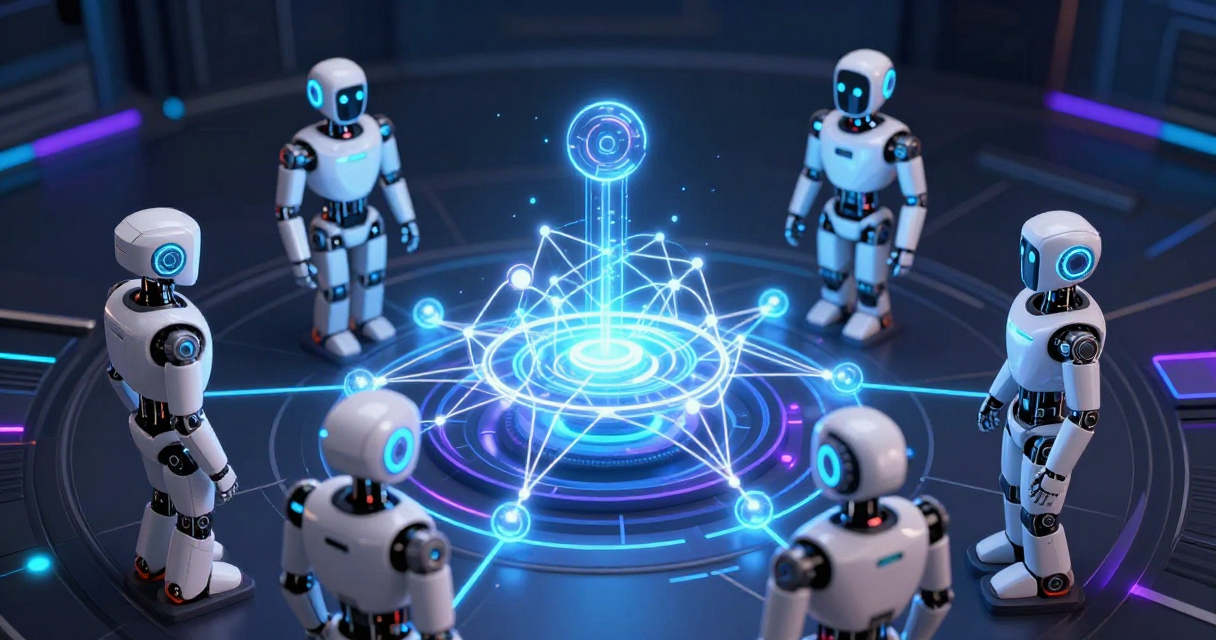
An AI agent framework is a software toolkit that lets developers build systems where large language models don't just answer questions — they take actions. Frameworks like CrewAI, LangGraph, LangChain, and others provide the scaffolding for defining agent roles, connecting them to tools, managing memory and context, and orchestrating multi-step workflows.
In 2024 and early 2025, the landscape was chaotic. Every framework had its own way of defining tools, its own wire format for messages, its own approach to multi-agent coordination. If you built an agent in CrewAI, it couldn't talk to one built in LangGraph. If you connected a tool via one framework's SDK, you had to rebuild the integration for every other framework. The result was a Cambrian explosion of innovation — and a compatibility nightmare for teams building production systems.
Why Do Protocols Matter More Than Frameworks Now?
Protocols solve the interoperability problem by defining how components communicate, regardless of which framework built them. In 2026, three open protocols have emerged as the de facto standards layer for AI agents:
MCP (Model Context Protocol)
Introduced by Anthropic in late 2024, the Model Context Protocol standardizes how AI agents connect to external tools, data sources, and workflows. Think of MCP as the USB-C port for AI — build a tool integration once as an MCP server, and any MCP-compatible client (Claude, ChatGPT, VS Code, Cursor) can use it. MCP handles agent-to-tool communication and has become the universal standard for tool integration.
A2A (Agent2Agent Protocol)
Originally developed by Google and now donated to the Linux Foundation, the A2A Protocol handles agent-to-agent communication. It lets agents built on different frameworks discover each other's capabilities via JSON "Agent Cards," delegate tasks through a defined lifecycle, and coordinate workflows — without sharing internal memory or proprietary logic. A2A launched with 50+ partners including Salesforce, SAP, LangChain, and ServiceNow, and provides official SDKs in Python, JavaScript, Java, C#, and Go. Its five design principles — agentic capabilities, existing standards, security by default, long-running task support, and modality agnosticism — make it enterprise-ready.
ACP (Agent Communication Protocol)
IBM's Agent Communication Protocol (ACP) addressed a similar interoperability challenge from the enterprise side. Critically, ACP's core concepts have since been incorporated into the A2A Protocol, making A2A the single convergence point for agent-to-agent communication. This consolidation is a major reason 2026 feels like the year the protocol layer "won" — the industry isn't fragmenting across three competing standards, it's consolidating.
How Do You Choose the Right Framework in 2026?
With protocols handling interoperability, the framework you choose matters less for lock-in and more for developer experience and operational fit:
- CrewAI: Best for rapid prototyping and teams that want role-based multi-agent orchestration with minimal boilerplate. Now fully independent of LangChain, written from scratch in Python. Ideal for business workflow automation where speed-to-deployment matters.
- LangGraph: Best for teams that need fine-grained control over agent state machines, complex branching logic, and human-in-the-loop patterns. Deep integration with the LangChain ecosystem. Suited for production systems with complex orchestration requirements.
- LangChain: The foundational orchestration layer. Still the broadest integration surface for connecting LLMs to tools and data sources. If you're already in the LangChain ecosystem, LangGraph is the natural upgrade for agentic workflows.
- Google ADK (Agent Development Kit): First-class support for both MCP and A2A out of the box. Best for teams building agents that need to interoperate with Google's ecosystem (Gemini, Agentspace) and external A2A-compatible agents from day one.
The key insight for 2026: your framework choice is no longer a compatibility bet. As long as your framework supports MCP and A2A (and most major ones now do), your agents can interoperate with the broader ecosystem regardless.
What Does Protocol Convergence Look Like in Practice?
The practical architecture for a modern AI agent stack in 2026 follows a clean layered model: build your agents with any framework → equip them with tools via MCP → connect them to other agents via A2A.
This means a CrewAI agent can delegate a research sub-task to a LangGraph agent, which in turn queries a database through an MCP server — all without any custom integration code. The protocols handle discovery, authentication, message formatting, and task lifecycle management. For enterprises, this is transformative: instead of building a monolithic agent platform, you can compose specialized agents from different teams and vendors, connected through standardized protocols. A Salesforce agent coordinates with a custom internal agent, both speaking A2A, both accessing enterprise tools through MCP.
As we covered in our roundup of May 11's biggest AI developments, this composability is rapidly becoming table stakes for serious AI deployments.
What Are the Production Patterns That Actually Work?
Based on the convergence we're seeing, several production patterns have emerged as best practices in 2026:
1. Protocol-first architecture. Design your agent system around MCP for tools and A2A for inter-agent communication from the start. Don't build custom wire formats — adopt the protocols and benefit from the ecosystem of existing servers, clients, and SDKs.
2. Framework-agnostic tooling. Write your tool integrations as MCP servers. This makes them consumable by any MCP-compatible agent, regardless of framework. If you switch from CrewAI to LangGraph next quarter, your tools go with you.
3. Hybrid orchestration. Use lightweight frameworks for simple agent chains and graduate to heavier frameworks (LangGraph, ADK) only when you need complex state management, checkpointing, or human-in-the-loop flows.
4. Security by default. A2A's design preserves agent opacity — agents communicate without exposing internal memory, tools, or proprietary logic. Leverage A2A's built-in authentication and authorization schemes, which have parity with OpenAPI's security model.
5. Mind the infrastructure costs. As we explored in our analysis of the AI power crisis, running multiple agents at production scale requires serious infrastructure investment. Protocol convergence helps by reducing redundant tool integrations, but compute costs still demand careful planning.
So, What Should You Build On Today?
The bottom line for 2026: bet on protocols, not frameworks. The framework you choose should be driven by your team's familiarity, your orchestration complexity, and your ecosystem preferences — not by fear of lock-in.
If you're starting fresh, the safest bet is to pick a framework with first-class MCP and A2A support (Google's ADK and LangGraph both qualify, with CrewAI rapidly closing the gap). Build your tools as MCP servers. Design inter-agent communication around A2A's task lifecycle model. And keep your framework migration cost near zero by staying protocol-compliant.
The AI agent framework wars aren't over — frameworks will continue to differentiate on developer experience, performance, and enterprise features. But the protocol layer has won. In 2026, the question isn't "which framework should I use?" It's "how quickly can I get my agents speaking the same language?" And for the first time, there's a clear, standards-based answer.
Comments ()