Google's Agent Gambit and Anthropic's Enterprise Surge: The AI Power Shift Nobody Predicted
How Did We Get Here?
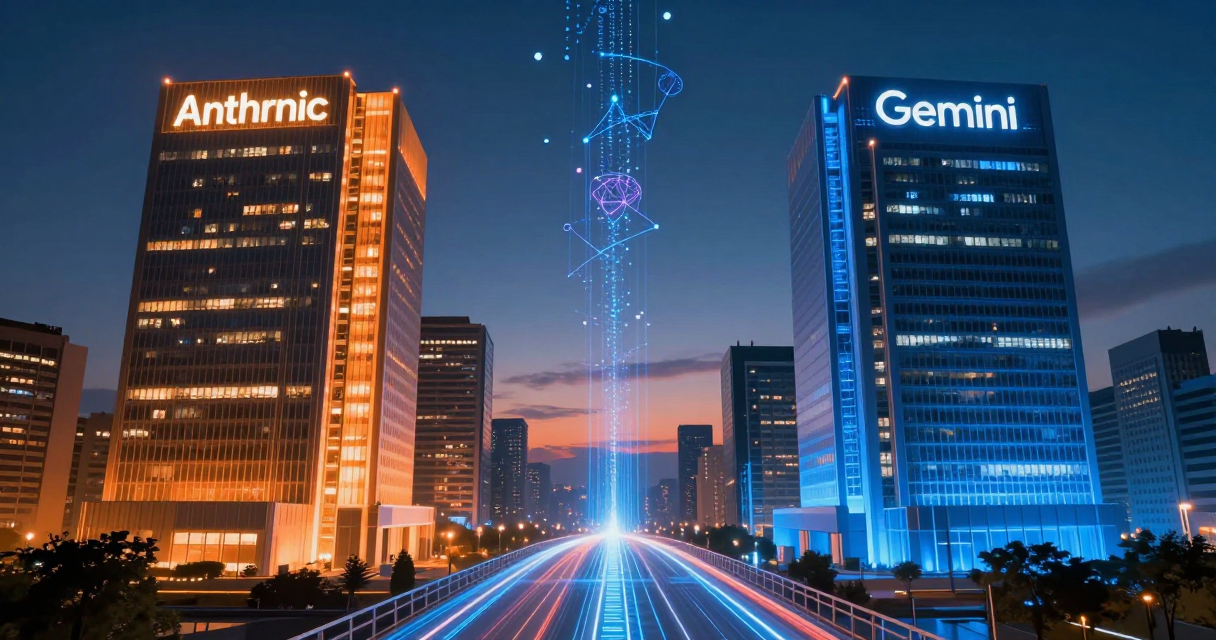
For most of the past three years, the AI industry narrative has been surprisingly stable. OpenAI built the consumer frontier with ChatGPT, Google played catch-up with Gemini, and Anthropic positioned itself as the "safety-first" alternative that enterprises could trust. The story was supposed to be about who built the smartest model. Instead, it has become about who built the most useful AI infrastructure — and two very different companies just staked their claims in the same week.
On May 19 and 20, Google used its I/O developer conference to declare that 2026 is the year of agents — not chatbots, not copilots, but autonomous software that plans, executes, and verifies its own work. Meanwhile, Anthropic, which has been quietly converting frontier model capability into enterprise contracts at a pace that stunned even industry insiders, clinched the number one spot on CNBC's 2026 Disruptor 50 list with financial numbers that redefine what "scale" means in AI.
These two events, happening days apart, tell a larger story about the AI industry's pivot from model benchmarks to real-world deployment. Here's what actually happened, and why it matters.
What Did Google Actually Announce at I/O 2026?
Sundar Pichai opened Google I/O 2026 with a declaration that set the tone for the entire event: the industry is transitioning from AI that assists to AI that acts. Every major announcement at the two-day conference in Mountain View bent back to that thesis.
The headline releases were substantial. Gemini 3.5 Flash — the first model in Google's new Gemini 3.5 series — went generally available on May 19. Despite being a "Flash" tier model, it outperforms Google's previous flagship, Gemini 3.1 Pro, on coding and agentic benchmarks: Terminal-Bench 2.1 at 76.2%, GDPval-AA at 1656 Elo, and MCP Atlas at 83.6%. It runs approximately four times faster than competing frontier models in output tokens per second, clocking around 289 tokens per second according to Artificial Analysis data, while costing what Google describes as "less than half" of competing models.
The strategic importance of Gemini 3.5 Flash cannot be overstated. It is not merely a new model — it is the substrate for everything else Google announced. AI Mode in Search runs on it. Antigravity's parallel subagents run on it. The Gemini app's personal agent runs on it. The calculus is straightforward: agentic products only become economically viable when the underlying model is both capable and cheap to invoke thousands of times per workflow. Google's answer is to make a frontier-tier model that operates at Flash-tier economics.
Antigravity 2.0 represents Google's bet on agent-first development. Originally launched in November 2025 on Gemini 3 Pro, the platform has evolved into a full-fledged desktop application and command-line interface. Developers can now spin up specialized subagents within VS Code that autonomously plan, execute, and verify work across the editor, terminal, and browser. The platform includes built-in cross-platform terminal sandboxing, credential masking, and hardened Git policies — addressing the security concerns that have kept enterprises cautious about autonomous coding agents.
Google also introduced Gemini Omni, a generative model that starts with video but is designed to handle any input-output combination. It combines Gemini's intelligence with an intuitive understanding of physics — gravity, kinetic energy, fluid dynamics — for more realistic content generation. Videos created with Omni include Google's imperceptible SynthID digital watermark, a move toward content provenance that will become increasingly important as generated media floods the internet.
Why Are Enterprises Flocking to Anthropic?
While Google was making infrastructure announcements, Anthropic was quietly posting numbers that reshape the competitive landscape. According to Ramp Economics Lab's AI Index, Anthropic passed OpenAI in business adoption for the first time in April 2026 — 34.4% of businesses now use Anthropic compared to 32.3% for OpenAI. Over the previous year, Anthropic quadrupled its business adoption while OpenAI grew by just 0.3 percentage points.
The revenue numbers are even more striking. CEO Dario Amodei disclosed in early May that Anthropic's Q1 2026 revenue hit $4.8 billion — representing 80 times year-over-year growth. To put that in perspective: Anthropic's estimated total 2025 revenue was roughly $4 to $5 billion for the entire year. The company now generates that in a single quarter. The annualized run rate has surpassed $30 billion, and the company is reportedly on track for $10.9 billion in Q2 2026.
Claude Code, Anthropic's autonomous coding agent, reached $1 billion in annualized recurring revenue within six months of launch — making it one of the fastest developer tools ever to hit that milestone. Over 1,000 enterprise clients now pay Anthropic more than $1 million annually, a figure that more than doubled in recent months. Anthropic reported its first operating profit in Q2, a milestone that moves the company from "high-growth startup" to "large-scale commercial operation."
The strategic logic is clear in hindsight. While OpenAI iterated across consumer products, agentic experiments, and a sprawling product portfolio, Anthropic built its commercial motion around a focused thesis: large organizations need AI they can trust, control, and deploy at scale. President and co-founder Daniela Amodei articulated this plainly in her Disruptor 50 interview: "From day one, we launched our first product just about three years ago, and really out of the gate we said, 'we're prioritizing building for businesses.'" The customer list reflects that focus — Goldman Sachs, Blackstone, KPMG, PwC, SAP, and EY are all Anthropic clients.
What Does the Agent Shift Actually Mean for Developers?
The convergence of Google's infrastructure play and Anthropic's enterprise traction reveals a broader truth: the AI industry is no longer competing on benchmark scores. It is competing on deployment architecture.
Google's Antigravity 2.0 introduces the concept of managed agents — a single API call provisions a fully sandboxed agent with remote execution capabilities, removing the infrastructure friction that has kept most organizations from running autonomous agents in production. Google AI Studio now supports native Kotlin for building Android applications, with one-click deploy to Cloud Run and Firebase service integration. The Antigravity SDK gives developers programmatic control over the agent harness, enabling custom deployments on private infrastructure.
Anthropic, meanwhile, has built its developer ecosystem around Claude Code's integration into enterprise workflows. The Glasswing cybersecurity program allows AI systems to operate in production environments that previously would not have permitted any AI near critical codebases. The MCP (Model Context Protocol) specification, which Anthropic open-sourced, has become a de facto standard for connecting AI models to external tools and data sources — Antigravity's MCP Atlas benchmark scores prove that interoperability is now a competitive dimension.
For developers, the practical implication is that building AI-powered applications has shifted from "prompt engineering" to "agent orchestration." The question is no longer "which model is smartest?" but "which platform lets me deploy autonomous workflows safely, affordably, and at scale?" Google's answer is infrastructure — cheap models, managed services, and comprehensive tooling. Anthropic's answer is trust — enterprise-grade safety guarantees, compliance features, and a track record of responsible deployment.
What Are the Risks in This New Landscape?
Neither company's position is unassailable. Anthropic faces a critical tension: its revenue model incentivizes driving customers toward more expensive models, even when cheaper alternatives suffice. Uber's CTO publicly disclosed that the company already blew through its 2026 AI budget, a cautionary tale about cost management that could push enterprises toward cheaper alternatives — potentially Google's Gemini 3.5 Flash. Anthropic's enterprise concentration is also a risk: with revenue increasingly dependent on large contracts, the loss of two or three anchor clients could create significant volatility.
Google's challenge is execution. The company's enormous distribution advantages — Search, Android, Chrome, Cloud — give it unparalleled reach, but its track record on developer tools is mixed. Google has a habit of launching ambitious developer platforms (Firebase, Angular, Flutter, Google Cloud Functions) and struggling to maintain them. Antigravity 2.0 will need consistent investment over multiple years to earn the kind of developer trust that Anthropic has built. The company's sprawling empire also means competing priorities — the same Gemini models that power Antigravity must also serve Search, YouTube, Android, and Workspace.
The broader market risk is valuation pressure. Anthropic is reportedly raising $30 billion at a $900 billion-plus valuation, which would formally eclipse OpenAI's $852 billion post-money figure from March 2026. These numbers set expectations that will be difficult to sustain. If growth slows — and at this scale, it eventually will — the repricing could be brutal for the entire AI funding ecosystem.
What Happens Next?
The most likely outcome is not a winner-take-all scenario but a bifurcation of the market. Google's infrastructure play positions it as the default platform for building AI-powered applications at scale — the AWS of the agentic era. Anthropic's enterprise focus makes it the default choice for organizations that need AI they can trust in regulated, high-stakes environments — the Salesforce of frontier AI.
OpenAI remains a wild card. The company still holds significant advantages in consumer mindshare and research output, but its commercial position is under pressure from both sides. Google's cheaper models eat at OpenAI's pricing power, while Anthropic's enterprise credibility undercuts its value proposition to business customers.
The real winners in this shifting landscape may be developers and enterprises themselves. Competition between Google and Anthropic — and the continuing pressure from OpenAI — is driving down costs, improving safety guarantees, and accelerating the transition from experimental AI to production-grade autonomous systems. The models are no longer the bottleneck. The infrastructure for deploying them responsibly is where the real battle is being fought, and for the first time, there are multiple credible contenders.
Sources:
- Google I/O 2026: A Complete Guide to Gemini 3.5, Antigravity 2.0 — tosea.ai
- All the news from the Google I/O 2026 Developer keynote — Google Developers Blog
- 100 things we announced at I/O 2026 — The Keyword
- Anthropic beats OpenAI on business adoption — Ramp Economics Lab
- Anthropic Dethroned OpenAI on CNBC's Disruptor 50 — ChatForest
- Anthropic hits $30B run rate, leads CNBC Disruptor 50 — AI Weekly


Comments ()