AI Agents Wrote Faster Quantum Algorithms. Lean Proved Every One.
DeepMind's Gemini 4 agent teams cut quantum algorithm costs by up to 290x, and Lean proved every result before it counted. The full library is open on GitHub.
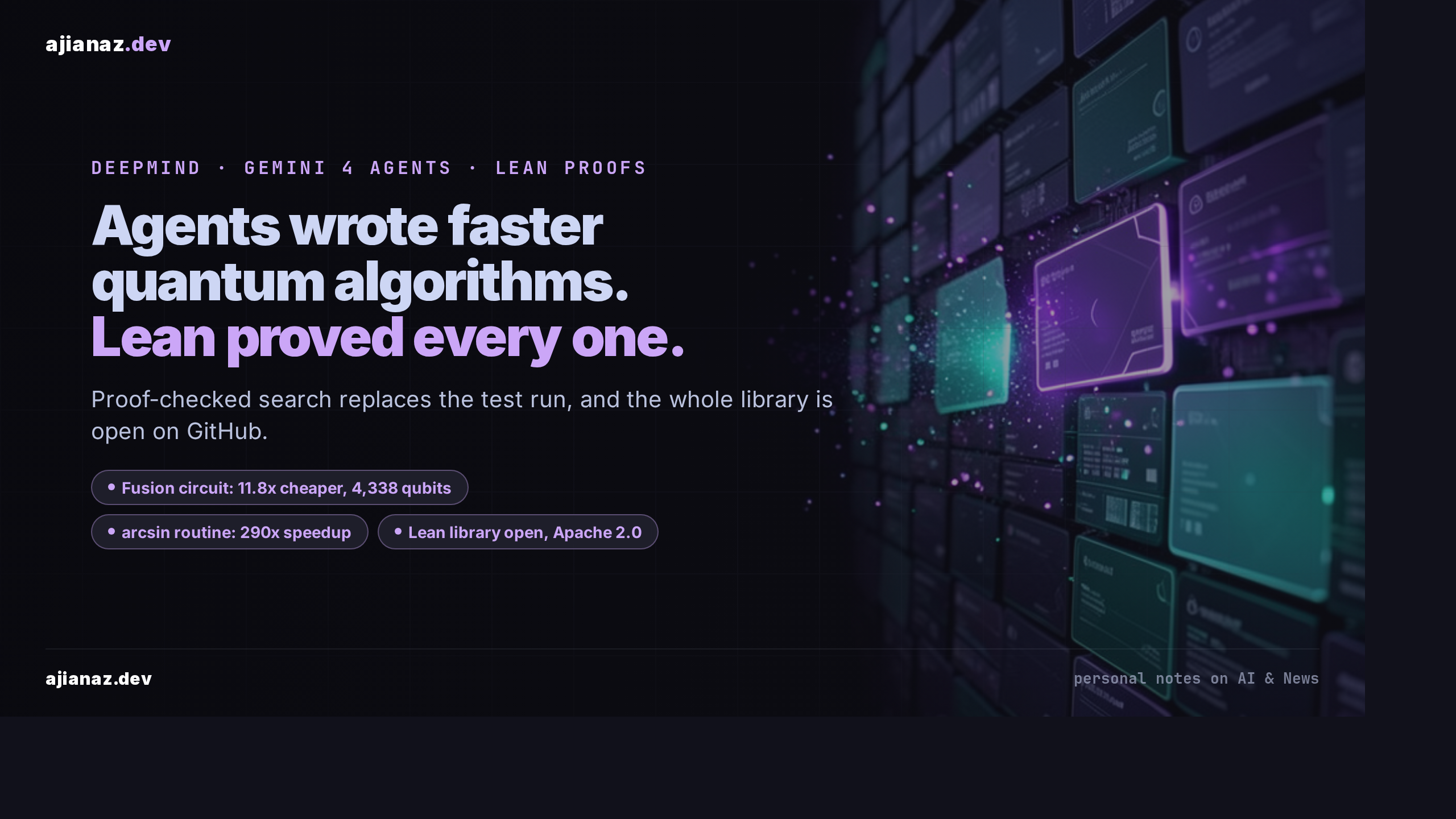
Google DeepMind posted on November 23 that teams of Gemini 4 agents found measurable improvements to quantum algorithms, and that every result was proven correct in the Lean theorem prover before it counted. The announcement goes with a paper first uploaded to arXiv on November 6. The numbers: an 11.8x cut in computing cost for an inertial confinement fusion circuit, 8x for simulating a light-sensitive molecule, 2.5x for Cytochrome P450, the enzyme that breaks down most medicines, 2.57x on one implementation of Grover's search, and 290x on the arcsin routine that other quantum algorithms use to load numbers.
The method matters more than the leaderboard. Discovery loops like AlphaEvolve work by generating candidate solutions and testing them against a real evaluation. Quantum algorithms break that loop. You cannot run a resource-heavy circuit on today's small processors, and simulating it classically is itself intractable, which is why work in this field used to take expert teams years. The DeepMind setup replaces the test run with a proof: agents write candidate programs against formal problem specifications, and a result only enters the shared notebook after Lean certifies both correctness and cost. Memory shrank along with the speedups, from 5,650 to 4,338 error-corrected qubits on fusion, and from 481 to 333 on the enzyme.
The organization is worth copying too. Separate agent teams worked independently, kept wikis, and met at a scheduled conference every four hours to trade and debate ideas. Humans set the direction by writing the problem specifications instead of the algorithms, then supervised progress. The blog's own line on the payoff: proof-checked AI search compresses work that once took years of manual design.
Everything is open. The Lean library is on GitHub under Apache 2.0 with the problem specifications and benchmark challenges in a second module, the discovered programs live on the repo's discoveries branch, and the repo shows commits as recent as November 17. The limits are stated plainly in both documents: these algorithms would still demand more resources than the first error-corrected quantum computers will provide. This is a head start on the algorithmic timeline, not a demo anyone can run today.
The delta from AlphaEvolve is specific. That system searched classical algorithms, where an evaluation function is usually available. This work extends agent-driven discovery to a field where evaluation is impossible at scale, and it adds a correctness gate that runs without hardware. That combination is the reusable part. Wherever real-world testing is too expensive or too slow, proof-checked search is now a demonstrated option, in Lean or any proof assistant with a large enough library.
For anyone weighing "AI accelerates research" claims, the bar just got concrete. Ask what the output carries with it. Benchmark numbers a vendor controls are weak evidence. Machine-checkable proofs, with the specifications and the verifying library public, are strong ones. DeepMind shipped the second kind and made it easy to check.
Sources: DeepMind blog, arXiv 2611.09822, formal-quantum-computation on GitHub, the discoveries branch README, and AlphaEvolve.
Comments ()