Anthropic's $300M Stainless Grab: How the AI Infrastructure War Just Entered a New Phase
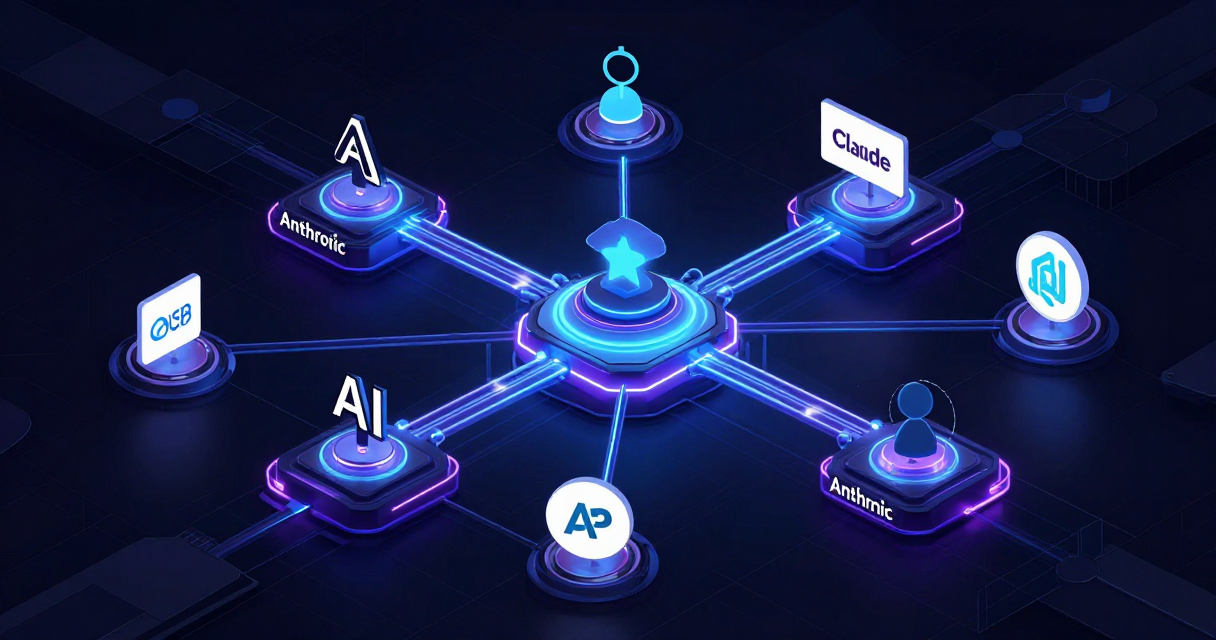
When Anthropic announced it was acquiring Stainless for more than $300 million, the immediate reaction was straightforward: another AI lab buying a developer tools company. But the details that followed revealed something far more consequential. Anthropic wasn't just adding a new capability to its platform. It was systematically removing a critical piece of shared infrastructure from every single one of its competitors — including OpenAI, Google, Cloudflare, and Meta.
Stainless, founded in 2022 by former Stripe engineer Alex Rattray, built the automated SDK generation platform that powers the official developer libraries for the AI industry's biggest players. Every Anthropic SDK since the company's earliest API days was generated by Stainless. So were OpenAI's Python, Node.js, Java, Go, and Ruby clients. So were Google's. Cloudflare's. Replicate's. Runway's. Hundreds of companies depended on Stainless to turn their API specifications into production-ready SDKs across TypeScript, Python, Go, Java, Kotlin, and more — automatically updating them as APIs evolved.
Anthropic's decision to shut down all hosted Stainless products by September 1, 2026, means those companies now have roughly four months to either build their own SDK infrastructure or find alternatives. This isn't a passive acquisition. It's infrastructure denial as a competitive strategy, and it signals a fundamental shift in how the AI wars are being fought.
Why SDK Infrastructure Became the New Battleground
The AI industry's competitive focus is migrating down the stack. For the past two years, the primary battleground was model performance — who had the smartest, fastest, most capable frontier model. Anthropic's Claude, OpenAI's GPT series, Google's Gemini, and Meta's Llama competed on benchmarks, reasoning capabilities, and multimodal understanding. But a clear consensus has emerged: frontier models are commoditizing. The gap between the top models is shrinking. Anthropic itself acknowledged this reality in its announcement of the Stainless acquisition, framing the move around a broader thesis that "the frontier of AI is shifting from models that answer to agents that act."
When the product is an agent rather than a chatbot, the equation changes entirely. An AI agent is only as capable as the systems it can reach. Its value is determined not by how smart it is in isolation, but by how effectively it can connect to databases, APIs, internal tools, enterprise software, and external services. The SDK layer — the code library that a developer installs to interact with an API — becomes the critical junction point. If your agent can't cleanly connect to a service, the quality of the underlying model is irrelevant.
This is why Stainless mattered so much. It didn't just generate SDKs — it generated good SDKs. The kind that feel native in each programming language, that handle edge cases properly, that stay up-to-date as APIs change. As one analyst put it: "SDKs are sticky. Whoever ships the cleanest one wins the long tail of developer mindshare."
The Acquisition Playbook: Open Standard, Closed Toolchain
Anthropic's strategy with Stainless mirrors a playbook that has worked before in technology. Jan Schmitz, who runs AI analytics company BrightBean, described the pattern succinctly: "Control the standard by giving it away, then control the implementation by owning the toolchain."
The comparison is to Google's approach with Kubernetes. Google open-sourced the container orchestration standard, contributed it to the Cloud Native Computing Foundation, and then made Google Kubernetes Engine the dominant managed implementation. Anthropic proposed the Model Context Protocol (MCP) in late 2024 as an open standard for connecting AI agents to external systems. It has since been contributed to the Linux Foundation and adopted by OpenAI, Google, Microsoft, and AWS. MCP defines the universal language for agent connectivity.
Stainless sits directly on top of MCP. It generates the SDKs, CLIs, and MCP servers that implement that connectivity. By acquiring Stainless, Anthropic now controls the primary toolchain for building the connectors that make MCP work in practice. The standard is open. The tooling to build against it is Anthropic's.
The contrast with OpenAI's approach to acquisitions is instructive. When OpenAI acquired Astral in March 2026 — the company behind Python developer tools uv, Ruff, and ty — it explicitly committed to keeping Astral's tools open source. OpenAI's calculus was different: Astral's tools make the Python ecosystem better for everyone, including OpenAI. There was no strategic value in restricting access.
Anthropic's calculus with Stainless is the opposite. The value of Stainless is precisely that it was a shared dependency. Removing it from competitors forces them to either invest heavily in rebuilding equivalent tooling or accept a disadvantage in SDK quality. Anthropic wasn't buying a product. It was buying a head start.
Inside Anthropic's $30 Billion Revenue Machine
The context for this aggressive infrastructure play is Anthropic's explosive growth. The company told investors it generated $4.8 billion in Q1 2026 revenue and expects to reach $10.9 billion in Q2 2026 — a 130% quarter-over-quarter increase. CEO Dario Amodei has described the company as achieving an 80x annualized growth rate, pushing Anthropic to a $30 billion revenue run rate. The company raised a $30 billion Series G round in February at a $380 billion post-money valuation.
At that scale, the Stainless acquisition for $300 million is a rounding error financially. But strategically, it's one of the most significant moves in the AI platform wars. Anthropic is no longer a research lab trying to build the best model. It's a platform company assembling a vertically integrated stack: model layer (Claude), runtime layer (Bun, acquired in December 2025), computer-use layer (Vercept, acquired in February 2026), and now SDK/tooling layer (Stainless). Each acquisition targets software that orchestrates how models receive input, produce output, and connect to external tools.
What This Means for the Rest of the AI Industry
For Anthropic's competitors, the Stainless shutdown creates a concrete deadline. OpenAI, which initially built its SDK tooling in-house before moving to Stainless as API complexity grew, must now either reverse that decision or find a new automated solution. Google, Cloudflare, Replicate, and Runway face the same challenge. All of them have until September 1, 2026, when Stainless's hosted platform goes dark.
Existing customers retain full ownership and modification rights to SDKs already generated by Stainless. The existing libraries will continue to work. But the engine that created them — and that would have maintained them going forward — is now Anthropic's property. This is the crux of the disruption: not that current integrations break, but that the path forward becomes uneven. Anthropic's SDKs will continue to improve automatically. Everyone else's will require manual investment.
The broader lesson is about where competitive advantage actually lives in the AI era. For years, the assumption was that the company with the best model would win. The Stainless acquisition challenges that assumption. Anthropic is betting that the moat isn't in the model — it's in the infrastructure layer that connects models to the real world.
Will the Moat Hold?
The honest answer is that it's too early to tell. SDK generation is ultimately a solvable engineering problem. OpenAI, Google, and Cloudflare all have the resources to build equivalent tooling. The acquisition creates urgency and buys Anthropic time, but it doesn't create a permanent lock-in. What matters is whether Anthropic can translate this head start into a sufficiently superior developer experience that switching costs become prohibitive.
There's also the question of whether Anthropic's approach creates backlash. Shutting down a shared dependency that hundreds of companies rely on is an aggressive move. If the developer community perceives Anthropic as weaponizing infrastructure, it could accelerate efforts to build open alternatives outside of Anthropic's control.
For now, though, the move is undeniable in its strategic clarity. Anthropic identified a piece of shared infrastructure that gave it no particular advantage, acquired it, and redirected it entirely toward its own platform. Whether this becomes a durable competitive moat or just a temporary speed bump, one thing is clear: the AI industry's infrastructure war has escalated, and the battle lines are no longer being drawn around model performance. They're being drawn around who controls the plumbing.
Sources:
Comments ()