The Framework Wars Are Over: And Nobody Won
Eight frameworks compete for developer mindshare, but the real battle isn't about frameworks at all. It's about memory.
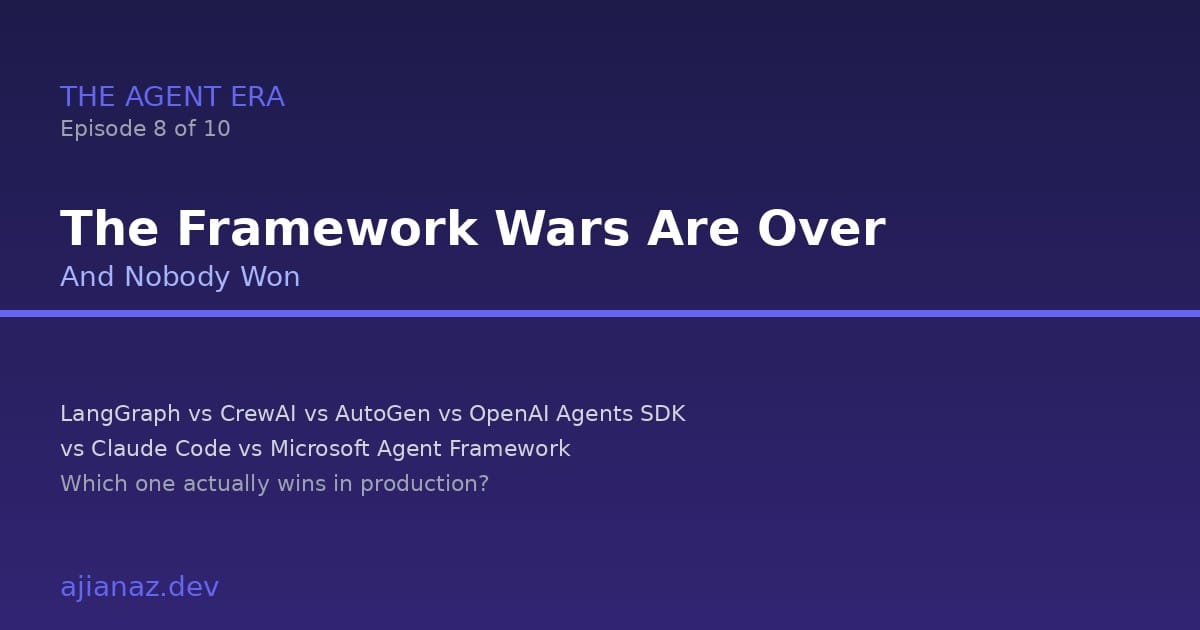
The Agent Era — Series
Episode 8 of 10
The Landscape in 2026
By mid-2026, the AI agent framework space has exploded into a dizzying constellation of options. At least eight serious frameworks compete for developer mindshare, each promising to be the foundation for production-grade autonomous systems. Yet a clear winner has failed to emerge — and the data suggests that's not an accident.
Tier 1: The Production Contenders
LangGraph
The closest thing to an industry standard. LangGraph offers stateful, graph-based workflows that map naturally to complex agent behaviors. Its checkpointing system and native support for human-in-the-loop patterns have made it the default for enterprises moving beyond prototypes.
Users: Uber, LinkedIn, Klarna. Weakness: 50+ lines of boilerplate for simple agents, and proprietary licensing has alienated parts of the open-source community.
CrewAI
The darling of hackathons and rapid prototyping. CrewAI's role-based agent paradigm — defining agents as "Researcher," "Writer," "Analyst" — makes it the fastest path from idea to working demo. IBM and NVIDIA have experimented with it internally.
The catch: no TypeScript support, limited persistence, and a growing pattern of teams prototyping in CrewAI, then migrating to LangGraph for production.
Microsoft Agent Framework
Microsoft merged AutoGen and Semantic Kernel into a unified framework. Azure-native integration is its killer feature for enterprise shops. Limited to Python and .NET — a non-starter for the JavaScript-heavy startup world.
OpenAI Agents SDK
Reaching GA in March 2025, it attracted over 1 million developers in its first month. Simplest entry point for building with GPT models, but deliberately opinionated toward OpenAI's ecosystem.
Claude Code
Anthropic's coding agent achieved 80.9% on SWE-bench — the highest score of any system. Over 90% of Anthropic's own code is AI-assisted. Less a framework and more a proving ground for what agents can accomplish.
The Coding Agent Proving Ground
- 42% of new code is now AI-assisted (Sonar 2026).
- 85% of developers use AI tools daily.
- Cursor: $500M ARR, 360,000 paying users.
- GitHub Copilot users report being 55% faster.
The Migration Pattern
A clear pattern has emerged: teams prototype in CrewAI, then migrate to LangGraph for production. But here's the insight most comparison posts miss:
"Your framework choice is not the primary variable in whether your agent system succeeds. Memory is the dimension most comparison posts skip, and it is often what breaks agents in production."
Framework wars generate clicks. Memory systems determine outcomes. The frameworks are good enough. All of them. But there are three breakthroughs still missing — and they determine the future.
Comments ()