DevDay 2026: which OpenAI launches actually need a paid plan
Dots launched on Pro and Business Premium, plan usage works for Plus and Pro, and the developer surfaces opened at every tier. The split is the roadmap, stated in pricing instead of words.
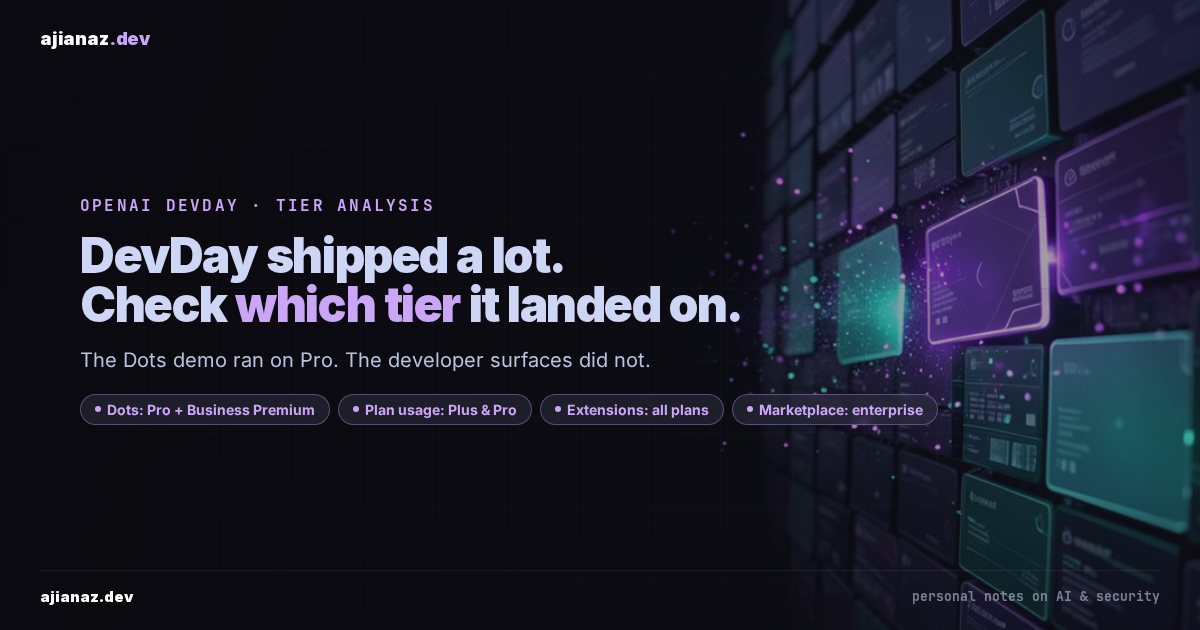
OpenAI gave its always-on agent, Dots, a keynote slot at DevDay, then listed the availability in one quiet line: Pro and Business Premium in eligible markets. Enterprise, Edu, and Healthcare users can try a beta when a workspace admin turns it on. Everyone else reads about it. That gap between the demo and the checkout page is the interesting part of this launch, because the same keynote shipped the plumbing that decides who gets to build on top of an agent: Sign in with ChatGPT now carries plan usage into third-party apps, and plugin extensions put developer interfaces inside the ChatGPT sidebar.
Dots landed on the $100-a-month Pro plan. Muse, the free agent it keeps getting compared to, costs nothing and ships with a free virtual machine. So when a feature lands behind a paid plan first, that is a statement about who the company thinks the builders are. Which of these launches can a developer without a Pro subscription reach?
Dots first: Pro and Business Premium
OpenAI's own recap gives a premium launch to an always-on agent. Dots keeps context, works in the background, and gets a name and an avatar, which is product language for something that sits closer to you than a chat window does. The Verge's writeup lists the tier gating plainly: Pro, Business Premium, and Enterprise subscribers get it at launch. The new Pro 500 plan sits above them: the highest usage allowance at 25 times Plus, with Ultrafast access included.
The bundling tells you where OpenAI thinks the margin is. ChatGPT passed 1.2 billion weekly users this quarter, which makes the free tier an acquisition channel, not a product. Margin lives in the subscription, and the subscription now includes an agent. OpenAI CFO Sarah Friar told CNBC the vision is to bring Dots to the whole consumer base, but there is no committed date for Plus.
Sign in with ChatGPT now moves plan usage
Identity sign-in is available globally. What launched at DevDay is the second half: eligible apps can draw on a subscriber's plan allowance. Sixteen partners are live, including Cognition's Devin, Notion, Vercel, T3, OpenClaw, and Dactyl. The docs are specific about the mechanics. Usage drawn through a partner counts against the subscriber's existing plan limits, the app can charge its own fees on top, and the user sets a weekly percentage cap per app in ChatGPT settings.
The tier detail matters for developers. Plan usage works for Plus and Pro subscribers in participating tools. So the app you build can serve a paying subscriber's requests through their existing plan, but only if that subscriber is on Plus or above. A developer building on this feature is building on top of someone's subscription, and the eligibility rules decide how large that base is.
There is a second constraint inside the docs. Using your plan through an app does not hand the app your conversation history or memories. Sharing usage and sharing identity are separate permissions, and the cap is a cap, not a reserved allocation. For any developer who has watched an API integration grow into an infrastructure dependency, that separation is the line between a login button and a platform commitment.
Plugin extensions and the marketplace question
Plugin extensions opened the surfaces OpenAI uses for its own features: sidebar apps, conversation panels, file viewers, composer mentions in the desktop app. Canva and Figma shipped extensions at launch. This is the real developer surface, and it is open to every plan, including free accounts.
Then comes the marketplace. The OpenAI Marketplace is for enterprise procurement, with 32 partners at launch and a mechanism for enterprises to apply committed spend toward approved software. A solo developer reading the keynote might hear "marketplace" and picture an app store payout. What launched is a procurement channel for companies that already buy from OpenAI at scale.
That is the shape of the whole keynote. OpenAI's own recap counts more than 20 major announcements. Sort them by tier and the takeaway is blunt: the platform moves point enterprise-first, with individual developers getting SDK updates and the enterprise getting procurement rails. Both things shipped on the same day, and only one of them is a distribution channel you can join as an independent.
What a free-tier developer gets
It is a real list. Plugin extensions, MCP events for automation triggers, the Codex CLI update, code review in the desktop app, and Sign in with ChatGPT identity, which OpenAI says is available globally. GPT-6.1 Sol reached every plan on the same day it launched, and its system card addendum discloses a number worth knowing if you build agents on it: when a search tool breaks, Sol fails to tell the user and guesses anyway in 2.1 percent of test cases, against 4.9 percent for GPT-6 Sol and 28.7 percent for Luna.
What sits behind the paid wall is the agent itself, its speed tier, and the parts of the stack that touch procurement. If your product's next feature assumes your users have a Dot, assume your users are on a Pro-tier budget. If it assumes your users can plug into ChatGPT as a surface, that door is open at every tier today.
Simon Willison liveblogged the keynote from the room and caught the demo failures in the morning stream. The afternoon panel closed with OpenAI executives predicting that manual development of code will stop existing, a claim aimed at exactly the audience segment that got the smallest slice of the launch. Watch what ships to which tier over the next quarter. The split between what is free and what is Pro is the roadmap, stated in pricing instead of words.
Where this gets practical for small teams: the parts of the stack that cost nothing to build on are the ones where OpenAI wants reach, and the parts that sit behind Pro are the ones where OpenAI wants revenue per user. Building on the free surfaces costs nothing today and risks little. Building on plan-usage flows ties your unit economics to someone else's subscription tier, and the eligibility table can change without your product changing. The builders who got burned by platform shifts before will recognize the shape: the free tier is a beachhead, not a contract.
This piece stays close to the subscriber-side split. The inference-cost side of the same keynote, what near-Astra output at a fifth of the price does to agent budgets, is a separate analysis: self-hosting a Jev-compatible decision API on a plain CPU covers the local route when per-token pricing still feels expensive.


Comments ()