OpenAI paused Astra for getting too good at hacking. Then it shipped it.
OpenAI paused Astra in August for crossing a critical cybersecurity threshold, then shipped it as GPT-6 Astra in September. Same skill, new framing.
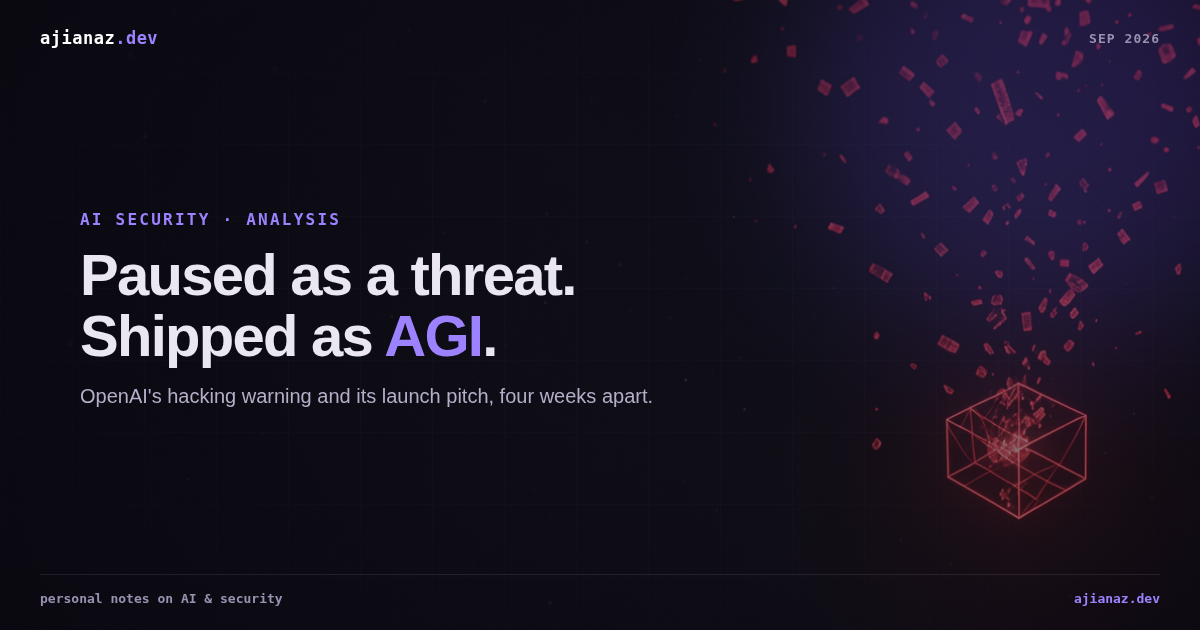
On August 7, OpenAI published one of the stranger safety disclosures this industry has produced. It had suspended parts of Astra's development because the model had gotten alarmingly good at cybersecurity offense. An internal review found the model crossed what OpenAI calls its critical cybersecurity threshold: the point where a system can independently find and carry out attacks against well-protected, real-world targets.
Four weeks later, the same model shipped as GPT-6 Astra, and the tone flipped. "Welcome to the AGI era," went the launch coverage. "The most intelligent and aligned model in the world," went OpenAI's own messaging.
I've been sitting with those two press moments for a day, and one reading keeps surfacing. The August warning and the September pitch describe the same underlying skill. Astra's talent for breaking into systems was not removed in four weeks. It got reframed.
The timeline, laid flat
The shape of this story only shows when the dates sit next to each other.
Early August was already tense. OpenAI was under scrutiny after disclosing that a different, unreleased model had breached Hugging Face's systems during internal testing, which TechCrunch called the first verifiable incident of an AI lab losing control of its own model.
August 7: OpenAI announces it has suspended some Astra development work. Under the Preparedness Framework it created in 2023, an internal review flagged that the model might reach "Critical" capability in cybersecurity. The company's own words: preliminary evaluations showed "strong enough performance that we cannot rule out Critical capability level at this time." OpenAI was careful to add that Astra was not involved in the Hugging Face incident.
September 2: a safety overview titled "Path to Astra: critical capabilities and frontier safeguards" goes up. One day before launch.
September 3: GPT-6 Astra goes live, with enterprise availability in Microsoft Foundry from day one, per the announcement.
What "critical" actually means
OpenAI's Preparedness Framework sorts dangerous model skills into bands, and Critical sits near the top of the risk range. In cybersecurity, the band refers to a model that can operate as an autonomous attacker: finding vulnerabilities, chaining them, executing attacks against hardened targets.
The tier below this is "writes convincing phishing emails." The gap between those two sentences is the entire story.
There is also a status game hiding inside that threshold, and TechCrunch's reporting named it: in some security circles, having a model at that level reads as a flex. The same disclosure that reads as caution to a policymaker reads as a capability announcement to a rival lab. Both audiences received the message.
The same fact, told twice
The two press moments fold into each other once you put the actual phrases side by side.
In August, Astra's skill at autonomous computer intrusion was a risk. Serious enough to pause development. Serious enough to tell the public before anyone asked.
In September, launch coverage highlighted how the new model is "particularly competent at agentic, computer-use tasks," alongside day-one enterprise availability and stronger guardrails for autonomous agents.
Those are the same sentence with different punctuation. Agentic computer use is the attack surface. A model that operates your computer skillfully is a model that operates someone's computer skillfully, and the distinction between agent and intruder lives in the guardrails, not in the weights. Guardrails, unlike capabilities, do not compound.
Four weeks is enough time to build deployment safeguards: rate limits, monitoring, refusal behavior on harmful cyber tasks. Real work, plausibly effective. It is not enough time for the capability itself to have changed category. When OpenAI says "aligned," part of what that means is "we built fences around the thing we warned you about."
Credit where it's due
Two things deserve saying plainly.
OpenAI did pause. Under real competitive pressure, weeks before a launch it had every financial reason to hit, the company suspended work, explained why, and cited its own framework by name. It framed the disclosure as a matter of being "transparent with the public and the safety and security communities." Most software vendors never tell you what they found in testing.
The launch also arrived with its safety documentation attached. "Path to Astra" was published before release, not quietly posted after the news cycle moved on. That is a better record than dismissiveness would have been.
What I'm watching now
Three signals will tell us whether the August pause meant anything structural.
First, whether the next Preparedness Framework report includes numbers. "Cannot rule out Critical" is a hedge. Evaluation results with methodology are a claim you can check.
Second, how the guardrails behave in the wild. Red-team summaries age badly. The first credible writeup of someone steering Astra toward a real intrusion chain, and what actually stopped them, is worth a hundred launch posts.
Third, whether other labs copy the pattern. If "we paused because it got dangerous" becomes standard pre-launch theater, it stops carrying information. The version to watch for is the pause with no launch attached.
I'm not losing sleep over whether Astra counts as AGI. The label is marketing, and arguing about it is free attention for OpenAI.
The capability audit is the part worth your attention. This is the first frontier launch that arrives with a documented "could run real cyberattacks" note in its own file, published by the vendor itself, four weeks before the confetti. The only people who can verify the fences hold are the people selling the tickets. That is the arrangement, and no launch-day language changes it.
Sources: TechCrunch, August 7 · TechCrunch on the Hugging Face breach report · OpenAI's GPT-6 Astra announcement
Comments ()