Forget Cloud-Dependent IoT: Smart Sensing Networks With Edge AI Are Achieving Real-Time Autonomy (And Your Network Just Might Fix Itself)
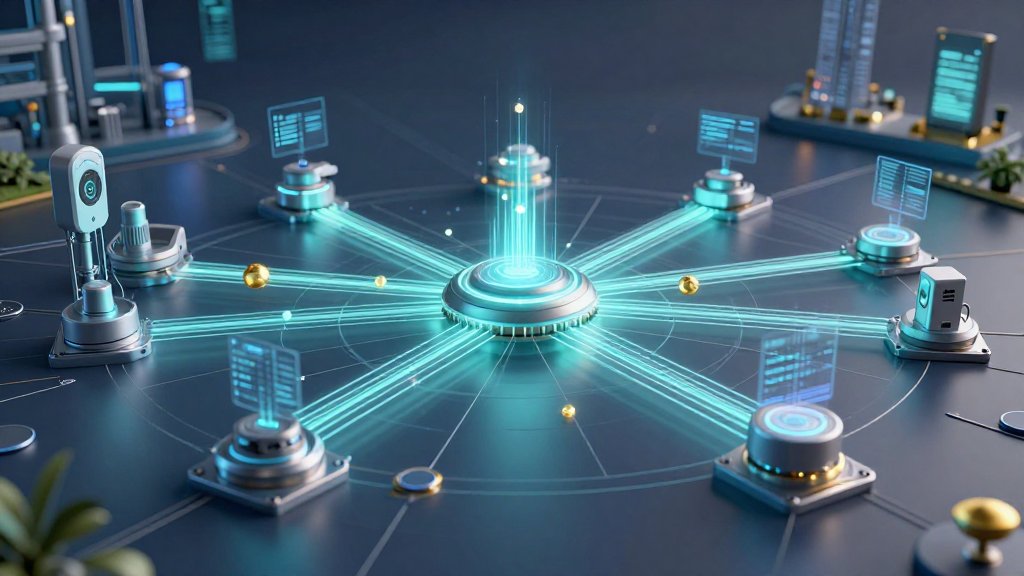
Remember when IoT devices were basically dumb sensors that needed to phone home to a distant cloud server before they could do anything useful? Those days are rapidly becoming about as relevant as fax machines. Welcome to the era of Smart Sensing Networks with Edge AI—a world where your IoT devices are not just collecting data, they're making split-second autonomous decisions, healing their own networks, and basically treating cloud connectivity like a nice-to-have rather than a life-support system.
The Self-Healing Revolution: Networks That Fix Themselves
A groundbreaking technical paper published this week reveals that IoT networks are evolving from fragile, manually-managed systems into self-healing powerhouses. The research demonstrates a three-layer resilience framework achieving 99.99% autonomous fault recovery while reducing mean-time-to-repair (MTTR) from hours to under 90 seconds. Let that sink in: your network could identify, diagnose, and repair issues faster than you can finish your morning coffee.
Image: Architecture diagram showing the three-layer self-healing IoT framework with Edge Intelligence Layer, Adaptive Protocol Layer, and Autonomous Recovery Layer working in harmony.
This isn't theoretical lab stuff—empirical results from smart city deployments show 47% reduction in network downtime and 68% improvement in predictive maintenance accuracy compared to conventional IoT implementations. The architecture implements federated learning for distributed anomaly detection, blockchain-anchored trust verification for edge nodes, and protocol-agnostic adaptation enabling seamless interoperability across 15+ IoT standards. Translation: these networks are smarter, more secure, and far less likely to leave you stranded when things go wrong.
Edge AI Becomes the Default, Not the Exception
The writing is on the wall (or rather, embedded in the silicon): Edge AI is transitioning from niche add-on to baseline requirement. Qualcomm's launch of the Qualcomm AI Program for Innovators (QAIPI) 2026 – APAC this week underscores just how seriously major players are taking this shift. The program supports startups across Japan, Singapore, and South Korea with up to $10,000 in grants and $5,000 in patent filing incentives to develop edge AI solutions.
Image: Qualcomm's Edge AI architecture showing distributed intelligence across IoT devices with local inference, reduced data traffic to cloud, and autonomous decision-making capabilities.
But hardware vendors are way ahead of the startup curve. NXP's recent demonstrations of processors with integrated Neural Processing Units (NPUs) show AI processing performance improvements of up to 30x faster than traditional CPUs. Their face recognition AI test clocked in at 24 milliseconds on NPU versus 869 milliseconds on CPU—hardly an apples-to-apples comparison, but it illustrates the point: specialized hardware is rapidly becoming table stakes for any IoT device claiming to be "smart."
Meanwhile, the TinyML Foundation's rebranding to the Edge AI Foundation in November 2024 signaled the industry's broader shift toward "scalable, energy-efficient AI at the edge." Smart home appliances, wearables, and industrial sensors that previously relied on cloud processing are increasingly deploying on-device inference for everything from offline voice recognition to anomaly detection. Your smart thermostat doesn't need to ping Amazon's servers to decide whether to adjust the temperature—it can figure that out locally, thank you very much.
From Dumb Pipes to Intelligent Infrastructure
Perhaps the most telling sign of this evolution is the emergence of domain-specific IoT platforms. MediaTek's new retail-focused IoT platform unveiled at NRF 2026 combines 5G, Wi-Fi 7, and embedded NPUs for generative AI capabilities in retail environments. We're talking about kiosks with AI-powered product recognition, POS systems with real-time analytics, and digital signage that can actually understand who's looking at it and adjust accordingly.
Image: MediaTek's retail IoT platform architecture showcasing 5G connectivity, Wi-Fi 7, edge AI capabilities with NPU, and retail-specific applications like AI kiosks and digital signage.
This verticalization represents a massive shift from "generic IoT" toward domain-specific intelligence. If store devices can assume a common AI and connectivity baseline, product teams can concentrate on differentiated experiences rather than reinventing the integration wheel. It's also fundamentally changing the economics of deploying intelligent hardware—analytics workloads can be distributed among in-store devices rather than being entirely pushed to expensive cloud infrastructure.
The Numbers Don't Lie (But They're Still Mind-Boggling)
Market forecasts now assume edge AI will grow from approximately $16.5 billion in 2024 to nearly $84 billion by 2032. That's a quintupling in less than a decade—growth that makes even the most hyped crypto rallies look pedestrian. Meanwhile, IoT deployments are projected to reach 29 billion devices by 2027, creating networks of unprecedented complexity and vulnerability.
Current IoT infrastructures exhibit some alarming characteristics: average MTTR of 4.2 hours for sensor network failures, 60+ incompatible standards creating interoperability barriers, 73% of IoT deployments lacking end-to-end encryption, and centralized control planes that fail beyond 10,000 devices. Edge AI with autonomous resilience isn't just about cool features anymore—it's about survival at scale.
The Road Ahead: From Autonomous to Sentient
The research roadmap for self-healing IoT networks extends through 2030 and beyond, with three distinct phases. Phase 1 (2026-2027) focuses on enhanced autonomy with neuromorphic computing integration, federated learning standardization, and post-quantum cryptography deployment. Phase 2 (2028-2029) envisions cognitive networks with 6G integration, semantic communication protocols, and digital twin synchronization. Phase 3 (2030+) projects "sentient ecosystems" with self-evolving network intelligence and quantum-IoT hybrid systems.
It sounds like science fiction, but the foundations are being laid today. IoT sensors combined with self-healing materials are already enabling infrastructure that can predict maintenance needs based on real-time data analysis. Corrosion costs the global economy over $2.5 trillion annually, and smart sensing networks are poised to shift industries from reactive repairs to predictive maintenance.
The Bottom Line
Smart Sensing Networks with Edge AI for real-time autonomy aren't just the future—they're rapidly becoming the competitive baseline for any serious IoT deployment. Companies still treating edge computing as optional are about to be lapped by competitors who understand that the future of IoT isn't about more sensors connected to bigger clouds. It's about smarter, more autonomous networks that can think for themselves, heal themselves, and make real-time decisions without needing permission from a data center halfway across the world.
The question isn't whether your IoT infrastructure needs edge AI and autonomous capabilities—it's whether you can afford to be caught without them while your competitors are already deploying self-healing networks that recover from faults in under 90 seconds. Your move.
Sources:
- Architecting Self-Healing IoT Networks: Implementing Edge AI and Adaptive Protocols for Autonomous Resilience - HULU Education (February 2026)
- Qualcomm AI Program for Innovators 2026 - APAC Officially Kicks Off - PR Newswire (February 3, 2026)
- NRF 2026 Recap: Powering the Store of the Future with MediaTek - MediaTek (January 30, 2026)
- Introduction to Edge AI Solutions with NXP's NPU-equipped i.MX/MCX - Nexty-Ele (February 2026)
- Enabling Intelligence in IoT with Edge AI and TinyML - ExpertLancing (February 2, 2026)
- 11 IoT trends in 2026: How intelligent, secure and scalable architectures are redefining the IoT - ithinx (February 3, 2026)
- Edge Computing & IoT: The Future of Data Processing at the Source - CTO Magazine (February 2, 2026)
- Scientific breakthroughs: 2026 emerging trends to watch - CAS Insights (February 3, 2026)
- The Power of Edge AI: Revolutionizing Future of Real-Time Autonomy - DevConf 2026 (February 1, 2026)
- Six IoT semiconductor predictions for 2026 - Design And Reuse (February 2026)
Comments ()