Next.js vs Nuxt: The 2026 Framework Battle Nobody Asked For (But Everyone's Fighting Anyway)
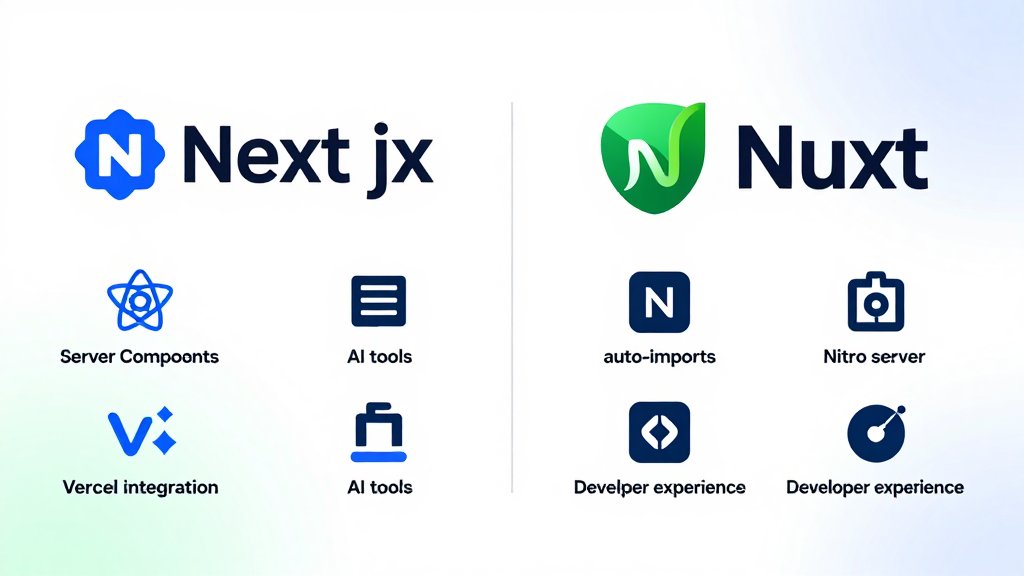
Remember when choosing a web framework meant picking between jQuery and vanilla JavaScript? Those were simpler times. Now it's 2026, and we're witnessing the ultimate showdown between Next.js (React's golden child) and Nuxt (Vue's sleek underdog). The battle lines are drawn, the Twitter threads are endless, and your project timeline is screaming at you to just pick something already.

Image source: Codexty Framework Comparison Study
The Reality Check: Next.js is Winning, But Not Because It's Better
Let's be honest here. Next.js dominates the market not because it's technically superior, but because Vercel has effectively built an entire ecosystem around it. With 29.8 million projects using React versus Vue's estimated 3 million, the numbers don't lie—Next.js has achieved what every framework dreams of: default status. When AI code generation platforms like v0 and Lovable spit out code, guess what they're using? React and Next.js exclusively. That's not an accident; it's a carefully cultivated monopoly.
"React has gained a Matthew Effect advantage in the AI era: More training data → Higher AI generation quality → More users → More training data" — Dev.to Analysis, January 2026
Nuxt 4: The Framework That Actually Respects Your Time
While Next.js has been busy adding Server Components, Suspense boundaries, and enough architectural complexity to make your head spin, Nuxt has been quietly shipping developer experience that doesn't require a PhD to understand. Nuxt 4 brings auto-imported components, intuitive composables like useFetch, and a file-based routing system that just works without you questioning your life choices.
The performance numbers tell an interesting story. Vue 3.5's typical starter bundle weighs in at 18-22KB compared to React 19.2's 32-40KB. That's not just smaller—that's nearly 50% less JavaScript your users have to download. In a world where every kilobyte affects Core Web Vitals and SEO rankings, that's not nothing.
Image source: Nunuqs 2026 Framework Comparison
The AI Factor Nobody's Talking About
Here's the uncomfortable truth that framework wars conveniently ignore: AI development tools have effectively crowned React the winner by default. When you use v0.app, Bolt.new, or Lovable, you're getting React code whether you asked for it or not. This creates a self-reinforcing cycle where React gets better AI support because it has more training data, which attracts more users, which generates more training data. Meanwhile, Vue developers are stuck with Bolt.new's secondary support.
This isn't just a technical preference anymore—it's a hiring pipeline issue. With React dominating job listings at 12,000+ positions versus Vue's significantly smaller talent pool, choosing Nuxt means accepting that you'll have fewer qualified candidates and potentially longer hiring times. For enterprise teams scaling from 5 to 50 engineers, that's a non-trivial consideration.
When Nuxt Actually Wins (And It's Not Just Hipster Appeal)
Despite the overwhelming momentum behind Next.js, Nuxt has legitimate advantages that React evangelists love to downplay. The learning curve is genuinely gentler—new hires ship features in days, not weeks. Vue's Single File Components make state management feel like a solved problem rather than an architectural debate. And Nuxt's Nitro server engine lets you deploy to Vercel, Netlify, Cloudflare, AWS, or basically anywhere without vendor lock-in.
Real-world companies have noticed. GitLab, Upwork, Ecosia, and even parts of the Financial Times rely on Nuxt. Why? Because when you're building multilingual, SEO-heavy platforms, Nuxt's hybrid rendering and content-layer integrations are production-grade advantages, not nice-to-have features.
The 2026 Verdict: Stop Looking for a Universal Winner
Here's the thing nobody in the Twitter threads will tell you: there is no universally "better" framework. There's only the framework that matches your specific constraints.
Image source: Ailoitte Framework Analysis 2026
Choose Next.js if: Your team already drinks the React Kool-Aid, you need enterprise-grade tooling support, or you plan to leverage AI development tools heavily. The ecosystem is unmatched, the job pool is massive, and Vercel's integration is genuinely magical when everything works as advertised.
Choose Nuxt if: You value developer experience over ecosystem size, you need deployment flexibility beyond Vercel, or you're building a smaller team that needs to ship fast without framework drama. The learning curve is smoother, the bundles are smaller, and you're not constantly fighting against the framework's opinions.
The Bottom Line
Both frameworks are mature, production-ready, and capable of building world-class applications in 2026. The difference isn't technical capability—it's about alignment with your team's reality. Pick the one that matches your hiring pool, your deployment infrastructure, and your tolerance for framework philosophy. Everything else is just noise.
And if you're still paralyzed by indecision? Here's a radical suggestion: pick one, build something, and iterate. The code you ship will matter infinitely more than the framework you chose.


Comments ()